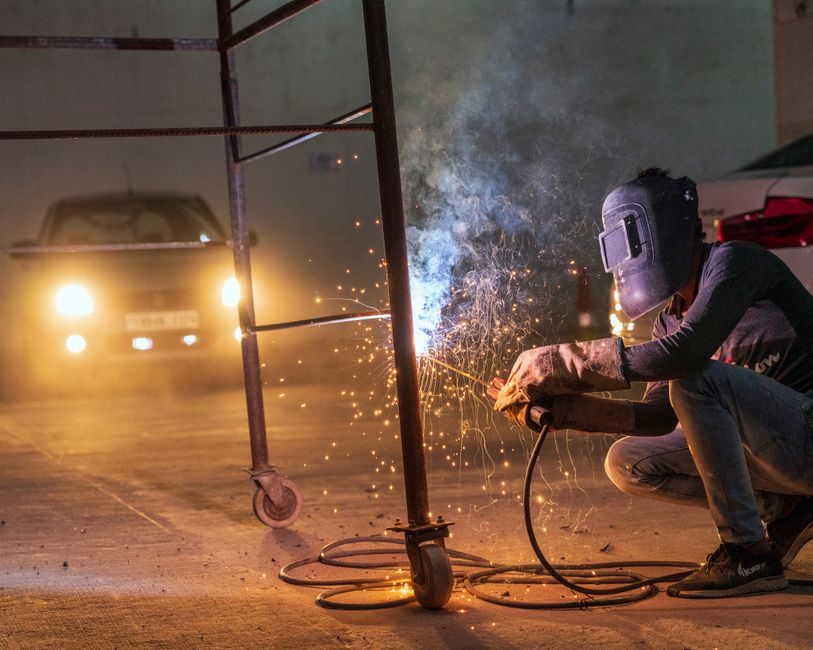
A correct stud welder install is decided before the gun is plugged in: the three commercial process families — Capacitor Discharge (CD), Short Cycle (SC) and Drawn Arc (DA) — each carry their own amperage, stud diameter, base-metal and ceramic-ferrule rules, and no single power source covers all of them. Get the matching wrong and you get cold sets, blowholes or stud burn-through on the first attempt.
Stud welding accessories are now a global stock-and-rental category: UK specialist Studfast Studwelding Ltd lists CD weld studs in mild steel, drawn-arc studs, collets/chucks, and full stud-welding machines built to British Standards from its Northants base [S3], and rental rigs with generators are bookable on same-day terms for site power where mains is absent [S1]. Chinese OEMs — e.g. Changzhou Qishuyan Jinda Welding Co., founded 1990 with 101–200 staff — supply arc studs, ceramic ferrules and CD chucks in SS304, copper-plated and aluminium grades in 3–12 mm diameters to North America, South America and Eastern Europe [S2].
Process Selection: CD vs Short Cycle vs Drawn Arc
CD (Capacitor Discharge) stud welding uses a bank of capacitors charged to a low voltage (typically 60–200 V) and discharged through the stud; weld time is 1–3 ms, base-metal heat input is low, and it suits thin sheet (≥0.5 mm) and small studs M3–M8 / Ø 3–8 mm to mild steel, stainless steel and aluminium [S3]. SC (Short Cycle) is a drawn-arc variant run without a ceramic ferrule, for Ø 6–12 mm studs on thicker plate where a clean cosmetic fillet is acceptable.
DA (Drawn Arc) is the heavy process: 400–3,000 A of welding current from a 3-phase transformer-rectifier, lift-and-arc sequence, ceramic ferrule (the arc welder consumable) to contain the molten pool and shield the arc, stud diameters from Ø 6 mm up to Ø 25 mm+ in structural/anchor applications [S2][S3]. DA is the only process appropriate for shear connectors on composite decking and for anchoring rebar/embed plates in civil work. The penalty is a much heavier weld head, larger stud gun, longer cycle time, and mandatory ferrule disposal.
Primary Power, Circuit and Cool-Down Specs
CD power sources run on 1-phase 230 V at 10–16 A, are lightweight, and are forgiving on field power; SC and DA machines need 3-phase 400–480 V at 32–63 A on a dedicated breaker, with the chassis bonded to a real earth ≤1 Ω [S1]. Stud-welder cable sets (gun lead + ground lead) are a hard spec: keep total loop length ≤4 m for DA above 1,500 A to avoid voltage drop; beyond that, weld current droops and you get starved fillets. Lift the gun lead off the floor with non-conductive hangers; a chafed earth return is the single most common cause of intermittent "good" welds that fail a bend test.
Generator-fed rigs are a real branch: rental companies ship diesel gensets sized to the welder's kVA (a 2,500 A DA set needs ~150 kVA), with the regulator isolated from the welder's input by a dedicated, bonded grounding point separate from the building ground [S1]. On the same-day dispatch model published by the US rental site, in-stock orders ship the same business day for orders placed before 12 PM CST, with expedited shipping available on a paid basis [S1].
Base-Metal and Stud Preparation Gates
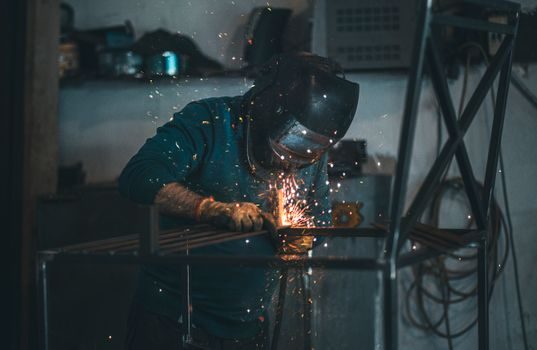
All three processes share three non-negotiable pre-conditions: (1) base metal in the weld zone must be clean — mill scale, paint, oil and galvanizing removed to bright metal within a 12 mm radius of the stud axis; (2) base-metal thickness must exceed a published minimum (≈1/3 of the stud diameter for DA on mild steel); (3) the surface must be flat within 0.5 mm across the stud foot — bowed plate or corrugated decking needs pre-levelling for CD. The stud itself: keep weld-end and flux ball dry, store in original packaging, and on stainless use a low-carbon (≤0.03 % C) grade for corrosive service. [S1]
For stud-only side preparation, the chuck/collet geometry is process-specific. CD chucks for Ø 3/4/5/6/8/10/12 mm studs and DA chuck shoes in 13/16/19/22/25 mm sizes are standard consumable categories; brass and copper-plated variants dominate the accessory list, with M3–M8 outer-threaded aluminium CD studs sold in matching sets [S2]. Pin/stud length and foot diameter are matched by the chuck — never re-use a worn chuck that no longer holds the stud square; a tilted stud produces an eccentric fillet that fails torque testing.
Ceramic Ferrules, Ferrule Choice and Disposal
For drawn-arc with ferrule, the ferrule is a one-shot ceramic consumable sized to the stud diameter (typical 4.7–22 mm OD ferrule families are catalogued by Chinese and UK suppliers for the same stud diameters) [S2][S3]. The ferrule contains the arc plasma, shapes the fillet, shields the cooling pool from atmospheric nitrogen, and reduces spatter. It is a single-use item and must be cracked out and disposed of after each weld; chipped or cracked ferrule is scrap, not a "still usable" consumable.
Where the ferrule is undesirable (visible cosmetic work, tight corners), Short Cycle processes the stud without a ferrule — at the cost of a rougher fillet and tighter limits on base-metal thickness. 18 × 0.35, 22 × 0.42) so the ferrule choice is not generic — match it to the stud OD and the joint configuration on the print [S2].
Who This Is For — and Who It Is Not For
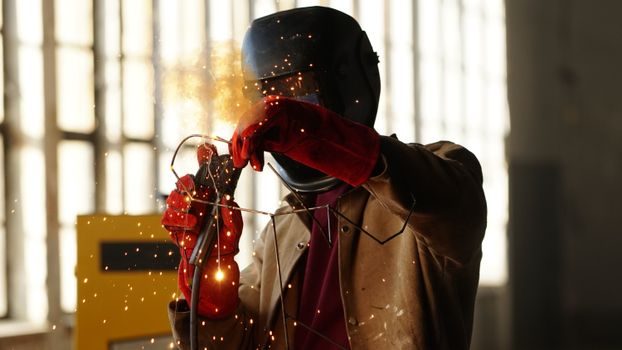
Stud welding fits high-volume fastening of identical metal studs to plate in mild steel, stainless and aluminium — composite-deck shear connectors, insulation pins, earth-rod bosses, cabinet and HVAC fasteners, and signage/light-pole base plates. It is for shops that run the same stud thousands of times, where a robotic or hand-held stud welder pays for itself in cycle time versus drilling and tapping. It is not for one-off structural bolts on a job site (use linear guide-class bolting practice instead), not for dissimilar-metal pairs the operator has not characterised, and not for cast-iron or hardened tool-steel bases where cracking risk is high without pre-heat. For the rarer crossed-roller guide or precision-slide work where the stud is also a locating feature, hand fixture and hand-loaded CD with a precision-ground chuck is still the right answer. [S2]
QA, Bend Testing and Failure Modes
Production QA on stud welds is a 90° bend test (or a torque test on threaded studs) at a documented sample rate — typically 1 in 50 studs for production, 1 in 1 for first-article, with the bent-stud face inspected for a sound fillet without undercut. A good DA weld in mild steel shows a uniform fillet ~0.5× the stud diameter high; CD welds show a small, sharply defined button. Common failures and their root causes: porous fillet = dirty base metal or wet stud; under-fillet = low current or long gun lead; stud burn-through = excessive current or wrong process; stud tilt = worn chuck or off-axis loading. [S3]
Two commercial signals are worth tracking into Q3 2026. First, the "popular product for Jul 2026" CD weld stud in mild steel highlighted on the Studfast homepage confirms steady UK demand for short-cycle and CD consumables in metric sizes into food and medical-equipment lines [S3]. Second, the same-day shipping + generator-rig rental model from US suppliers is now a documented response to job-site and field-power projects where 3-phase mains is unavailable [S1]. Both are stable indicators that the spec-driven install — not the brand-new gadget — is what specifiers will be paying for through the rest of 2026.
For related coverage, see Floor Sander Installation: Drum-Edger-Buffer Setup, Grit Sequence and Dust-Port Hookup.