
A correct air impact wrench installation hinges on three independent gates — drive size matched to fastener socket, free-speed airflow and pressure matched to tool CFM, and an inlet-air treatment chain (filter + regulator + lubricator) sized to the same CFM — and skipping any one of them is the single most common reason a new tool feels underpowered on its first shift [S1][S3].
Reference units spanning the 2026 catalog range from a C$41.59 brushless-style 1/2" air impact gun listed on DHgate Canada to a 1" drive Grizzly T10813-class heavy-duty pneumatic unit sold around US $198 on eBay, and the same five-step installation sequence applies end-to-end [S2][S6].
Match Drive Size, Torque Class, and Fastener Before You Open the Box
1/2" drive air impact wrenches are the workhorse for general automotive and light-assembly work, typically rated 300-800 ft-lb (400-1,085 Nm) nut-busting torque, and 3/4" drive models cover truck, agricultural and heavy-equipment fasteners in the 1,000-1,800 ft-lb (1,355-2,440 Nm) band [S1][S3]. A 3/4" drive "Super Duty" air impact wrench listed on kitairu.net sits in this truck/heavy-equipment segment, while 1" drive tools such as the Grizzly T10813 (1" drive heavy-duty impact air wrench, 99.1% positive feedback listing) target industrial fasteners above 2,000 ft-lb and are not interchangeable with 1/2" or 3/4" sockets [S3][S6].
Select by fastener grade, not by maximum torque: M10-M16 (3/8"-5/8") wheel and suspension nuts grade 8/10.9 are well inside a 1/2" drive tool's comfort zone; M18-M22 (3/4"-7/8") hub and axle nuts require 3/4" drive; track-pad and subframe bolts above M24 require 1" drive [S1][S3]. A common failure mode is using a 1/2" drive tool on a 3/4" lug nut — the anvil shank is undersized, the socket will not fully engage the friction ring, and the user compensates with longer trigger time, which overheats the hammer mechanism.
Air Supply, Hose, and FRL Sizing Are Part of the Installation
90 psig (6.2 bar) dynamic pressure at the tool inlet, with a minimum 3/8" (10 mm) inside-diameter hose for 1/2" drive tools and 1/2" (13 mm) ID for 3/4" and 1" drive models, is the rule that separates a working installation from a paper spec [S1]. 1/2" drive impact wrenches commonly draw 4-6 CFM (113-170 L/min) at load, 3/4" drive units 7-10 CFM (198-283 L/min), and 1" drive tools 10-18 CFM (283-510 L/min), which means a 6 CFM (170 L/min) compressor paired with a 1" drive tool stalls the motor and never reaches stall torque [S1][S3][S6].
The air-preparation chain must be installed upstream of the hose and matched in CFM rating: a particulate filter (5 µm element), a regulator with gauge set to 90 psi, and an airline lubricator drip-fed at roughly 1 drop per minute per 50 CFM consumed — the air motor inside an impact drill-class tool and inside an air impact wrench is the same vane-type architecture and the same lubrication rule applies [S1]. For a truck-shop or pit installation drawing air from a central compressor, mount the FRL within 8 m (25 ft) of the tool to keep pressure drop across the hose under 5 psi (0.34 bar) at peak CFM.
Mechanical Installation: Anvil, Socket Retainer, and Direction Control
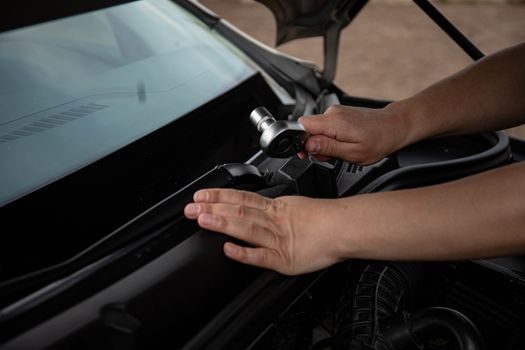
After the air supply is verified, install the anvil and socket retainer: 1/2" drive anvils use a 1/2" square with either a friction ring (ball detent) or a through-hole pin retainer; 3/4" anvils use a 3/4" square with a friction ring plus a through-hole for safety pins on high-torque sockets; 1" anvils use a 1" square with a through-hole and a captive retaining pin [S3][S6]. Push the socket squarely onto the anvil until the friction ring seats audibly; the retainer hole must align with the through-hole for sockets that carry a safety pin — a misaligned retainer is the most common cause of socket ejection under stall.
Direction control on a standard 1/2" composite air impact wrench uses a three-position throttle trigger (forward / reverse / neutral) and a regulator ring on the bottom of the handle for power adjustment; before tightening any production fastener, cycle the trigger 5-10 times in each direction with no socket fitted to confirm smooth rotation and to bleed condensate from the air motor [S1]. The twin-hammer mechanism inside 1/2" drive twin-hammer models (kitairu.net lists a "1/2-Inch Drive Air Impact Wrench Twin Hammer" variant) is louder than the single-rocking-dog mechanism, and an air pick-class service tool sharing the same 90 psi rail will pulse rather than stall if the regulator is correctly set.
First-Bolt Commissioning and Stall-Torque Verification
The first bolt of a new installation should be a controlled test on a known grade-8 (or 10.9) bolt fitted with a calibrated shear-load fixture, run forward for 2 seconds, then reverse for 2 seconds, to confirm the tool reaches rated torque before being handed to production [S1][S3]. For work where applied torque must be verified to ±4%, a torque wrench tester is connected inline between the tool and the fastener and the impact is read as a peak; if the reading is below the rated nut-busting torque by more than 15%, the failure mode is almost always the air supply (under-sized compressor, kinked hose, waterlogged filter) and not the wrench.
A 1/2" aluminum-housing air impact wrench (kitairu.net lists both "1/2 In. Aluminum Air Impact Wrench" and "1/2 Inch Composite Air Impact Wrench Lightweight" variants) is intended for shop mechanics and weighs roughly 1.6-2.2 kg (3.5-4.8 lb); a 3/4" drive super-duty unit weighs 3.5-5.5 kg (7.7-12 lb) and a 1" drive Grizzly T10813-class tool weighs 7-9 kg (15-20 lb), so bench-mount or overhead-balancer support is part of the installation for the 1" class [S3][S6]. Composite-housing 3/4" drive wrenches with built-in mufflers (kitairu.net also lists a "3/4 Inch Drive Air Impact Wrench With Muffler" using "quiet tool technology") reduce shop noise by 4-6 dB and are the right pick for enclosed pit installations where the operator sits within 1 m of the exhaust.
Failure Modes, When Not to Install, and Escalation Cues

Do not install and commission an air impact wrench on a fastener that already shows a stretched or galled thread, a corroded nut, or a heat-marked bolt head — the failure mode is sheared stud inside the workpiece, not the tool, and any torque reading is meaningless on a damaged fastener [S1]. Do not substitute a 1/2" drive tool on a 3/4" lug nut, a 3/4" on a 1" track bolt, or a 1" on a 1-1/2" industrial fastener — drive size, not stall torque, is the selection gate, and the wrong anvil is the only failure mode that cannot be fixed by adjusting the air supply [S3][S6].
Escalate to a hydraulic torque wrench or a controlled-tensioning system when the fastener is a critical-path pressure boundary, when the joint is part of a linear guide or crossed-roller guide preload stack, or when the OEM specifies a torque-vs-angle sequence rather than a single torque value. Track for service replacement: once the hammer-mechanism end play exceeds 0.5 mm (0.020") measured at the anvil, the tool no longer transmits rated stall torque and should be pulled from production — this is the standard rebuild trigger used in heavy-truck shop practice and applies equally to 1/2", 3/4" and 1" drive classes [S1][S3][S6].
Track next: confirm the 2026 catalog mix still splits 1/2" drive as the volume segment (1/2" air impact wrench kit listings on alibaba.com confirm the kit-level demand) and 1" drive as the niche industrial segment, and watch for IEC 61939-class shop-air audits that will start flagging 95+ psig unregulated supplies as a non-conformance in tier-1 OEM plants.
This topic is covered further in How to Choose a V-Ribbed Belt: Spec-Driven Selection for Engine and Accessory Drives.