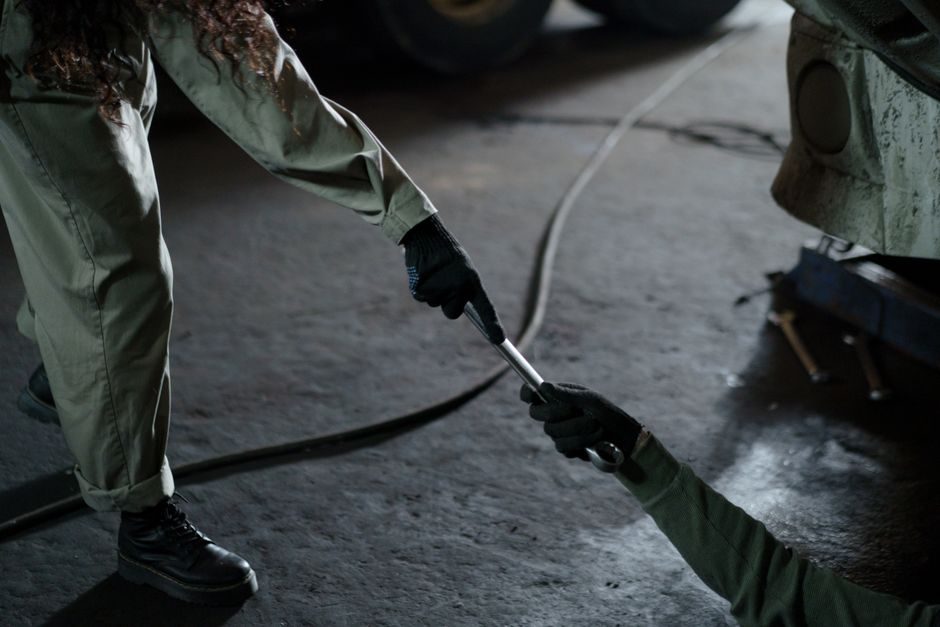
An air impact wrench — listed under pneumatic hand tools and impact wrenches & air sockets in CENS trade catalogues [S1] — is a rotary-impact tool driven by a vane or twin-clutch air motor, and it remains the fastest way to tighten or break down M16–M30 fasteners on a production floor.
That speed comes at the cost of infrastructure: the tool needs a regulated 6.2–8.3 bar (90–120 psi) supply, an FRL (filter-regulator-lubricator), and a matched 3/8" or 1/2" hose. For engineers weighing pneumatic against cordless or hydraulic, the deciding factors are duty cycle, sustained torque above 700 N·m, and whether the workstation already has clean, dry shop air.
What an air impact wrench actually does at the fastener
The output stage stores energy in a rotating hammer mechanism and releases it as short torsional pulses, so the operator feels almost no reaction torque even when the tool is delivering 800–1,800 N·m of breakaway torque [S1]. Pulse-per-second count typically runs 900–1,500 on 1/2" drive production models, and that is what lets a single operator run down a wheel-nut or suspension bolt in 2–4 seconds.
Because the energy is stored in the hammer rather than in the operator's wrist, vibration exposure (HAV) per ISO 5349-1 and noise emission per ISO 15744 stay in a class where a well-engineered tool sits near 84 dB(A) and a tri-axis vibration total around 4–7 m/s² — lower than an equivalent impact driver run on battery, where the cells sag under continuous load and the motor compensates by hammering harder.
Core advantages over cordless and hydraulic
Three numbers drive the procurement case: weight, cycle time, and cost-per-hour. A 1/2" pneumatic impact in the 1.8–2.4 kg band is 30–40% lighter than a cordless equivalent rated to the same breakaway torque, and it does not lose output as the battery state-of-charge drops [S1].
Ownership cost also favours pneumatics at high utilisation: there is no battery to replace every 3–5 years, no Li-ion storage compliance, and the air motor itself is field-serviceable with a vane kit and a hammer-spring replacement. The CENS supplier listing for this category confirms multiple Taiwan and mainland OEM sources competing on the same basic form factor, which keeps spare-part pricing tight [S1]. For a deeper look at how an air impact wrench is specified and what the internal mechanism actually looks like, the engineering reference page walks through drive sizes, anvil types and hammer-pin geometry.
Hard disadvantages: airline, FRL, and the duty-cycle trap

Every pneumatic tool inherits three real liabilities. First, the air supply must be clean, dry and regulated; a standard FRL with a 5 µm particulate filter and a -20 °C pressure dewpoint dryer is the minimum for any production line, and any water or oil carry-over destroys the hammer mechanism within months. Second, the tool cannot be used far from a compressor: a 10 m 3/8" hose at 7 bar drops roughly 0.3–0.5 bar by the time the air reaches the tool, which can pull a borderline-rated impact out of its torque window. [S1]
Third, continuous stall — pressing the trigger against a seated fastener — overheats the air motor and burns the vanes. A 1/2" production impact is typically rated for a 50–70% duty cycle at rated load; exceeding that on a hard joint is the single most common cause of premature warranty claims. Operators must also wear hearing protection (the 84–95 dB(A) range above [S1]) and HAV-monitored gloves, and the exhaust air must be plumbed away or deflected so it does not blow chips into the operator's face or into adjacent instrumentation. For a side-by-side read on how pneumatic compares to other impact tools, the impact drill reference and the air pick page cover the related handheld categories.
Application fit: who should buy, who should not
Buy air if the workstation has a 6.2–8.3 bar ring main with a verified FRL, the shift runs 200+ fastenings on M16–M30 joints, and the operator pool needs a tool with no battery-management training. Typical fits: automotive wheel and underbody lines, heavy-truck chassis assembly, off-highway equipment build, and large-engine torquing where the joint count justifies a fixed air drop. [S1]
Do not buy air if the work is mobile field service, the joint count per shift is under 50, the available compressor is undersized, or the application needs audited torque accuracy — pneumatic impacts are fastening tools, not torque-wrench-tester replacements, and critical joints (wheel studs, structural bolts, pressure-vessel closures) still need a calibrated torque audit after the impact rundown. For an in-depth look at how the air quality monitor upstream of the FRL protects both the tool and the finished joint, the reference page covers dewpoint, ISO 8573-1 class limits, and sampling point placement.
Selection criteria: a four-axis comparison
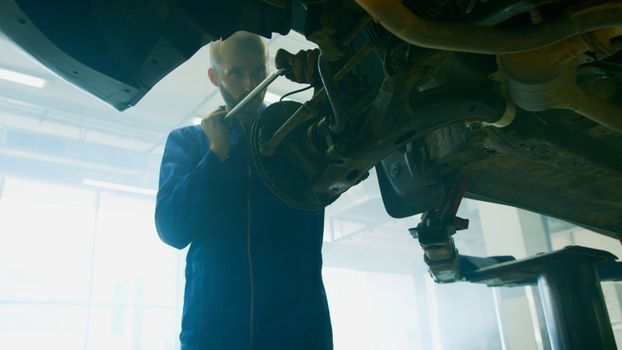
Four parameters separate a good purchase from a warranty-flood: drive size (3/8", 1/2", 3/4", 1"), breakaway torque class (400, 700, 1,200, 2,000+ N·m), air consumption (CFM or L/s at rated load), and weight. A 1/2" mid-class impact typically draws 4–6 CFM (2–3 L/s) at 6.2 bar, while a 3/4" heavy model can pull 10–15 CFM — and a compressor that cannot sustain that flow will starve the cell and overheat the hose. A pneumatic nail gun installation guide walks through the same FRL and sizing logic and translates directly to impact-wrench line drops. [S1]
Match the anvil to the joint: a friction-ring retainer is fine for socket changes on a service truck, a pin-and-hole retainer is mandatory on a moving assembly line. Match the handle to the operator: pistol-grip suits vertical bolting, D-handle suits horizontal suspension work. A practical first-bolt commissioning checklist covers air-line sizing, regulator setting, and the torque-audit step that proves the joint is actually where the engineering spec says it is.
Maintenance, audit and total-cost signals to track
Plan a vane-and-spring service at roughly 800–1,200 operating hours, a hammer-pin inspection every 400 hours, and an annual torque-output audit against a reference transducer. Plants that skip the audit typically discover drift only when a customer warranty claim lands on a wheel-nut or suspension bolt. For the TCO picture across a fleet, the pneumatic nail gun TCO breakdown uses the same five-line cost model and applies directly to impact-wrench fleet budgeting. [S1]
Either trend forces a planned service before an unplanned line stop. Sourcing and the broader pneumatic-hand-tool supplier map are catalogued in the CENS trade index for this category [S1], and a working selection logic for air solenoid valve integration on auto-drain and safety-shutoff circuits rounds out the air-prep picture for any new cell.