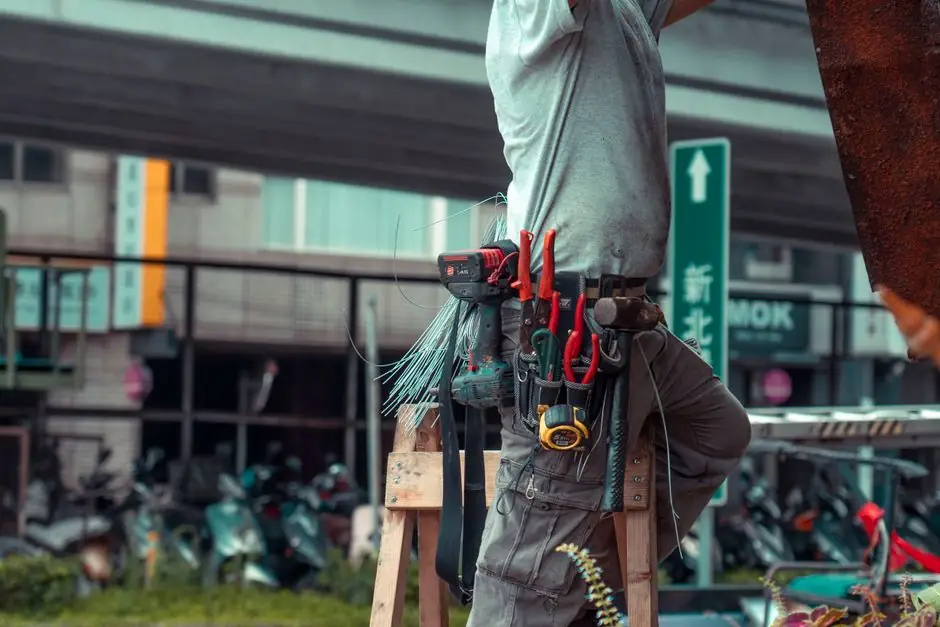
An air impact wrench is a torque-on-bolt tool, not a hole-making tool. Concrete work splits into two mechanical tasks: drilling/coring the substrate, and then driving anchors or form-tie bolts. The first job belongs to a rotary hammer with an SDS-Plus or SDS-Max shank; the second is the only place where a pneumatic impact wrench can legitimately appear on a concrete site.
Spec sheets on the 2026-08-08 market cluster around a few hard numbers: 1/2" square drive, twin-hammer clutch, 90 PSI (6.3 kg/cm²) working pressure, 1/4" NPT air inlet, free speed 7,000 RPM, max torque 746 N·m (550 ft-lb), average air consumption 7.0 SCFM at 25% duty [S4]. 1" drive models extend to 10" extended anvil shafts for truck and chassis work [S5]. CE-marked 1/2" composite-body industrial units sit in the $25-35 FOB Zhejiang range at 100-piece MOQ [S1].
Concrete Work Splits Into Two Tool Classes
Drilling into cured concrete, brick, or masonry is a percussion-and-rotation job. Pneumatic rotary hammers (the air-driven cousins of the cordless SDS-Plus hammers covered under impact drill references) deliver 1.5-20 J of impact energy per blow, which is what fractures the aggregate. A standard 1/2" pneumatic impact wrench delivers essentially zero impact energy to the bit: its twin hammers fire only when resistance builds on a nut or bolt, and its anvil is sized for square-drive sockets, not for rotary hammer bits. Pushing a 1/2" impact wrench into drilling duty will stall the air motor, burn the clutch, and produce a glazed, half-depth hole. [S3]
Anchor installation is the other half. After the hole is drilled and cleaned to the manufacturer's spec (blow-out bulb + nylon brush, per Hilti and Powers/DEWALT anchor literature), the anchor is set either by torque-controlled tightening on a hex nut, or by a setting tool on sleeve anchors. The torque step is where a 1/2" air impact wrench can stand in, provided the wrench has a regulated torque range that covers the anchor spec. Typical M12 wedge anchors call for 60-80 N·m; M16 anchors step to 110-170 N·m; M20 chemical anchors can require 240-400 N·m depending on the resin system [S4].
Drive Size, Clutch Type, and Torque Window
Selection on a concrete site narrows to three mechanical gates. First, square drive: 3/8" is too small for any anchor above M10, 1/2" is the workhorse covering M10-M20, 3/4" and 1" are reserved for M24+ structural anchor bolts and for form-tie release [S5]. Second, clutch: twin-hammer designs dominate the 1/2" and 3/4" classes and give the broad torque band 200-746 N·m that anchor work needs [S4]; pin-clutch and rocking-dog mechanisms are older designs that hold up better in dusty site air but produce less peak torque. Third, regulation: a torque-limiting handle or a separate inline regulator on the FRL (filter-regulator-lubricator) is required to land within an anchor's specified torque window, because an unregulated wrench that maxes at 746 N·m will snap an M12 wedge anchor long before the operator feels the resistance [S1].
Air supply is a hidden gate. 7.0 SCFM at 90 PSI is the published average for a 1/2" twin-hammer [S4], which means a 25% duty cycle pulls ~1.75 SCFM average but can spike to 25-30 SCFM under stall. A portable 185 CFM diesel compressor runs three or four wrenches at once; a 75 CFM electric unit struggles with one. Inline lubrication matters: a 1/2" pneumatic wrench run on dry air without a lubricator will see its rotor vanes and hammer pins wear in weeks, not years.
Ergonomic and Composite-Body Models for Site Work
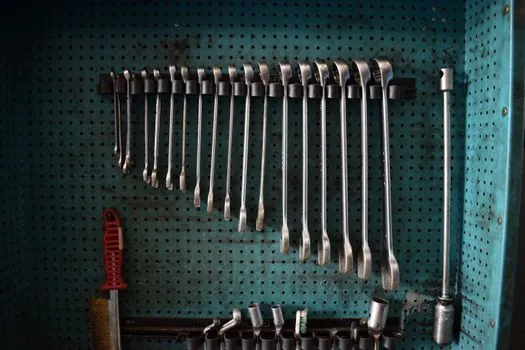
Concrete sites punish tools with abrasive dust, dropped housings, and awkward vertical or overhead anchor runs. Composite-body wrenches with shock-absorbing rubber overmoulds on the handle and head have become the default for European and Australian OEM catalogues in 2026 [S2]. The published feature set for one such professional-series wrench: composite-material housing, handle and head in shockproof rubber, single-hand operating lever with reversing and speed regulation, marketed for high-power fastening with vibration reduction [S2]. Vibration reduction matters because concrete anchor crews run hundreds of cycles per shift; older all-metal wrenches transmit the twin-hammer pulse directly into the operator's hand, contributing to HAVS (hand-arm vibration syndrome) claims.
Weight and length are the other ergonomic gates. A 1/2" twin-hammer at 4.53 lb (2.01 kg) and 7.10" head length is comfortable for vertical anchor work on a wall [S4]. 1" extended-anvil models at 10" shaft are tools for under-truck work, not for vertical concrete anchor runs; using one overhead is a fatigue and dropped-tool hazard [S5]. For horizontal slab anchor runs at chest height, the 1/2" class hits the best balance of torque, weight, and socket access.
Where Pneumatic Wins and Where It Loses on Concrete
Pneumatic impact wrenches win on concrete sites where compressed air is already plumbed in (precast yards, tilt-up panel plants, large bridge decks) and where the operator needs sustained high-torque cycles without thermal cut-out. Cordless 1/2" impact wrenches have closed the gap on light anchor work (60-150 N·m range), but a cordless M18 or 18V class tool delivering 700+ N·m will heat-throttle within 30-40 cycles of heavy M20 work, while a pneumatic twin-hammer at 90 PSI runs all shift with an FRL [S4][S1].
Pneumatic loses on small residential pours, interior remodels, and anywhere a 185 CFM compressor cannot follow. In those settings, the right tool is a cordless SDS-Plus rotary hammer for the hole and a cordless 1/2" impact wrench or a manual torque wrench for the anchor nut. The cost crossover is around 50 anchor holes per day: above that, the pneumatic wrench and its compressor time pay back versus the battery fleet; below that, cordless is the lower-friction choice.
Spec Comparison Across the 2026-08-08 Catalogue
Lining the main options against the decision criteria for concrete anchor work:
1/2" twin-hammer composite (Fervi AP04, East Pneumatic EP252): 746 N·m max, 7,000 RPM free speed, 4.53 lb weight, 1/4" NPT inlet, composite/rubber overmould, CE-marked, $25-35 FOB at 100-piece MOQ. Fits M10-M20 anchor snugging, M12-M16 is the comfort zone [S1][S2][S4].
1" extended-anvil industrial (Jiangsu Chuangyang 1" model): 1" square drive, 10" extended anvil, side greasing port, 45° air inlet for clearance under chassis, rubber-grip handle, intended for truck tyre and large-machinery work rather than vertical concrete anchors [S5].
Cordless 18V/20V 1/2" impact wrench: 300-1,200 N·m depending on model class, 0 air supply needed, batteries add 2-3 lb, thermal cut-out under sustained heavy cycles. The right tool where compressed air is unavailable, and increasingly the right tool for M16 and below.
SDS-Plus rotary hammer (pneumatic or cordless): 1.5-5 J impact energy, SDS-Plus bit shank, 0 N·m torque-on-bolt output. This is the tool that actually drills the concrete hole. It belongs in the same tool crib as the impact wrench, not on the same line of the budget as a substitute for it.
Failure Modes and Sourcing Signals
Three failure modes dominate concrete-site impact wrench use. First, over-torque breakage of wedge anchors: the operator runs a non-regulated wrench and snaps an M12 or M16 anchor below the rated torque, then the anchor has to be cut off and a new one drilled beside it. Mitigation: regulated torque or a separate torque wrench tester for QA. Second, clutch burn from stall: a 1/2" wrench held against a fully tightened anchor without letting the operator feel the cutoff. Mitigation: a reaction bar or a two-handed grip and a strict rule that the operator releases the trigger the instant the hammer sound drops. Third, premature wear from unlubricated air: rotor vanes and hammer pins wear in 2-3 months on dry air versus 2-3 years on properly oiled air with an inline lubricator set to 1-2 drops per minute. [S3]
Sourcing signals worth tracking on 2026-08-08: Zhejiang and Ningbo remain the main pneumatic-tool export hubs, with multiple 12-year- and 30+-year-established suppliers (East Pneumatic, Ningbo Bestar) carrying CE-marked 1/2" composite wrenches at $25-35 FOB [S1][S3]. European OEM entrants (Fervi AP04) sit at a higher price tier with single-hand regulation and shockproof rubber mouldings [S2]. If anchor-bolt torque specs on a job call for repeatable ±5% accuracy, the buying decision shifts from a $30 Chinese wrench toward a regulated or shut-off clutch tool; if the job is one-off form-tie release at 500+ N·m, a $30 CE-marked twin-hammer is the rational pick. For demolition-adjacent concrete work where the same crew is also driving nails, the Pneumatic Nail Gun for Demolition: Spec Map, Tool Lineup, and Sourcing Signals (2026-08) piece tracks the parallel tool selection. Track next: M20+ chemical-anchor torque specs versus the new generation of cordless high-torque wrenches crossing 1,500 N·m in 2026-2027.