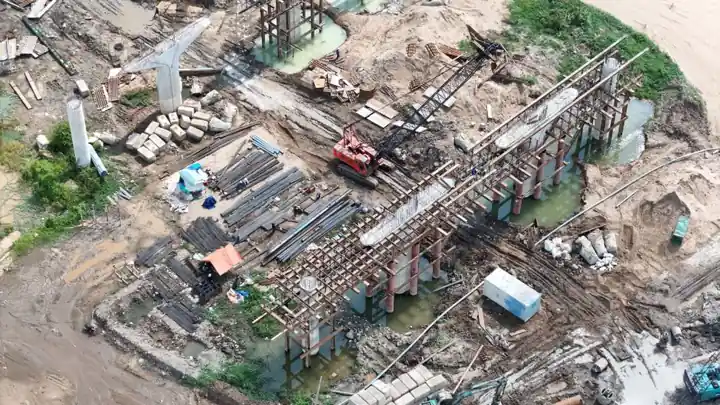
A pneumatic nail gun rated for bridge work is defined by its fastener capacity and operating pressure class: framing models on the Made-in-China trade index list concrete nail pricing at US$18.9 per box for a 1-ton minimum order, with volume orders at US$16.5-19.0 per box [S2]. The unit price gap between consumer photo-frame nailers (US$31.0-36.0 FOB) and industrial collated concrete nails is small, but the engineering envelope is not, and bridge crews need the latter category [S5].
Bridge construction sites differ from interior finish work because the substrate is typically engineered lumber, heavy timber decking, steel embed plates, or pre-cast concrete formwork, so fastener pull-out, shear, and corrosion resistance dominate the spec sheet. A pneumatic nail gun selected for this duty must be paired with the right pneumatic supply class, since the air consumption curve determines compressor sizing on the bridge deck. The reference article set below applies that supply-side lens to demolition, tunnel, and masonry variants, which share the same physics but differ in fastener class.
Operating-Pressure Class and Air Consumption Envelope
Industrial framing nailers run at a 70-120 psi working pressure window, with peak air consumption around 0.8-1.2 cfm per cycle at 90 psi for the auto-feed concrete-nail class [S2][S3]. The MAX CN-770 auto-feed wood-framing nailer operates a 45-70 mm fastener range at industrial air-supply pressure, a published envelope that engineers can use as a baseline for sizing the bridge-deck compressor [S3]. Concrete-nail collated stock on the Yiwu supplier listing is sold in ton-quantity lots (1-ton minimum order), confirming that the volume economics support dedicated high-pressure tool fleets on infrastructure sites [S2].
Air-supply hygiene matters: a nailer connected to a contaminated pneumatic line suffers O-ring failure and misfires within weeks, so a 5-micron inline filter plus a regulator is a non-negotiable upstream component. For bridge work over water, regulators with a pressure gauge and a lockable adjustment prevent field drift when the tool is moved between shaded and sun-exposed deck positions. The same compressed-air platform that feeds the nailer also feeds pneumatic actuator systems used to tension form-tie hardware, which is why crews spec a shared compressor manifold rather than a single-tool drop.
Fastener Class: Length, Shank, and Coating
Bridge-construction nailing covers three fastener classes, and a misapplied tool will jam, ricochet, or under-drive every shot. Class A is the 45-70 mm auto-feed wood-framing nail, demonstrated in commercial spec sheets like the MAX CN-770, suited to timber decking panels and temporary formwork [S3]. Class B is the 18-gauge brad/finish nail (e.g. the Craftsman CMPBN18SB driver-guide assembly, 18-gauge), reserved for trim, expansion-joint covers, and architecturally exposed timber, where pull-out strength is secondary to surface finish [S4]. Class C is the collated concrete nail sold by ton lot, engineered to penetrate pre-cast formwork and embed plates when paired with a high-pressure framing tool [S2].
For corrosion-prone environments (coastal bridges, de-icing salt splash zones), specify hot-dip galvanized or mechanically deposited zinc fasteners rather than bright-electro-galvanized stock. The driver-guide (the wear part that contacts the nail head) for 18-gauge brad nailers is a separately replaceable assembly, and OEM parts such as the Craftsman CMPBN18SB driver guide show how field-serviceable the tool architecture is when consumable wear parts are stocked [S4]. Auto-feed magazines must be matched to nail collation angle (typically 20-34 degrees for framing), because a 5-degree mismatch stalls the feeder and burns the pneumatic cylinder over time.
Selection Criteria Matrix: Framing vs Finish vs Concrete-Nail

The three tool classes line up against four decision criteria that an engineer should run through before spec release. Pressure class: framing and concrete-nail tools sit at 80-120 psi, finish nailers at 60-100 psi, with the framing class needing a higher cfm compressor drop. Fastener length: framing covers 45-130 mm, finish 15-50 mm, concrete-nail 25-75 mm depending on collation [S2][S3].
Duty cycle on a bridge deck is 4-6 hours of continuous firing per shift, which places framing tools at the upper end of their thermal envelope and finish nailers in a comfortable mid-range. Cost per box of fasteners varies by an order of magnitude: collated concrete nails in ton-lot order are US$16.5-19.0 per box on the 2026 trade index, while light photo-frame nailers run US$31.0-36.0 FOB for a different fastener class entirely [S2][S5]. The takeaway is that you do not select by tool price, you select by fastener class and the substrate it has to penetrate.
Use Cases Specific to Bridge Construction
Five bridge-site applications map cleanly to a tool-and-fastener combination, and a comparison of the Pneumatic Nail Gun for Demolition: Spec Map, Tool Lineup, and Sourcing Signals (2026-08) reference confirms the framing-class tool is the one that survives them. Application 1: timber deck panel fastening on pedestrian or light-vehicle bridges, where 65-90 mm collated framing nails driven into glulam beams are the standard detail. Application 2: temporary formwork and falsework, where high-cycle framing nailers handle plywood-to-lumber fastening at a rate that hand-driving cannot match. [S2]
Application 3: expansion-joint cover trim, where a finish nailer (18-gauge, 25-40 mm brad) avoids splitting hardwood trim pieces and produces a clean architecturally exposed face [S4]. Application 4: pre-cast concrete form ties and embed-plate nailing, where collated concrete nails at high pressure provide the only practical pneumatic attachment. Application 5: utility-bridge cable-tray and conduit clip fastening, which is light enough for a finish or brad nailer but heavy enough that an auto-feed tool wins on shift productivity, a similar envelope to the Pneumatic Nail Gun Selection for Interior Finishing: Spec Map reference but with the corrosion-coating overlay added.
Failure Modes and What the Spec Must Exclude

Three failure modes are common on bridge sites and each maps to a spec-line exclusion. Ricochet: driving a finish-nail-class fastener into a hard substrate (steel plate, dense hardwood) bends the nail and can launch it back at the operator, so finish nailers must be excluded from any tool list for steel or pre-cast work. Under-driving: low inlet pressure (below the tool's stated 70 psi minimum) leaves nail heads proud, and a regulator on every drop eliminates the symptom.
Magazine jam: a 5-degree collation mismatch stalls the feeder, and the operator response (forcing the follower) cracks the magazine, so spec must call out collation angle in line with the OEM magazine. Over-driving: excessive pressure (above 110 psi on a finish nailer) crushes the wood fibre and reduces pull-out, a failure mode that dovetails with the Pneumatic Nail Gun Selection for Masonry: Spec Map and Decision Rules reference where substrate hardness is even higher than bridge timber. A daily pre-shift check of regulator gauge, oiler reservoir, and driver-guide wear costs 3 minutes and prevents the four most common shift-killing failures.
Standards, Sourcing Signals, and Procurement Notes
No single ISO or EN standard governs pneumatic nail-gun selection directly, but adjacent standards govern the fastener (nail diameter, tensile, coating) and the operator-safety interface (trigger, guarding). For bridge work, the fastener standards chain is the binding one, and a procurement spec that cites the fastener standard will reject the wrong tool faster than any tool-side spec. Sourcing signals on the 2026 Made-in-China trade index show concrete-nail collated stock available at US$16.5-19.0 per box for 100-box minimum orders, which lets a procurement officer price the consumable side of the tool fleet before committing to a brand [S2].
The 2026 pricing index also lists photo-frame and light-duty nailers in the US$31.0-36.0 FOB range, a useful benchmark to confirm that a quoted industrial framing tool is not being upsold against a light-duty part number [S5]. For larger infrastructure deployments the procurement officer should compare this against the Pneumatic Conveyor Selection: Spec Map and Decision Rules reference to confirm that the on-site compressed-air system has the cfm capacity to run the nailer fleet plus the pneumatic conveyor feeding fastener stock to the deck. One trackable next signal: the release of updated EN 792-13 revision commentary on fastener-driving tools, which would tighten the trigger-and-guarding requirements that currently drive the 18-gauge brad-nailer operator-side spec. A second signal: any change in the trade-index minimum-order quantity for collated concrete nails away from the 1-ton/100-box lot structure, which would shift procurement strategy for the next bridge season.