An air impact wrench is a rotary torque-multiplication tool that delivers high breakout torque to threaded fasteners, while a pneumatic nail gun is a linear reciprocating tool that drives collated nails into wood or light-gauge steel. Both run on shop-air at a typical 90 psi (6.2 bar) supply, but their mass, air-consumption, vibration, and duty-cycle envelopes sit in different regimes — a 1" heavy-duty twin-hammer model ships at 18.4-20.4 kg per pair [S2][S5] versus 1.0 kg for an F50B framing-style nailer [S4].
The working cycle defines the divide. Impact wrenches concentrate energy in a rotary hammer mechanism (single or twin hammer, or pin-clutch) acting on a square or hex anvil; nail guns concentrate energy in a piston/cylinder firing a single fastener per actuation. Pneumatic framing nailers typically operate at 70-120 psi with 0.04-0.08 SCF per shot, while a 1" impact wrench at full trigger pulls 5-10 SCFM continuous, an order of magnitude higher — meaning an FRL'd 1/2" air line (minimum 3/8" ID at 25 ft) sized for a nailer will starve a 1" wrench.
Mechanism and Power Path: Rotary Hammer vs Linear Piston
The 1" heavy-duty twin-hammer mechanism in [S5] is the dominant impact-wrench architecture above 1,500 ft-lb: two hammers strike a cam-anvil in synchrony, producing a tighter pulse frequency and lower per-pulse vibration than single-hammer designs, which is why wheel-service and structural-steel shops gravitate to it. Torque multiplication is roughly 10-20x input air torque, with a stall torque band of 1,200-2,000 ft-lb typical for 1" units weighing 8-10 kg each [S2][S5].
A pneumatic nail gun's piston-cylinder is dimensioned around the fastener, not the tool's mass: the F50B in [S4] drives finish/Brad-style nails into softwood or MDF at low recoil, with the magazine angled (typically 21° or 34°) to control collation feed. Drive energy is set by inlet pressure and the tool's internal air-volume chamber — turning the regulator down trades penetration depth for reduced split on hardwood, while an impact wrench's torque is governed by regulator pressure acting on motor vanes and a mechanical reduction train, not by air-volume chamber size.
Mass, Anvil, and Fastener Interface
Mass tracks duty: a 1" air impact wrench lot of 2 pieces registers 18.4 kg net / 20.4 kg gross in a 1.6 cu-ft carton [S2], and 4 pieces of a 3/4" variant ship at 20.4 kg net / 22.6 kg gross in 1.15 cu-ft, while a 1/4" mini impact wrench sits in a much lighter bracket aimed at motorcycle/ATV work [S6]. That mass is largely steel hammer-case and motor-housing for vibration damping; an F50B-class nailer at 1.0 kg/piece [S4] is built around a thin-wall aluminum or composite housing because its recoil impulse is 5-10% of an impact wrench's.
Anvil drive size is the single most important fastener-side spec on an impact wrench: 1/4" hex [S6], 3/4" square, and 1" square [S2][S5] cover the spectrum from instrument work to heavy-equipment wheel nuts. Nail guns are spec'd by nail length, shank diameter, head type, and collation angle — none of those numbers cross over into the impact-wrench spec sheet, which is why a single shop rarely substitutes one for the other despite the shared compressor.
Air Supply, FRL, and Noise Budget
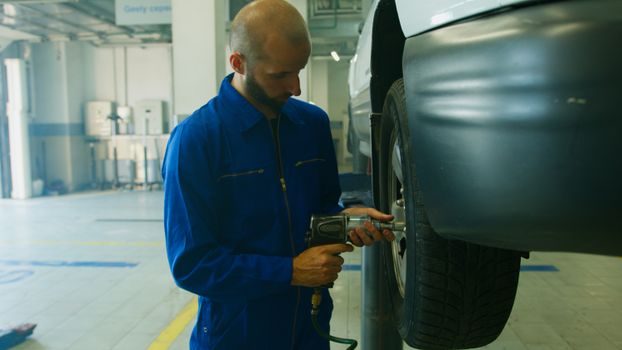
Air consumption is where the two tool classes part company most painfully for buyers. A 1" twin-hammer impact wrench under load can demand 8-12 CFM at 90 psi, and sustained use will thermal-limit a 60-lb wheel-job if the compressor tank is under 80 gallons; the nail gun in [S4] runs the same 90-psi supply but pulls air in millisecond slugs, so a 6-gallon pancake compressor handles framing work that a 1" wrench would brown out on. For spec-driven selection of the wrench side, see the air impact wrench selection frame.
Filtration and lubrication are non-negotiable for the impact wrench: 5-micron particulate filtration with a mist lubricator delivering 3-5 drops/minute of air-tool oil is the standard shop practice, and the FRL must be sized above the tool's CFM, not at it. Nail guns are more tolerant of intermittent lubrication and will run on a simpler regulator-filter combination; however, both share the same risk profile on unregulated supply — moisture carryover into a twin-hammer mechanism corrodes the cam-anvil and halves tool life, while moisture in a nail gun causes misfires and dry-fire hammer impact damage to the bumper.
Comparison: Selection Criteria Across the Two Tool Classes
Lining the two tool classes against the same four decision criteria exposes where each wins: [S1]
Criteria 1 — Torque/fastener type: impact wrench delivers 200-2,000 ft-lb rotary torque on threaded bolts/studs; nail gun delivers linear drive energy on nails 1"-3.5" long. Verdict: no overlap; pick by fastener, not by tool availability.
Criteria 2 — Air consumption at 90 psi: impact wrench 5-12 CFM continuous; nail gun 0.04-0.08 SCF/shot intermittent. Verdict: a 1" wrench needs a 60-80 gal compressor; a nailer runs on a 6 gal pancake.
Criteria 3 — Mass and operator fatigue: 1" twin-hammer 8-10 kg per tool with high-vibration pulse; F50B-class nailer 1.0 kg with low-recoil linear stroke [S4]. Verdict: nailer wins shift-long fatigue by a wide margin.
Criteria 4 — Cost-of-entry at OEM lot pricing: a 2-pc 1" wrench export pack lands at multi-kg air-tool pricing per the [S2] carton profile, while a 50-pc F50B nailer lot lists at CNY 98/piece EXW [S4]. Verdict: nailer is roughly an order of magnitude cheaper per unit.
Job Match: Who Each Tool Is For and Who It Is Not

The 1" air impact wrench is built for heavy-vehicle wheel service, structural-steel bolting, mining-equipment maintenance, and oilfield pipe-handling, where high-mass rotary torque is the binding constraint. The 1/4" mini impact wrench in [S6] targets motorcycle/ATV/auto-interior work at 50-80 ft-lb — a different job envelope entirely. Both are wrong for any application requiring controlled torque below their lowest clutch setting, which is why torque-critical assembly (aerospace, locomotive wheel-set, structural-bolt inspection) routes through a torque wrench tester plus a calibrated manual or electronic torque wrench rather than an impact tool.
The pneumatic nail gun, in the F50B form factor [S4], is built for framing, sheathing, sub-floor, trim, and pallet/crating work. It is the wrong tool for concrete, masonry, or structural-steel fastening — those require powder-actuated, rotary-hammer, or through-bolt systems, not a collated-nail piston. The shared compressed-air supply and shared FRL create the only meaningful overlap; the two tools do not compete on the same fastener.
Limits, Failure Modes, and Cross-Tool Misuse
The dominant failure mode on impact wrenches is hammer-mechanism wear under inadequate lubrication, leading to loss of torque output long before the motor-vane set is exhausted. The dominant failure mode on nail guns is dry-fire damage to the driver-blade bumper and O-ring set when the operator runs out of fasteners but keeps the trigger pulled. Neither tool should be operated without the FRL specified above, and neither tolerates regulated inlet pressure above its nameplate without a pressure-relief path — over-pressurizing a nail gun can fracture the cylinder head. [S2]
For a clean cross-class comparison with another pneumatic rotary tool, the sander vs impact drill piece uses the same mechanism-versus-job-match frame and complements the air-supply discussion here. Site work that pairs both tool classes — say, timber framing with bolted base plates — should be planned as two separate air-drop runs, because the impact-wrench peak CFM will starve the nailer line during wheel-tightening cycles and cause misfires.
Trackable signals to watch: 1" twin-hammer export-pack weight continues to land in the 18-23 kg/2-4 pc band (2026-05)[S2][S5]; F50B-class nailer lot pricing holds at CNY 98 EXW / 50-pc MOQ (2026-05)[S4]; and 1/4" mini impact SKUs remain an active catalog line at CENS as of 2026-05[S6], confirming sustained OEM demand across all three size brackets in the same quarter.