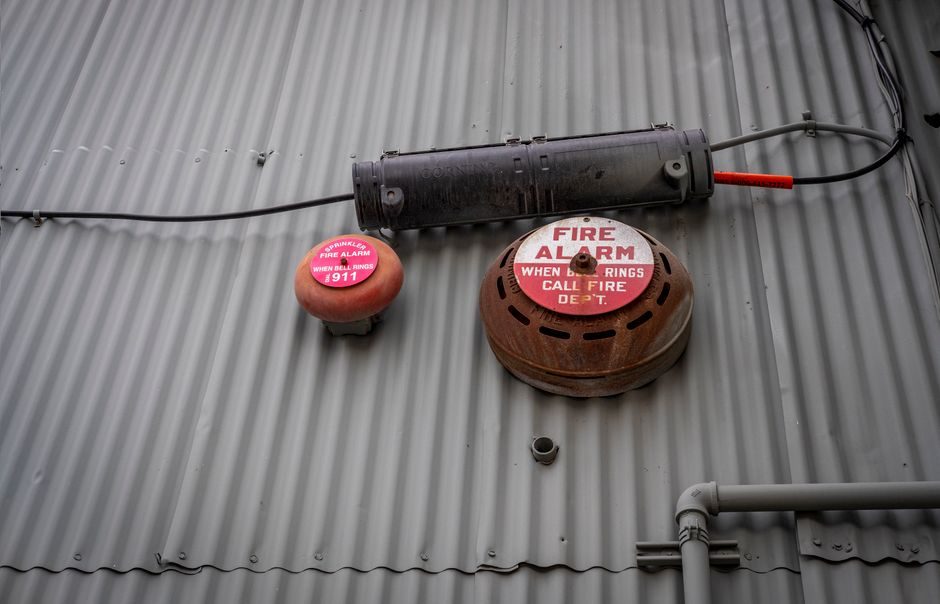
ALC wall panels and fire alarm control panels (FACP) are not substitutes — one is a building envelope product, the other is a life-safety electronic control unit — so the correct spec exercise is to separate the two completely, then check each against its own standard set before procurement writes a single line item.
ALC (Autoclaved Lightweight Concrete) panels are cement-bonded porous units cured under high-pressure steam, commonly specified in 100 mm thickness for external curtain-wall infill and 50–75 mm for internal partitions; FACPs are 24 V DC loop-powered panels certified to EN 54-2 / EN 54-4, with the wall-mount enclosure typically rated IP30 inside a building's fire command room.
Scope and governing standards — why no head-to-head exists
An ALC wall panel is covered by EN 12602 (factory-made AAC elements) with reaction-to-fire classified to EN 13501-1 (Euroclass A1 non-combustible is the default for pure AAC) [S5]. A fire alarm control panel is covered by EN 54-2 (control and indicating equipment) and EN 54-4 (power supply equipment), with the firefighter indicator panel in Germany additionally tied to DIN 14661:2023-02, which establishes the requirements, testing, and marking principles for the fire-brigade control panel (FBF) connected to a BMA per DIN 14675-1 [S5]. The two standard chains share no overlapping test method, so direct head-to-head scoring is meaningless — a procurement officer should treat them as two unrelated line items with separate submittal packages.
Specification data — ALC wall panel
Standard ALC panel geometry: length 600–3,000 mm, width 600 mm, thickness 50 / 75 / 100 / 125 / 150 / 175 / 200 mm, with the 100 mm size dominating the curtain-wall and high-rise partition market. Dry density is graded B04 (≈0.40 g/cm³) to B06 (≈0.60 g/cm³) under EN 12602; λ10,dry sits at roughly 0.10–0.13 W/m·K and drops to ~0.12 W/m·K at design moisture, giving R-values around 0.83 m²·K/W for the 100 mm sheet. Compressive strength is class 2 to class 6 (≈2.5–7.5 N/mm²), sufficient for low-rise loadbearing partitions but not for primary structure. Reaction to fire is Euroclass A1 (non-combustible, no flame spread, no smoke), and acoustic Rw for a 100 mm single leaf is 36–40 dB, rising past 50 dB with a 50 mm cavity and 12.5 mm gypsum board. [S1]
Specification data — fire alarm control panel

Modern addressable FACPs run 24 V DC (operating window 21–28.6 V on the Siemens FT724), quiescent current 125 mA, optional 70 W PSU, and battery standby of 2 × 12 V / 7 Ah [S3]. Loop capacity scales by class: the MAVILI ML-125XX series handles up to 2,032 addresses across 16 loops via the VIP protocol with a 240 × 64 backlit LCD [S2]; the Tiancheng JB-TB-TC5109 caps at 255 addresses per loop and 4 loops (1,020 points) in 48 zones with per-loop glass fuse protection and self-designed loop protocol [S6]; the Maple Armor FW106S/FW106SC targets small-to-medium facilities for both new build and retrofit commercial, institutional, and industrial sites [S4]. A conventional 2-zone unit such as the Fire-Lite MS-2 still ships for very small sites. Networking top-end on the Siemens FT724 is 32 panels/terminals per C-WEB cluster, 14 clusters via fiber-optic C-WEB/LAN, 64 panels total in an EN 54-conform network; enclosure is 430 × 398 × 103 mm, IP30, RAL 7035, operating temperature −8…+42 °C [S3].
Decision matrix — which one does a given project actually need
Use the matrix below to route the specifier to the right product on day one. Cost and lead-time are typical ranges from the research, not contract numbers. ALC panel cost bands are project-volume dependent; FACP cost scales with loop count and network size, not with the wall area it protects. [S2]
Criterion 1 — Duty: envelope vs life-safety electronics. ALC = partition/curtain-wall infill; FACP = detection loop control. Criterion 2 — Governing standard: EN 12602 + EN 13501-1 vs EN 54-2 / EN 54-4 (plus DIN 14661:2023-02 for the German FBF variant) [S5]. Criterion 3 — Power: none vs 24 V DC, 70 W PSU, 2 × 12 V / 7 Ah standby [S3]. Criterion 4 — Addressable scale: 1 addressable point per panel (none) vs 255 points/loop (Tiancheng JB-TB-TC5109 [S6]) or 2,032 points/16 loops (MAVILI ML-125XX [S2]). Criterion 5 — Reaction to fire / IP rating: Euroclass A1 vs IP30 [S3]. Criterion 6 — Substitute risk: a gypsum board is a closer ALC substitute than any FACP.
If the procurement request is a wall-cladding or partition item, the answer is ALC panel; if it is detection/notification control, the answer is the FACP and the perimeter alarm or gas alarm controller is a sister device, not an alternative. For a heat- versus gas-detection trade-off inside the same FACP, see the spec map on flame vs gas detector selection.
Limitations and failure modes each specifier must respect
ALC panels fail in two well-known modes: long-term moisture absorption that erodes the design λ (the 0.12 W/m·K figure assumes design moisture, not saturation), and brittle pull-out at fixings because AAC has low tensile strength around threaded anchors — engineers should specify bonded anchors or a dedicated AAC plug rather than universal plugs. The 100 mm panel also has limited single-point load capacity, so heavy wall-hung items (boilers, kitchen hoods) need through-bolted back-plates. ALC is not a substitute for structural concrete in beams or columns. [S1]
FACP failure modes are different and more safety-critical: a loop short or break that is not detected within the EN 54-2 fault supervision window can disable an entire detection zone, and battery standby (2 × 12 V / 7 Ah on the Siemens FT724 [S3]) must be sized to local code hours — typical EN 54-4 requirement is 24 h quiescent + 0.5 h alarm, but extended standby up to 72 h is common in some jurisdictions. The IP30 enclosure is not suitable for damp or plant-room locations without an additional rated housing. On addressable systems, mixing detectors from different vendors on a proprietary loop (e.g. MAVILI VIP [S2] or the Tiancheng self-designed loop [S6]) will typically fault the panel — a clause requiring the panel's own loop protocol must be enforced at submittal.
Selection criteria checklist for the procurement engineer
For ALC: confirm EN 12602 grade (B04/B05/B06), declared λ at design moisture, Euroclass A1 reaction-to-fire certificate, dimensional tolerance class, and fixing method (bonded vs mechanical). For FACP: confirm EN 54-2 + EN 54-4 third-party certification (LPCB, VdS, CNBOP), loop protocol and address count, network topology (cluster/cluster-of-clusters) [S3], battery standby sizing against local code, and the IP rating of the wall box. Where the project is in Germany and a firefighter indication point is required, add DIN 14661:2023-02 compliance for the FBF and verify the interface to the BMZ per DIN 14675-1 [S5]. For a fire alarm control panel submittal, also require evidence of compatibility with the listed detector family — most failures here are protocol-mismatch disputes, not hardware defects.
Cost and lead-time signals worth tracking

ALC panel cost is dominated by cement, lime, and steam-cure energy; lead time on the 100 mm standard size is typically short in China and Southeast Asia (stock items from major AAC plants), but the larger 200 mm block and reinforced lintels are made-to-order. FACP cost scales with loop electronics and protocol licensing rather than enclosure size, so two EN 54-2 panels at the same addressable count from different vendors can differ by 30–50% on list price, with Siemens FC361 listed in EUR 3,920–4,725 excl. tax and lower-end addressable units undercutting that band. Track two signals on the next procurement cycle: the AAC dry-density grade on the submittal (B04 vs B06 changes both thermal and acoustic figures), and the FACP's standby-battery sizing calculation against the local code hours. [S2]