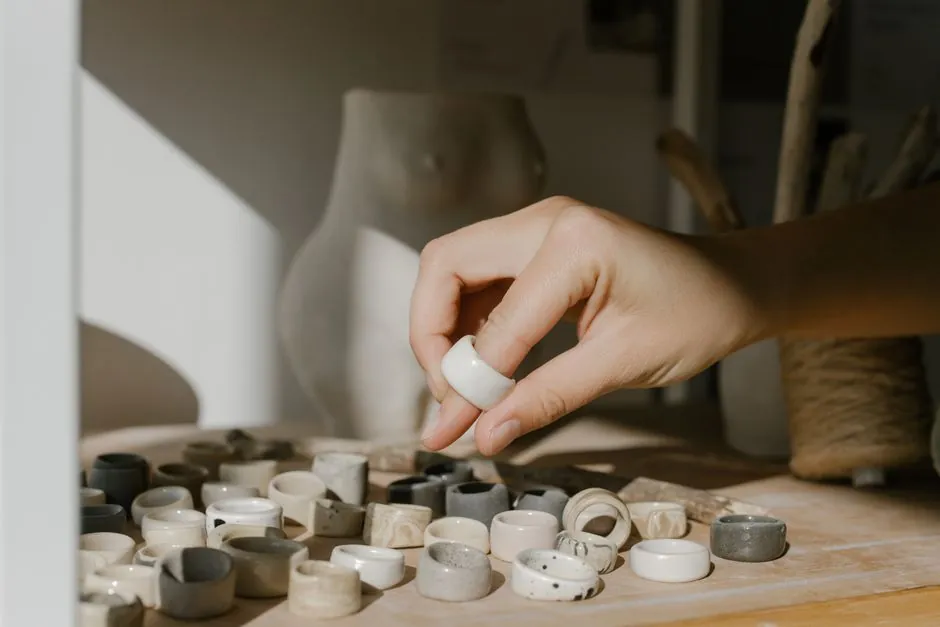
Alumina ceramic (Al2O3) delivers Vickers hardness above 1500 HV, sustained service up to 1600–1650°C in air, and a density of 3.6–3.95 g/cm³, roughly half that of carbon steel, which is why it dominates wear, electrical-insulation, and high-temperature structural jobs [S1][S2].
Trade-offs are equally concrete: fracture toughness is low, thermal conductivity trails metals and competing ceramics like SiC and AlN, and diamond-tool grinding is mandatory after sintering, all of which drive cost and lead time [S1][S3]. The four commercial purity grades (85%, 95%, 99%, 99.5%+) behave as different materials, so grade selection is the single biggest design lever [S2][S5].
Where Al2O3 Wins on the Spec Sheet
Rockwell hardness HRA80–90 places alumina second only to diamond on the Mohs-9 scale, and a Central South University of Technology wear test measured alumina's wear rate at 1/266 of manganese steel and 1/171.5 of high-chromium cast iron in sliding abrasion, which is why engineers specify it for chute liners, cyclone bodies, and pump housings [S3]. Alumina also gives Mohs 9 hardness, comparable to corundum and within reach of superhard alloys, but at a fraction of the cost [S3].
High-purity grades hold dimensional stability at 1600–1650°C in oxidising atmospheres thanks to a low coefficient of thermal expansion, which suits kiln furniture, thermocouple sheaths, and furnace tubes [S1][S2]. Electrical resistivity stays high and dielectric loss stays low at high frequency, making 96% and 99.5% Al2O3 the default substrate and insulator material in power electronics, RF windows, and high-voltage bushings [S1][S3]. The same ionic–covalent lattice resists most acids, alkalis, and molten metals, except for hot concentrated alkalis and hydrofluoric acid, which chemically attack Al2O3 [S2][S3].
Where Al2O3 Breaks: Brittleness, Machining, Heat Path
Alumina is brittle and absorbs almost no impact energy the way ductile metals do, so a single overload or point load can chip a seal face or shatter an insulator, and there is no plastic warning before failure [S1][S2]. That rules it out for applications expecting shock, vibration overload, or foreign-object impact, including most hammer-mill and jaw-crusher duties where high-chromium iron or Mn steel remain the workhorse.
Post-sinter machining requires diamond grinding only, which caps achievable geometry, drives tooling cost, and extends lead time versus cast or machined metals [S1][S3]. Thermal conductivity sits well below aluminium nitride and silicon carbide, so thick Al2O3 sections used as heat sinks or heat-spreaders will run hotter than the equivalent SiC or AlN part under the same load [S1]. Designers usually work around this by switching to AlN substrates for high-power LED and IGBT modules, or to SiC for heat-exchanger tubes, and reserve Al2O3 for the electrical-insulation, not the heat-path, role [S2].
Grade-by-Grade Comparison: 85% vs 95% vs 99% vs 99.9% Al2O3
Higher Al2O3 content means higher hardness, better dielectric strength, and better thermal stability, but also higher raw-material cost, longer sintering cycles, and tighter machining tolerance, so grade choice should track the duty, not chase purity for its own sake [S2][S5]. A practical 95% versus 99.5% matrix is below.
95% Al2O3: Rockwell HRA mid-80s, dielectric strength around 10–15 kV/mm, density near 3.7 g/cm³, used for general wear parts, mechanical seals, and electronic substrates where cost dominates [S2][S5]. 99% Al2O3: HRA high-80s, dielectric strength about 15–18 kV/mm, density near 3.85 g/cm³, the default for high-voltage insulators, pump shaft sleeves, and textile ceramic guides [S2][S3]. 99.5–99.9% Al2O3: HRA approaching 90, dielectric strength above 18 kV/mm, density 3.9–3.95 g/cm³, required for transparent armours, semiconductor wafer-handling chucks, and high-purity biomedical parts [S2][S5].
Typical Industrial Use Cases, with Real Numbers
Mechanical seals, valve seats, and sandblasting nozzles are the bread-and-bolt wear applications, and field data from Chinese alumina plants shows service life extended by at least 10× versus manganese steel under equivalent slurry-erosion duty [S3]. In power electronics, 96% alumina substrates (a near-twin of 95% grade with tighter process control) are the industry-standard PCB replacement for IGBT and thyristor modules because the coefficient of thermal expansion closely matches silicon and the dielectric loss stays low at switching frequency [S1][S3].
High-purity transparent alumina (often called transparent Al2O3 or single-crystal sapphire in extreme cases) is specified for armoured windows, scratch-resistant covers, and sodium-vapour lamp tubes, where optical transmittance plus Mohs 9 hardness matters more than toughness [S1]. Other recurring applications include high-voltage insulators, bulletproof ceramic armour tiles, semiconductor process wafer chucks, high-temperature kiln furniture, and ceramic bearing rolling elements for pumps and meters, where the electrical insulation is as valuable as the wear life [S3][S4].
Al2O3 vs SiC vs AlN vs ZrO2: A Decision Grid

Material selection is rarely alumina-or-nothing; the real question is which ceramic. Hardness: Al2O3 above 1500 HV, SiC higher, ZrO2 lower at around 1200–1300 HV, AlN much lower, so Al2O3 or SiC win for abrasive wear [S2]. Thermal conductivity: AlN around 170–200 W/m·K, SiC about 120–200 W/m·K, Al2O3 only 20–30 W/m·K, so heat-spreader and LED-substrate roles go to AlN or SiC, not Al2O3 [S1].
Toughness: ZrO2 (especially Y-TZP) exploits transformation toughening and outclasses Al2O3, so ZrO2 is the default for cutting-tool dies and femoral-head implants; Al2O3 is favoured where hardness and electrical insulation beat toughness [S2]. Density: Al2O3 at 3.6–3.95 g/cm³, ZrO2 around 5.7–6.1 g/cm³, SiC about 3.1–3.2 g/cm³, with SiC the lightest of the three for a given stiffness. A useful rule: pick Al2O3 for wear and insulation below 1650°C, SiC for thermal-shock and heat-path duty, AlN for high-power electronics, and ZrO2 for impact or medical roles, rather than swapping one for another.
Design and Sourcing Constraints Buyers Should Track
Manufacturing routes matter: dry pressing suits simple shapes, isostatic pressing suits longer and thicker parts, injection moulding covers complex geometry, and casting covers large thin-wall pieces; after sintering, all of them still need diamond grinding for any tight-tolerance feature, which is the real source of lead time [S3]. KYOCERA's fine-ceramics product range illustrates how Al2O3 is used across industrial-machinery, semiconductor-process, and medical-device parts because of its combined wear, insulation, and corrosion behaviour [S4].
Chemically, Al2O3 tolerates most mineral acids and molten aluminium, but hot concentrated NaOH/KOH and HF attack the grain boundary, so alkaline wash-down and HF pickling lines rule it out [S2]. Thermal-shock resistance is moderate: rapid quench from above ~500°C can crack an Al2O3 part, which is why SiC is preferred for burner nozzles and heat-exchanger tubes. Cross-checking the duty cycle against purity grade, machining route, and chemical exposure up front prevents the classic failure of specifying 95% Al2O3 where 99% or 99.9% is needed, or vice versa, and burning budget on a part that fails in service.
Failure Modes and What They Tell You
Chipping on seal faces usually means a misalignment or a thermal-shock transient, not a material defect, and switching to a tougher ZrO2 or adding a softer counter-face is often cheaper than upgrading purity [S2]. Surface wear on liners running beyond design life is a sign of grade under-spec: 85% Al2O3 in a high-velocity slurry will pit, while 95% or 99% will hold, and this is where the cost-of-downtime case for higher purity gets made on paper, not in the brochure [S3][S5].
Dielectric breakdown on a substrate is almost always a moisture or contamination issue on 95% grade where 99.5% was the actual requirement, which is why datasheets quote dielectric strength under controlled humidity, not in the field. Trackable signals going forward include 2026 standardisation work on alumina ceramic purity grading and tighter datasheet disclosure of Vickers hardness, dielectric strength, and grain size by grade, so buyers can stop comparing brochures and start comparing numbers [S2][S5].
For component-level specifications, see construction machinery and equipment.