Alumina (Al2O3) femoral ball heads in total hip arthroplasty (THA) have dropped from first-generation reported fracture rates as high as 13% to roughly 0.004% in third-generation hot-isostatically-pressed (HIP) alumina, with 10-year implant survival approaching 100% in modern series [S1].
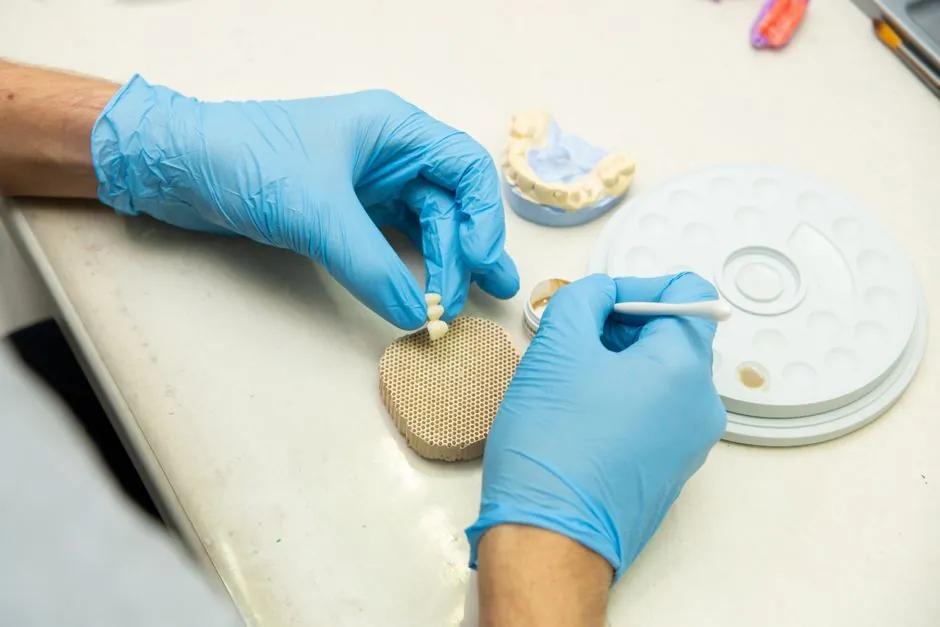
Boutin introduced alumina-on-alumina THA in 1970, and the bearing has since become one of the standard hard-on-hard options, with ceramic heads used in over 40% of THRs in the United States and a higher share in the United Kingdom, per the Drexel orthoceramics primer [S3]. Forged into a hip ball from sintered Al2O3 powder, the head articulates against either a polyethylene (UHMWPE) liner or, in ceramic-on-ceramic (CoC) couplings, against an alumina acetabular insert [S2][S3].
Material Generations and Property Evolution
Alumina femoral heads have evolved through four generations, each defined by purity, average grain size, and proof-testing discipline rather than chemistry: the chemistry stays alpha-alumina, but the average grain size has been driven down from about 3.2 µm in early material to 1.8 µm in modern third-generation alumina, and four-point bending strength has been raised to roughly 580 MPa [S1]. HIP, laser etching of identification marks (to eliminate the strength loss caused by mechanical engraving), and 100% proof testing are the manufacturing steps that together produced the third-generation Biolox Forte alumina, FDA-cleared in 2003 and the workhorse of premium CoC bearings today [S1].
Hardness and chemical inertness are the headline alumina attributes: the extreme hardness of aluminum oxide gives better scratch resistance than CoCr or stainless heads, and the oxide surface is hydrophilic, supporting fluid-film lubrication in the joint [S3][S4]. A 1997 ring-on-disc study (ISO 6474 test geometry) found alumina-on-alumina produced extremely low wear, while mixed pairs such as alumina against Y-TZP zirconia and Y-TZP against Y-TZP showed catastrophic wear in the same rig, a result that is one of the recurring justifications for staying within an all-alumina couple [S2].
Bearing Couples Compared: CoC, CoP, MoP
For a buyer or surgeon evaluating bearing options, the practical decision is the tribological couple, not the head alone, and three configurations dominate modern THA: metal-on-polyethylene (MoP, typically CoCr against UHMWPE), alumina ceramic-on-polyethylene (CoP), and alumina ceramic-on-ceramic (CoC) [S1][S10]. The criteria that separate them are wear rate, fracture risk, ion release, and revision complexity if a component does fail.
On wear, CoC alumina couplings sit at the low end, with 10-year follow-up showing significantly reduced polyethylene wear when an alumina head replaces a CoCr head, and ceramic-on-ceramic essentially eliminating insert wear at the cost of squeaking and brittleness [S1][S10]. On ion release, MoP releases cobalt and chromium ions of uncertain long-term risk and is the reason metal heads are typically avoided in younger, more active, and female patients of reproductive age [S1]. On fracture, the trade is roughly inverted between MoP and CoC: MoP heads essentially never fracture but wear, while alumina CoC heads may fracture at a third-generation rate of about 0.004%, but when they do, revision surgery is complicated by ceramic debris in the joint [S1][S5][S6]. Alumina-on-polyethylene, including highly cross-linked polyethylene (HXLPE), sits between the two: it removes the metal-ion concern, keeps fracture risk low, and accepts a small polyethylene wear contribution that is markedly lower than with CoCr heads [S6][S10].
Where Alumina Is the Right Pick, and Where It Is Not

Modern alumina heads and CoC bearings are particularly suitable for young and for very active patients, where the wear-debris-driven failure mode of polyethylene (osteolysis, aseptic loosening) dominates long-term outcomes and an alumina head materially lowers the wear burden [S1][S3]. Across broader THA demographics, the >40% U.S. head-usage share and higher UK share indicate that alumina is not a niche bearing anymore, but rather a default option surgeons choose when patient profile and implant cost line up [S3].
Alumina is the wrong pick where impact loads, neck-impingement geometry, or revision risk dominate: brittle ceramic fracture, even at 0.004%, leaves a debris field that makes subsequent surgery more difficult, and ceramic particles from a fractured head have been associated with osteolysis around the acetabulum in case series, a known complication that alumina-on-polyethylene and MoP couplings do not produce [S5][S6]. Manufacturers also constrain head size and neck geometry in pure alumina because larger diameters and thinner skirts raise stress; this is one driver behind the migration to alumina matrix composites (ZTA, e.g. Biolox delta) for premium and large-diameter heads [S4].
Limitations, Failure Modes, and the Move to ZTA Composites
Alumina's defining limitation is brittleness: the third-generation 0.004% fracture rate is a factor of roughly 30 lower than the 0.014% second-generation rate, but it is still nonzero, and the failure mode is sudden, not gradual like polyethylene wear [S1]. A second clinical limitation is stripe wear and, in CoC bearings, audible squeaking, both linked to fluid-film lubrication breakdown at certain cup-orientation angles; the geometry of cup positioning is therefore part of the alumina-on-alumina system, not just the material choice [S1]. A third limitation is the Al2O3 wear-particle biological response: although alumina debris is generally considered more bioinert than polyethylene or metal debris, the effects of Al2O3 particles on aseptic loosening are not fully characterized, and particle-induced autophagy has been reported in laboratory studies [S5].
To break out of the size-versus-strength trade of pure alumina, alumina matrix composites (ZTA, a zirconia-toughened alumina) were clinically introduced in 2003 and have been gradually replacing alumina as the clinical material of choice for ceramic bearings, with lab-reported strength up to about 50% higher than alumina in the Biolox delta material family [S3][S4]. For a deeper cross-material comparison including non-bearings uses of the same family, the alumina vs silicon nitride bearing selection breakdown is laid out in Alumina vs Silicon Nitride Bearing Balls: Selection Criteria Compared, which puts alumina hardness and cost head-to-head against Si3N4 toughness for buyers who also spec industrial bearings. A broader oxide-ceramics reference for the raw material is the industrial ceramic encyclopedia entry, and alumina-specific mechanical and tribological baseline values are detailed in the alumina ceramic entry.
Standards, Sourcing, and Manufacturing Reality
The two standards that govern the headline tests for biomedical-grade alumina bearings are ISO 6474 (implants for surgery, ceramic materials based on alumina) and ASTM F603 (alumina and alumina-zirconia powders for surgical implants); the ISO 6474 ring-on-disc geometry is the same rig used to disqualify alumina/Y-TZP and Y-TZP/Y-TZP pairs and to qualify alumina/alumina for hip endoprostheses [S2]. Within these standards, manufacturers have to control Al2O3 purity, density, average grain size (modern third-generation alumina around 1.8 µm), four-point bending strength (around 580 MPa), and hardness; the test regime plus 100% proof testing of every individual head is what drives the 0.004% field-fracture figure [S1].
Sourcing decisions still hinge on a few levers. Powder purity and trace-level silica content separate premium medical-grade alumina from generic high-alumina ceramics, and only a small number of suppliers produce qualified medical-grade powder and finished heads; the ceramics manufacturing of ball heads and liners is a tightly controlled sintering, HIP, and post-machining flow, with laser etching of the lot code to avoid the strength loss from mechanical engraving [S1][S7]. For procurement teams comparing options, the practical filters are: ISO 6474/ASTM F603 compliance on the certificate, declared grain size and 4-point bend strength, proof-test documentation, available head sizes (28/32/36/40 mm and beyond for ZTA), and regulatory clearances (FDA 510(k) for the U.S., TGA for Australia, CE under the EU MDR for Europe) on the finished device [S1][S8].
Trackable near-term signals to watch: alumina matrix composite (ZTA) head-share growth in national joint registries, regulatory filings of next-generation Biolox delta variants and equivalents, and any revision of ISO 6474 that tightens proof-test or grain-size requirements.