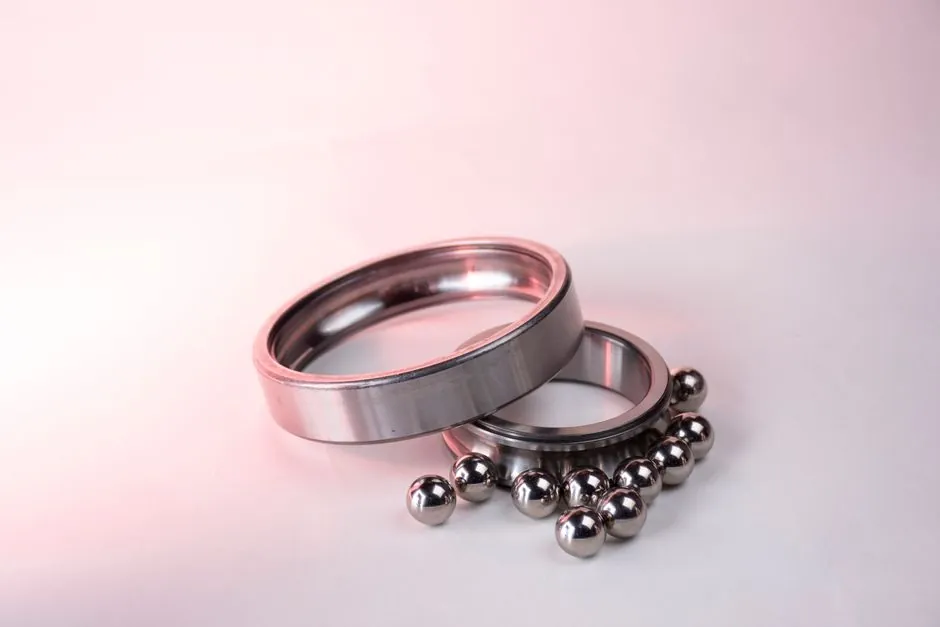
Alumina (Al2O3) bearing balls and silicon nitride (Si3N4) bearing balls sit at opposite ends of the ceramic-ball selection matrix: alumina is the lowest-cost, chemically inert workhorse rated for service up to roughly 1750 °C in inert atmospheres, while silicon nitride delivers a 60% weight reduction versus steel, a coefficient of thermal expansion at about 25% that of most metals, and the low-friction, high-RPM behaviour that defines modern hybrid ceramic bearings [S1][S3][S4].
For procurement and design engineers, the decision is rarely a pure performance race. It is a trade between cost, density, maximum operating temperature, toughness, and the speed/load envelope of the host machine. The criterion-by-criterion comparison below uses manufacturer-published figures from the past six months and is intended to be quoted directly into a bearing specification.
Material Grades and Property Baselines
Alumina bearing balls are produced in purity grades from about 92% to 99.5% Al2O3, with higher-purity grades raising hardness and wear resistance at a measurable cost premium; the metallurgical behaviour and trade-off are detailed in a separate purity-to-hardness review and are governed under IEC 60672 class specifications for aluminas. Typical baseline figures: Vickers hardness 1500–1800 HV (99.5% grade), density 3.85–3.95 g/cm³, maximum use temperature roughly 1750 °C in inert atmospheres and around 1200 °C in air, compressive strength above 2000 MPa [S2][S5].
Silicon nitride (Si3N4) bearing balls are normally hot-isostatically pressed and reach a density near 3.2 g/cm³, roughly 40% lighter than steel and 17% lighter than alumina [S1][S9]. The material is intrinsically harder than alumina in rolling-contact applications, with a thermal expansion coefficient at about 25% of most metals, which preserves internal clearance over wide temperature swings and reduces skidding at high RPM [S2][S3][S9].
Density, Weight, and Speed Envelope
Mass directly sets centrifugal force and skidding risk inside the bearing raceway. Silicon nitride balls at 3.2 g/cm³ cut centrifugal load by roughly 17% versus alumina at 3.9 g/cm³ and by 60% versus bearing steel at 7.8 g/cm³, which is why high-speed machine-tool spindles, aerospace accessory gearboxes, and electric-motor bearings are dominated by Si3N4 hybrid configurations [S4][S9].
Alumina balls, being the heaviest of the common engineering ceramics, are correspondingly less attractive above roughly 10,000 RPM in grease-lubricated spindles. They remain common in chemical-process pumps, check valves, and metering instruments where the speed envelope sits below 3600 RPM and the priority is chemical inertness and dimensional stability under static load [S2][S5].
Hardness, Toughness, and Failure Mode

Silicon nitride is the harder of the two in rolling contact, with fracture toughness around 6–7 MPa·m^(1/2) and high resistance to surface fatigue, which is why Si3N4 is the default ceramic in machine-tool and aerospace hybrid bearings [S1][S8]. Zirconia (ZrO2), at 5.95 g/cm³ and roughly 8–10 MPa·m^(1/2) toughness, is the high-toughness alternative for impact-loaded service, not the focus of this comparison [S1].
Alumina has fracture toughness of only about 3–4 MPa·m^(1/2), and its failure mode is brittle fracture rather than wear; this is the dominant engineering reason alumina is rarely specified for hybrid ball bearings and is instead used in valve seats, check-valve balls, and pump components where compressive load and corrosion dominate [S2][S5]. For pure rotating-bearing duty the toughness gap typically pushes the choice toward Si3N4 even at higher unit cost.
Thermal Behaviour and Operating Temperature
Silicon nitride holds a coefficient of thermal expansion near 3.0 × 10⁻⁶/K, about one-quarter of most steels, which limits clearance change during thermal cycling and reduces the risk of preload loss in precision spindles [S3]. Alumina sits higher at roughly 7–8 × 10⁻⁶/K but is still lower than steel, with the practical ceiling set not by expansion but by creep and surface degradation in air above about 1200 °C; in inert atmosphere the useful ceiling extends toward 1750 °C [S2][S5].
In high-temperature rolling service, real-world spec sheets tend to anchor on roughly 800–1000 °C continuous for Si3N4 and 1000–1200 °C for high-purity alumina in oxidising atmospheres, with the more conservative figure of about 1200 °C often cited for hybrid bearings using either ceramic in the raceway [S2][S5]. Both materials lose hardness rapidly above these points, so high-temperature bearing duty above roughly 1000 °C is normally served by SiC or specialised grades rather than either of these two.
Chemical and Electrical Resistance
Alumina is essentially inert to most acids, alkalis, and organic solvents below its thermal ceiling, which is the underlying reason it is the default ball material for chemical metering pumps, downhole valves, and pharmaceutical flowmeters [S2]. Alumina ceramic is also an electrical insulator at typically 10¹⁴ Ω·cm volume resistivity, which adds bearing-protection value in environments where stray currents can pit races (for context, broader alumina coating behaviour for ESD fixtures is covered in a separate anti-static alumina review).
Silicon nitride is more stable in acidic conditions and is not subject to the low-temperature steam degradation that affects some zirconia grades, giving it slightly broader chemical stability in mixed-service environments [S1]. For the dominant industrial case (lubricated hybrid bearings with steel races) the chemistry difference is usually secondary to the speed and density advantage of Si3N4.
Cost, Grade Tolerances, and Sourcing
Alumina is the most economical all-rounder, typically priced at a fraction of Si3N4, with broad availability in common Inch and metric sizes from 1 mm up to 50 mm; silicon nitride is the premium choice, with the price gap widest at tight grades and large diameters [S6]. Both materials are produced to the standard bearing-ball grades 3, 5, 10, 16, and 25, with grade 3 the most common balance of precision and cost and grades 5 and 10 used in high-speed motors, medical systems, and aerospace components [S5].
For OEM sourcing: specify Si3N4 grade 5 or 10 in hot-isostatic-pressed (HIP) condition for hybrid spindle and motor bearings, and alumina grade 3 to 10 in 95–99.5% purity for valve, pump, and instrument duty where cost dominates. Common OEM product codes include SN-prefixed Si3N4 balls (e.g. SN0910) and AN/Al₂O₃ prefix ball lines, with tolerances to ABMA Std 10 or ISO 3290 depending on grade [S5][S8].
Decision Matrix: Alumina vs Silicon Nitride Bearing Balls
Use the table-style matrix below as the procurement shortlist. Alumina wins on raw cost, compression strength, and chemical inertness; silicon nitride wins on density, thermal stability, hardness, and maximum safe RPM. [S1]
For pumps, check valves, flowmeters, and downhole chemical service: specify alumina (95–99.5% Al2O3), grade 3–10, ABMA/ISO 3290. For high-speed spindles, aerospace accessories, EV motors, and precision instruments: specify hot-isostatically pressed Si3N4, grade 5 or 10, ABMA Std 10, with steel rings in a hybrid configuration. Trackable signals to watch in the next sourcing cycle: any price moves on HIP Si3N4 above 25.4 mm (1 inch) diameter, where supply is most constrained, and any OEM moves to alumina-hybrid bearings in mid-speed EV traction motors, which would shift the cost/performance line.