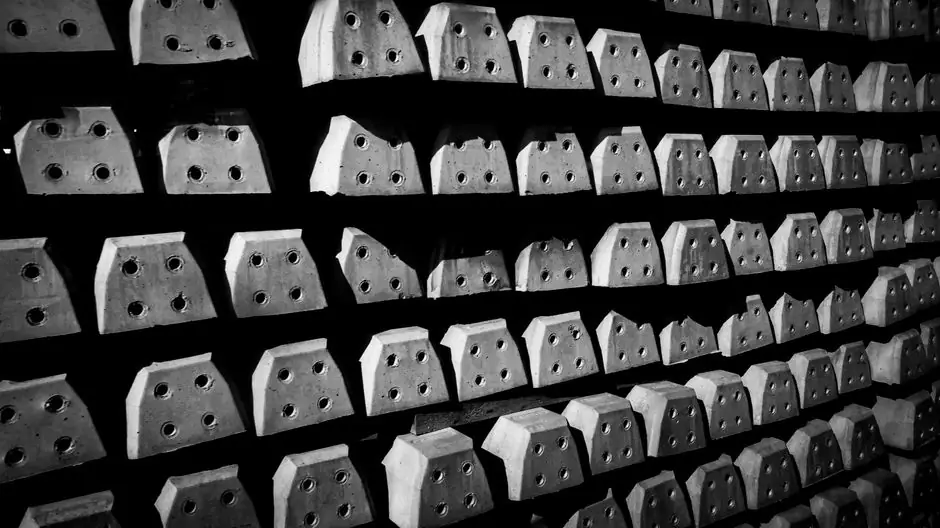
Hot-pressed boron carbide (B₄C) at 2.5 g/cm³ cuts areal density roughly 36% relative to sintered 99.5% alumina at 3.9 g/cm³, and a well-circulated vendor figure puts the ceramic-tile-only weight saving at about 30% on a finished Level III+ plate [S2][S7]. On a 10×12 in shooter's cut, that lands the same threat rating at approximately 3.5–4.5 lb (B₄C) versus 5.0–6.5 lb (alumina), with the exact figure depending on backing build and tile thickness [S7].
Weight is the headline number, but the engineering story is a four-way trade between density, hardness, fracture toughness, and cost; the lightest tile is not automatically the right one, and the cheapest tile is rarely the heaviest in service mass [S2][S3].
Density and Areal Density: The Real Weight Story
Areal density (kg/m², or lb/ft²) is what matters on a vehicle or a plate carrier, not bulk density alone; tile thickness for a given threat sets the actual mass [S2]. Hot-pressed B₄C tiles for Level III defeat typically run 6–8 mm thick, while an alumina tile reaching the same NIJ 0101.06 Level III rating generally needs 8–10 mm of high-purity (>99.5% Al₂O₃) material [S2][S3].
Reaction-bonded boron carbide (RBB4C) sits in the middle at roughly 2.6 g/cm³, only marginally heavier than the hot-pressed grade, and remains the workhorse of vehicle appliqué armor programs that want a 15–20% mass cut over alumina without the full B₄C price premium [S3]. The Savio et al. experimental study reinforces that B₄C's combination of ~30 GPa hardness and 2.52 g/cm³ density is the material-physics reason it remains the lightest conventional armor ceramic in serial production [S1].
Hardness, Toughness, and Multi-Hit: What You Give Up to Save Weight
Alumina AD85 (85% Al₂O₃) registers 860–1000 HV, sintered 99.5% alumina 1200–1600 HV, hot-pressed SiC 2300–2600 HV, and sintered/hot-pressed B₄C 2400–3100 HV; hardness tracks the ceramic's ability to fracture the incoming projectile tip during the dwell phase [S3]. Fracture toughness moves the opposite direction: alumina sits at 3–5 MPa·m^½ while hot-pressed B₄C is only 2–4 MPa·m^½ and reaction-bonded B₄C drops to 2–3 MPa·m^½, which is why B₄C tiles crack more readily after the first impact [S3].
Multi-hit performance is the operational consequence of that toughness deficit: NIJ 0101.06 Level III demands six shots on a single plate, and alumina's lower hardness is more than offset by its better crack arrest, so 99.5% alumina routinely clears the six-shot protocol where RBB4C tiles often require tighter spacing or larger tiles to do the same [S3]. Compressive strength reinforces the same ranking, with alumina at 1800–2000 MPa, hot-pressed SiC at 3500–4900 MPa, and hot-pressed B₄C around 3000 MPa [S2][S3].
Cost, Tile Geometry, and Manufacturability
A 10×12 in alumina strike face on a Level IV plate runs on the order of $20 in raw ceramic cost to the plate assembler, the lowest among the three common armor ceramics, and the broader processing chain (pressureless sintering at 1600–1750°C, conventional diamond grinding) is mature and widely available [S3]. B₄C, by contrast, requires hot-pressing at 2000–2200°C with pressure to reach full density, which is the dominant cost driver and the reason the same finished-plate ceramic line item can run 5–10× higher per unit area [S2][S3][S6].
For reference, the Body Armor News 2023 cost index lists AD85 alumina at 1×, sintered 99.5% alumina at 2×, hot-pressed SiC at 5×, reaction-bonded B₄C at 7×, and sintered/hot-pressed B₄C at 13× the baseline [S3]. Sintered alumina is also the easiest of the three to form into non-planar rear surfaces, which are used to attenuate reflected tensile shock waves and delay catastrophic spall [S2].
Threat-Specific Selection: Which Tile Wins Where
For tungsten carbide core AP (WC AP) threats, hot-pressed SiC and B₄C both substantially outperform alumina on a weight basis, because the dwell-phase erosion of a WC penetrator depends on ceramic hardness above ~2000 HV; below that, alumina's lower hardness means a thicker, heavier tile is needed for equivalent defeat [S3]. For M855 ball and mild steel-core AP, sintered 99.5% alumina is competitive on cost and frequently chosen for law-enforcement plates where multi-hit compliance and budget dominate the decision [S3][S6].
For rotary-wing, special-operations vehicle appliqué, and any platform where every kilogram of mass is a fuel or payload penalty, B₄C remains the default despite the unit cost, and SiC slots between alumina and B₄C as a price/performance compromise that is lighter than alumina and cheaper than hot-pressed B₄C [S2][S3]. Glass-ceramic and amorphous variants such as the Amorphoid family are roughly 10% lighter than B₄C (~2.2 g/cc) but remain niche, expensive, and not in widespread serial production [S8]. For a deeper read on how alumina's purity shifts hardness and downstream wear behaviour, see the engineering breakdown on higher alumina purity raising hardness.
Specification, Compliance, and the Limits of the 30% Rule
NIJ 0101.06 (and the field-deploying NIJ 0101.07) is a defeat-and-shot-pattern standard, not a material standard, so any of the three ceramics can be specified as long as the finished plate passes the rating protocol; the ceramic choice then lives in the program's mass, cost, and multi-hit budget [S3]. That is why an "equivalent rating" comparison still shows alumina plates 20–30% heavier for the same NIJ Level III+ rating: the additional mass is paid for additional multi-hit margin and lower tile cost, not for additional threat capability [S7].
Practically, the 30% lighter rule of thumb breaks down once a program needs repeated impact survival, low radar cross-section constraints (where thicker alumina changes the RF signature more than thinner B₄C), or a unit cost under roughly $150 per finished plate; in those cases alumina, or alumina-faced SiC hybrid tiles, re-enter the trade space as the mass-vs-cost optimum [S2][S3][S6]. For a fuller material-family reference on the alumina side, see the alumina ceramic encyclopedia entry, and for the B₄C/SiC end of the trade, the silicon carbide reference covers the same property envelope from a different angle.
Failure Modes and Field Limits
All three ceramics defeat the projectile by controlled fragmentation, not by elastic deformation, so the ceramic strike face is always single-use after a hard hit and must be backed by a fiber laminate (typically UHMWPE or aramid) to catch the comminuted debris and residual penetrator; choosing the ceramic is therefore inseparable from choosing the backing build [S2][S3]. B₄C's lower fracture toughness also makes it more sensitive to edge impacts and to dwell-time loss on oblique shots, where the projectile can "skip" along the surface rather than dwell and erode, which is one reason most fielded B₄C plates use a thin alumina or SiC strike face over a B₄C core [S3].
Edge clamping, tile spacing, and the tile-to-backing bond are the three mechanical details that decide whether a lighter B₄C plate actually survives its six-shot protocol, and they are also where the published 30% weight savings can quietly disappear if a thicker backing laminate is added to compensate for lower ceramic multi-hit margin [S2][S3][S6].
Trackable signals for the next six months: NIJ 0101.07 transition updates for body-armor certification (affecting which ceramic/baking builds can be sold to US law enforcement), any rotary-wing appliqué refresh that swaps RBB4C tiles for hot-pressed SiC to dodge the B₄C cost line, and pricing moves on sub-10 µm B₄C powder, which is the supply-side bottleneck behind the 5–10× ceramic cost premium over alumina.