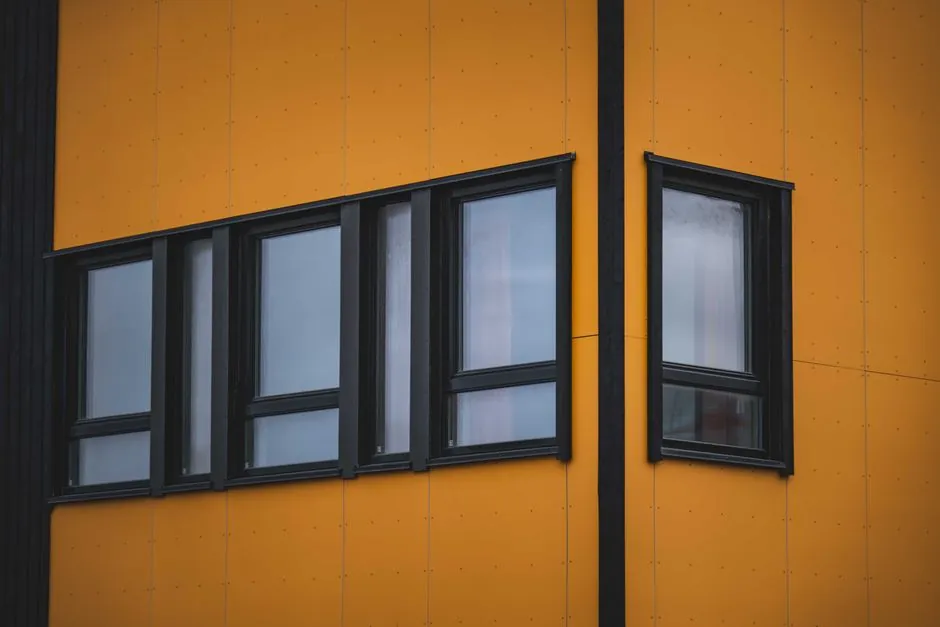
On a noise-loaded urban envelope, an aluminium window system with asymmetric laminated acoustic glazing and a thermally broken multi-chamber frame can reach Rw 40+ dB, matching typical STC 40 to STC 48 performance bands published for premium aluminium product lines in 2025 [S4][S5].
The European Environment Agency estimates more than 20% of Europeans, roughly 100 million people, are exposed to traffic noise above 55 dB, with WHO guidance capping daytime urban sound at 53 dB and night levels at 30-35 dB, a benchmark that drives acoustic-window specification on city centre, rail-adjacent and airport-frontage projects [S1].
Why Aluminium Frames Pair With Acoustic Glazing
Aluminium frames contribute mass, rigidity and slim sightlines, while polyamide thermal breaks decouple the inner and outer shells, interrupting the acoustic bridge that a single metal profile would otherwise form [S3]. Multi-chamber extrusions add stiffness without increasing visible frame width, which lets designers keep glazing ratios high on glazed curtain-wall and aluminum window door assemblies.
Three physical principles govern performance: mass, damping and decoupling. Heavier asymmetric glass panes resist low-frequency traffic and rail noise, laminated interlayers (PVB or EVA) absorb mid-frequency speech and music energy, and the polyamide thermal break plus EPDM perimeter gaskets decouple structure-borne paths and seal flanking leaks at the frame-to-wall junction [S3]. Laminated acoustic glass with asymmetric thickness combinations is the most common high-performance option, paired with double or triple insulated glazing and warm-edge spacers filled with argon or krypton [S4].
Glass Stack Options and Where Each One Fits
Laminated glass with a PVB or EVA interlayer is the baseline acoustic upgrade over monolithic glass, but ordinary laminate is not automatically acoustic-grade; performance depends on interlayer type, glass thickness asymmetry and complete IGU construction [S2]. Acoustic-grade laminate typically uses a thicker, softer interlayer (often 0.76 mm or more of PVB, or a specialist acoustic PVB such as those marketed as "sound control" interlayers) tuned to dampen the coincidence dip in the 1000-4000 Hz speech band.
For city sites near roads, rail corridors or airports, the practical decision tree runs: (1) double-glazed with one acoustic laminate pane and one float pane, asymmetric thicknesses such as 6-12-8.8 mm, for moderate sites; (2) triple-glazed with two acoustic laminate panes and an inert-gas cavity, for residential towers and hotels facing traffic corridors; (3) triple-glazed with thick outer pane (8-10 mm), wide cavity (16-20 mm) and acoustic laminate inner pane, for sites below flight paths or beside mainline rail. Asymmetric pane thickness is the most cost-effective single move because it shifts the mass-air-mass resonance away from the dominant traffic-noise spectrum.
Ratings: Rw, STC and OITC Compared Against Site Noise

Rw (weighted sound reduction index, ISO 10140) and STC (Sound Transmission Class, ASTM E413) are single-number ratings correlated to speech-band performance, while OITC (Outdoor-Indoor Transmission Class, ASTM E1332) weights the lower-frequency traffic and aircraft spectrum [S5]. Published Xline aluminium window test data lists STC 29 to 48 and OITC 23 to 38, with the higher figures corresponding to triple-glazed acoustic laminate configurations [S5]. StarveilBuild publishes two reference bands for its acoustic aluminium window line, Rw 35-40 dB and Rw 40+ dB configurations [S4].
For site selection, an urban site with daytime traffic noise around 70 dB and a comfort target of 40 dB indoors requires a window rating of roughly Rw 35-40 dB; a hospital or hotel room with a 35 dB indoor target on a 75 dB site needs Rw 40+ dB; a residential tower beside a railway with measured exterior levels above 80 dB should target the top of the published band, STC 45-48 / Rw 42+ dB, and budget for triple glazing with a wide cavity [S2][S4][S5]. Always subtract 3-5 dB as a rule-of-thumb installation penalty for field performance versus laboratory rating, and verify that the wall and frame-to-wall junction do not flank the window.
Sealing, Installation and the Frame-to-Wall Junction
Air leakage at the perimeter is the most common reason a high-rated window underperforms on site. Multi-layer interlocking EPDM gaskets, pressure-fit during glazing, combined with a backer rod and acoustic sealant at the frame-to-wall interface, close the flanking path that would otherwise let sound bypass the glazing [S3][S4]. For a system window door on a commercial facade, gasket compression set matters: specify EPDM rather than TPE or PVC for long-term acoustic resilience, and require the supplier to publish compression-set data.
Glazing bead selection interacts with acoustic performance. Dry gaskets with continuous EPDM boots give predictable compression and easy replacement, while wet glazing with structural silicone can reach higher acoustic ratings on unitised curtain wall because the continuous silicone bond eliminates the gasket line entirely. For a hybrid facade using glass curtain wall spandrels and punched aluminium windows, the unitised silicone-glazed units typically outperform the field-glazed stick-system windows by 2-4 dB because the factory-controlled glazing process yields more consistent bite and gasket compression.
Decision Criteria: Aluminium Versus uPVC and Timber on Acoustic Façades

On a criteria-based comparison, the three frame materials trade off as follows. Aluminium, the focus here, scores highest on strength-to-weight (enabling larger panes and slimmer sightlines), best on fire rating (non-combustible, A1 / A2-s1,d0 achievable with powder-coat), moderate on embodied carbon unless high-recycled-content billet is specified, and best on acoustic ceiling because the polyamide thermal break and multi-chamber extrusion can be tuned without sacrificing structural performance [S3][S4][S5].
uPVC frames deliver strong acoustic performance at lower cost but limit pane size and sightline, soften under UV in dark colours, and have a lower fire rating. Timber frames offer excellent natural damping and low embodied carbon with FSC-certified stock, but require more maintenance, limit large openings, and are rarely chosen for high-rise acoustic facades. For a 20+ storey acoustic-sensitive tower beside a motorway, aluminium is usually the only option that meets structural, fire and acoustic targets simultaneously, while on a low-rise infill project a timber-aluminium composite can be competitive on acoustics and aesthetics.
Common Specification Mistakes and Failure Modes
Specifying the wrong interlayer is the most frequent error: acoustic-grade PVB (typically 0.76-1.52 mm, softer than standard structural PVB) must be called out, otherwise a standard 0.38 mm PVB is supplied and the coincidence dip falls inside the speech band [S2][S3]. A second failure mode is symmetric glass thickness, which lets the mass-air-mass resonance peak fall at 200-500 Hz, exactly where road and rail energy concentrate; always specify asymmetry.
A third common problem is flanking transmission through the wall, ceiling or floor structure, which can deliver 10-15 dB of noise past a Rw 40 window if the surrounding lightweight facade is untreated [S1]. Acoustic façade panels, mineral-wool cavity insulation, and decoupled interior linings on the spandrel and adjacent partitions close this path. Finally, thermal-break selection affects both U-value and acoustics: a 24 mm polyamide strip gives a typical window U-value around 1.3 W/m²K, but for combined thermal-acoustic targets a wider 35-44 mm thermal break with foam-filled chambers reaches Uw 0.8-1.0 W/m²K without sacrificing Rw, a useful synergy for projects chasing both Passivhaus and acoustic certifications [S3][S5].
Indicative Cost, Lead Time and Sourcing Signals

Reference FOB pricing for acoustic aluminium windows from one China-based OEM sits at $70-160 per square metre, with a 30-day lead time and a 30-unit minimum order quantity, which is a useful benchmark for budgeting on commercial volumes [S4]. Acoustic-grade laminate, krypton fills and wider polyamide thermal breaks each add cost; triple-glazed acoustic units typically run 30-50% above standard double-glazed thermal-break windows in the same system.
On the specifier side, the most useful signals to track through 2026 are: revisions to ISO 10140 / ISO 717 rating methods, updates to WHO and EU Environmental Noise Directive guidance, and the spread of factory-glazed unitised acoustic window-walls on mid-rise residential projects in cities such as London, Kyiv and Warsaw. For a related comparison on framing decisions, the recent aluminum window wind pressure rating article covers the structural side of the same facade spec; acoustic and wind-pressure performance are typically co-optimised rather than specified in isolation.