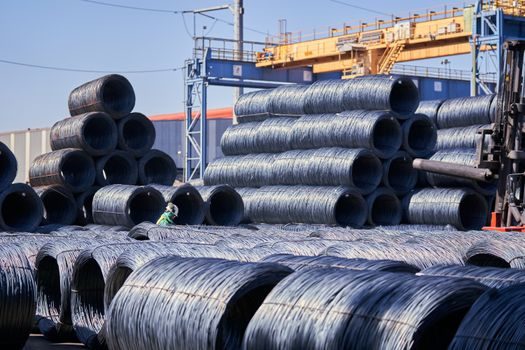
Aluminum coil and an aluminum die casting machine are not competing products — they sit at different steps of the same value chain. A coil is a continuous-rolled flat product (typical width 1,000–1,800 mm, thickness 0.2–6 mm in the commodity range) sold by the ton or kilogram, while an aluminum die casting machine is a discrete capital asset rated by clamping force that converts molten Al alloy into a near-net-shape part [S1][S6][S7].
The buying decision is therefore driven by the geometry the buyer actually needs: 2D sheet that can be cut, bent, stamped, or anodized comes from a coil mill; complex 3D features with thin walls, internal ribs, and tight tolerances on a single part come from a die casting machine (cold chamber 800–9,000 kN class) [S6][S7]. Mixing the two routes — buying coils to cast, or specifying a casting machine to roll sheet — wastes budget on every line item.
Two product forms, two spec sheets
A coil is specified by alloy-temper (1xxx, 3xxx, 5xxx, 6xxx series are the workhorses), thickness tolerance (often ±0.02 mm on precision strip), width, coil ID (508 mm / 610 mm standard), and surface finish (mill finish, anodizing quality, painted) [S1]. Specifications track metallurgy standards such as ASTM B209 for sheet and plate, with the coil produced by hot rolling + cold rolling + annealing rather than casting.
An aluminum die casting machine is specified by clamping force (tonnage), shot weight, platen size, and chamber type. Market listings on 2026-07-30 cluster into three tonnage bands: 25T hot-chamber small machines at $10,000–$11,000/set, 80T aluminum cold-chamber units at $17,000–$22,000/set, and 300–400T cold-chamber production machines at $48,000–$80,036/set [S6][S7]. Cold-chamber designs dominate aluminum work because molten aluminum attacks iron-based plungers, while hot-chamber machines are reserved for zinc and lead alloys at lower melt temperatures.
Aluminum alloy and zinc alloy: shared machine, different parameters
One 80T class machine can be retooled between aluminum and zinc, but the process window is not symmetric. High-pressure die casting of aluminum alloys requires a cold-chamber setup with injection pressures of 30–100 MPa and shot sleeves lined to resist the attack of molten aluminum above 660 °C; zinc alloys (Zamak 3, Zamak 5) cast cleanly in hot-chamber machines at 380–420 °C, allowing 100+ shots per minute on small tonnage [S2][S3].
Buyers comparing the two metals on the same line should weight three numbers: part weight (zinc caps out around 5 kg practical, aluminum reaches 30 kg on 900T presses), cycle time (zinc 30–60 s on hot-chamber; aluminum 60–180 s on cold-chamber including spray and cooldown), and unit scrap rate. For projects above 10 kg per part with structural loading — automotive subframes, EV motor housings, large lighting heat sinks — aluminum cold-chamber die casting is the only route of the three [S4][S7].
Alloy choice and temper bands on the coil side

Coil buyers deal in alloys designated AA1050, AA3003, AA5052, AA6061, and AA6063 in the 1xxx–6xxx series, with tempers O (annealed), H14/H18 (strain-hardened), and T4/T6 (heat-treated). AA1050 / AA1100 pure-1xxx series coils carry 99.0–99.5% Al and are priced as commodity stock for roofing and foil stock; AA3003 with ~1.2% Mn adds formability for HVAC fins; AA5052 (~2.5% Mg) is the marine-grade choice; AA6061-T6 sits at the top of the strength range for machined components and structural sheet [S1].
Thickness drives yield: commodity coils ship at 0.2–3 mm; structural and tread-plate coils go to 6 mm and beyond. Width commonly sits at 1,000 / 1,250 / 1,500 / 1,800 mm, with mill-enameled and anodizing-quality stock commanding a 6–12% premium over mill finish. Coil buyers should ask for the mill test certificate (EN 10204 3.1) confirming chemistry per batch — this is the single most-forged document in cross-border coil trade and is worth the audit before the truck is unloaded [S1].
Cost bands and unit economics on the casting side
Aluminum die casting machine listings on 2026-07-30 price FOB China as follows: 25T hot-chamber zinc machine at $10,000–$11,000 per set (MOQ 2 sets); 80T aluminum cold-chamber at $17,000–$22,000 per set; 300T automotive-grade cold-chamber at $48,000–$54,000 per set; 400T furniture-accessory machine at $71,143–$80,036 per set [S6][S7]. A 900 kN (≈90T) class aluminum cold-chamber is also listed in the same FOB $17,000–$22,000 band, indicating overlap between tonnage classes at the entry level [S6].
Capital cost is one number; tooling is another. A single-cavity die for a small aluminum housing (≤ 1 kg shot weight) commonly runs $8,000–$25,000 in Chinese tooling shops and amortizes over 50,000–150,000 shots; multi-cavity dies for zinc hardware can hit $30,000–$60,000 with million-shot life. The economic break-even of die casting versus CNC machining from coil stock is widely reported inside the 200–5,000 piece annual run, with die casting pulling ahead as volumes climb — exact thresholds depend on part complexity and alloy price, both of which shift every quarter [S4][S5].
Decision matrix: coil or die casting machine route
Buy aluminum coil if the deliverable is 2D flat stock for stamping, bending, roofing, fin stock, or anodized panels. Buy an aluminum die casting machine (or contract a die casting job shop) if the deliverable is a 3D net-shape part with internal features, repeatable tolerance at volume, and a target unit cost in the $0.50–$5 range at automotive production rates [S2][S3][S4]. A third option — sand or investment casting from foundry — fits low-volume (under 500/yr) heavy parts that would overstress die casting tooling; for sourcing map context, see Aluminum Coil Suppliers: 2026 Spec Bands, Vendor Tiers, and Sourcing Map.
For buyers still on the fence, a useful rule of thumb: if a coil can be cut and bent into the final geometry with no more than two welds or no machining beyond hole-drilling, stay on coil. If the part needs more than 30% material removal, has wall-thickness transitions below 2 mm, or requires M5+ threads in a one-piece part, switch to cold chamber die casting on a 200T+ machine. The wider category page on die casting machines covers machine-side selection; the aluminum die casting machine page covers alloy-specific machine parameters.
Quality systems and standards to anchor the spec
Coil orders should reference ASTM B209 (Al/Al-alloy sheet and plate), EN 485 (Europe), or GB/T 3880 (China), with mill certs to EN 10204 3.1. Die casting job-shop orders should require ISO 9001 minimum, and for automotive Tier-1 supply, IATF 16949 — Qingdao Rongmaofa Metal Co., Ltd. holds both ISO 9000 and IATF 16949, per the supplier record on 2026-07-03 [S5]. Alpha Metal Industries in India lists 40+ years of casting experience and ISO 9001 certification, useful as a second-source benchmark [S4].
Lamar Tool & Die Casting in California lists in-house vacuum anaerobic impregnation and powder coating as part of its standard finishing chain, a configuration now common at Western Tier-2 shops [S3].
Failure modes and constraints to plan around
Coils fail in storage through white-rust (galvanic corrosion under humidity > 60% without desiccant), camber drift, and edge damage — common claims on cross-border coil shipments. Die castings fail through porosity (gas entrapment at high injection speed), cold shuts (low melt temperature), and flash (insufficient clamping force); a 400T machine running an 80T die wastes cycle time on clamp-stroke and risks over-flash on flash-gap land. [S2]
Buyers should also plan for alloy price volatility: A380 aluminum alloy for die casting and AA3003 coil stock both track the LME / SHFE aluminum price, and a 10% spot move shifts die casting landed cost by roughly 6–7% (lower due to value-add) and coil stock by 9–10%. Long-term contracts with index-based pricing remain the standard hedge in both markets [S2][S5]. For a deeper dive on how to evaluate coil stock before placing a PO, see How to Choose an Aluminum Coil: Alloy, Thickness, and Surface Spec Map.
Two signals to watch in the next quarter: (1) whether the 300T cold-chamber listing price drops below $45,000/set as more Chinese vendors enter the FOB Ningbo/Shenzhen export lane, and (2) whether the AA5052-H32 / AA6061-T6 coil premium over AA1050-O widens past 12%, which would push HVAC and construction buyers to substitute 3xxx-series alloys. Both numbers are trackable on the same 2026-07-30 supplier listings that anchor this article [S6][S7].