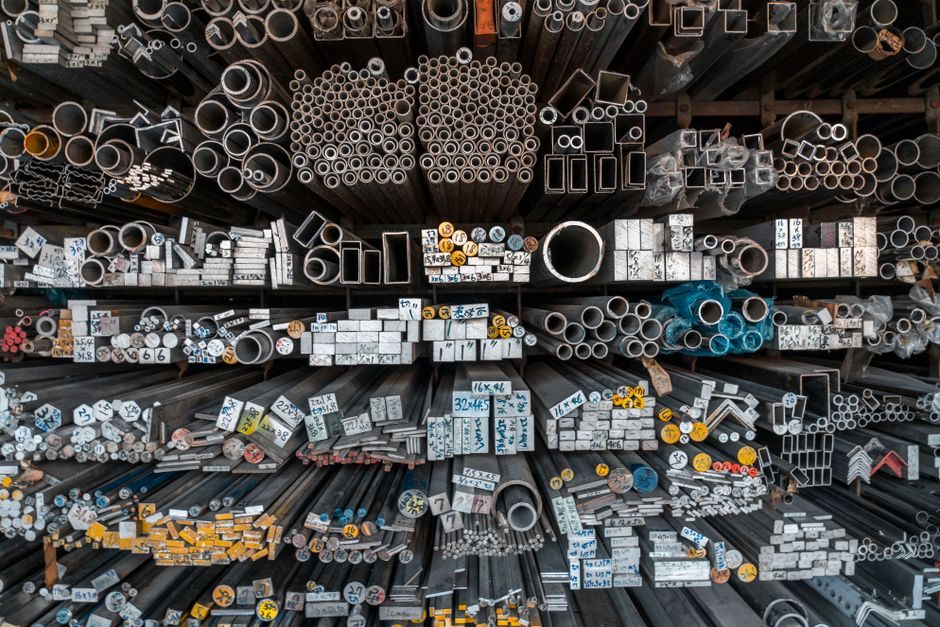
Specifying aluminum extrusions starts with the alloy temper, not the shape: 6063 T5/T6 is the default for window, door, curtain wall and light framing under GB/T 5237-2000, with a 6000mm stock length and anodized surface as the standard supply form [S2]. 6061 T5/T6 is selected where higher mechanical strength or post-extrusion CNC machining is required, while 2024 T4 and 7075 T6 are reserved for structural and aerospace-grade duty [S2].
2026 sourcing data shows extrusion pricing clustered at US$2.50-3.98/kg for standard profiles at 300 kg MOQ from audited Jiangsu and Guangdong mills, with one Foshan supplier offering US$3.20/kg and 3,000 t/month capacity under T/T or Western Union terms [S1][S6].
Alloy and Temper Map by Application
Four alloys cover roughly 95% of industrial extrusion work, each pinned to a different duty profile [S2]. 6063 T5 is the architecture default — anodizing-friendly, good corrosion resistance, moderate strength (~160-190 MPa UTS range) for window, door, curtain wall and T-slot framing. 6063 T6 adds a small strength step via artificial aging for the same chemical composition. 6061 T5/T6 is the structural and machining pick: harder, tougher, accepts anodizing less cleanly but machines well for CNC-fabricated industrial parts. 2024 T4 and 7075 T6 are the high-strength tail — aerospace, transport, high-load brackets — and command the highest per-kg price.
For frames, enclosures and machine guarding, the conservative choice is 6063 T5 in aluminum alloy form with anodized or mill finish, and 6061 T6 only when the assembly carries load or is post-machined. 7075 and 2024 are over-spec for most enclosure work and should be justified by stress data, not by familiarity.
Stock Length, Wall Thickness and Dimensional Envelope
Chinese mill default is 6000mm, the practical maximum for containerized export and the length that all audited suppliers in the data set list as standard [S2]. Wall thickness is supplied "according to request" rather than held to a single catalog value, because extrusion economics scale with the circumscribed-circle diameter (CCD) and minimum wall that the die and press can hold. Most architectural T-slot and curtain-wall profiles sit in the 0.8-3.0mm wall range; structural 6061 profiles typically start at 2.0mm and run to 6mm or more. Tolerances follow GB/T 5237 for architectural profiles and GB/T 6892 for industrial profiles, with the latter tightened for machined parts [S2].
Custom die work is offered against CAD by every supplier in the data set, and OEM is explicitly accepted — die cost is amortized over the order quantity, so short runs of a custom shape are usually uneconomic below 500 kg. The length, finish and packaging chain (plastic film inner, brown paper outer) is identical across audited suppliers, so length and packing are not a differentiator at the specification stage [S2].
Surface Treatment, Fabrication and What Each Option Costs

Surface treatment is a real spec, not a finishing touch: the data set lists mill finish, natural-color anodizing, powder-coat-ready mechanical finishing, and wood-grain/thermal-break variants for window-door profiles [S2][S3][S4]. Anodizing is built into the 6063 T5 supply chain at Chinese mills, which is why architectural profiles ship pre-anodized; 6061 and 7075 are typically shipped mill-finish and anodized downstream. Thermal-break profiles for aluminum window door assemblies add a polyamide strip and sit in a different price band from monolithic extrusions [S4].
Fabrication beyond the press is a separate workstream: CNC machining, cutting, bending, stamping and welding are listed as standalone service lines at audited Jiangsu and Guangdong suppliers, typically at 300-piece MOQ and a US$1.00-3.80/piece range for alloy CNC parts [S1][S2]. For reference, a deeper comparison of post-extrusion fabrication and alloy selection logic is laid out in this aluminum extrusion selection reference.
Decision Matrix: 6063 vs 6061 vs 7075
Three criteria sort 90% of extrusion buys: mechanical duty, post-extrusion machining, and surface requirement. On duty, 6063 T5/T6 handles architectural and light framing, 6061 T6 handles structural and machined industrial parts, 7075 T6 handles high-stress and aerospace [S2]. On machining, 6061 is the cleanest cut, 6063 is acceptable for light milling and tapping, 7075 machines well but is hard on tools. On surface, 6063 anodizes the most uniformly, 6061 anodizes with a yellower tone, 7075 is generally left coated or painted rather than decorative-anodized. On price, the 2026 spot range is US$2.50-3.98/kg for standard 6063/6061 profiles and several dollars higher per kg for 7075 [S6].
The rule of thumb: if the part is decorative, architectural, or a T-slot frame, pick 6063 T5 with anodizing. If the part is a structural bracket, machined housing or jig, pick 6061 T6. If the part is a high-stress aerospace or transport component and the stress case is documented, pick 7075 T6 — and only then.
Where Aluminum Extrusion is the Wrong Choice
Aluminum extrusion loses to crossed roller guide steel and to die-cast zinc on three specific cases, and the spec should reflect that. First, when the section exceeds the press capacity of the supplier: most audited Chinese mills run presses in the 600-2500 t range, and JMA's published 2000 t line is at the high end of the segment [S3]. Second, when the minimum wall must drop below ~0.8mm or the CCD must exceed the press's container diameter — there extrusion becomes uneconomic and roll-forming or casting should be evaluated. Third, when the part needs a near-net-shape volume in the tens of thousands with no secondary machining: die-cast zinc typically wins on unit cost, and a current breakdown sits in this zinc die casting cost guide.
Inside the aluminum family, linear guide rails and precision motion profiles are a different procurement problem from structural extrusions — they need tighter tolerance, surface finish and straightness than a 6063 architectural profile, and the audited mill data in this set does not address that segment.
Verification Checklist Before Releasing a PO
Five items separate a clean extrusion PO from a rework loop. Confirm the alloy-temper in the Chinese mill coding (6063 T5 = architectural; 6061 T6 = structural). Confirm the producing standard — GB/T 5237 for architectural, GB/T 6892 for industrial — because tolerance bands differ [S2]. Confirm stock length is 6000mm unless container or press constraint forces a cut. Confirm surface treatment, inner packing (plastic film) and outer packing (brown paper) match the supplier's published terms. Confirm MOQ is at 300 kg for standard profiles and verify the supplier's audit status — Diamond/Audited Member on the B2B platform is the minimum signal in this data set [S1][S6].
Trackable signals for the next sourcing cycle: 7075 T6 lead times at audited mills, expansion of thermal-break aluminum veneer panel lines at Foshan suppliers, and any upward revision of 6063 anodizing line capacity in Jiangsu — each will move 2026 H2 pricing bands. For buyers also sourcing aluminum ladder and architectural trim profiles, the same alloy-selection logic applies: 6063 T5 anodized, 6000mm stock, 300 kg MOQ, GB/T 5237.