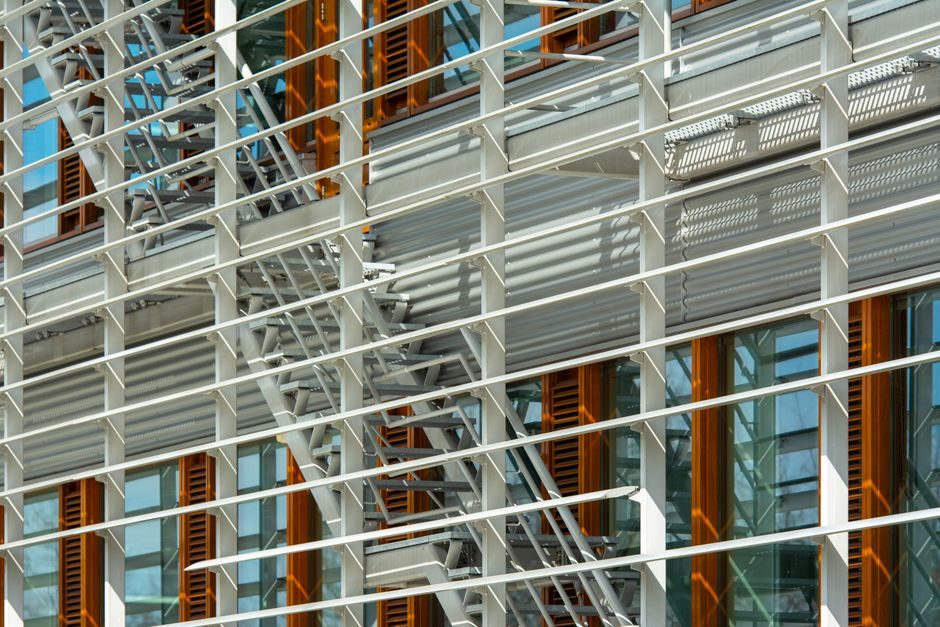
Aluminum extrusion profile supply on the major China B2B directories as of 2026-07-29 is dominated by AA6063-T5 and AA6061-T6 stock, with listed FOB price bands of US$2,800-2,900 per ton at 5-ton minimum order quantities [S5].
The supplier base spans at least four industrial clusters — Shandong (Linyi), Anhui (Ningguo/Xuancheng), Jiangsu (Suzhou, Wuxi), and Zhejiang (Shaoxing, Ningbo) — with mill finish, anodized, powder-coated, electrophoresis, wood-grain, and PVDF surface routes all quoted against the same GB 5237.1-2008 reference [S1][S2][S3][S6].
Alloy and Temper Inventory Most Suppliers Stock
AA6063-T5 is the default architectural extrusion: yield strength sits in the 200 MPa-class band that defines the 6xxx heat-treatable family, while pure aluminum sits at 7-11 MPa [S1]. AA6061-T6 covers structural and machinery sections; AA6082-T6 and AA6005 appear on Wuxi industrial-grade tube and hollow listings [S7]. Temper codes T3, T4, T5, and T6 are quoted as standard across Okorder and Made-in-China catalogs, with T5 (air-cooled from extrusion temperature) and T6 (solution heat-treated + artificially aged) being the two most-requested tempers for window, door, and curtain-wall profiles [S1][S4][S6].
For an engineer comparing these alloys against load cases, AA6063-T6 vs 6061-T6 vs 6082-T6 selection walks through the strength-versus-extrudability tradeoff that drives the supplier stocking pattern visible in the 2026 listings. Pure aluminum is nonmagnetic, reflects ~92% of visible light and up to 98% of mid/far-infrared from a fresh surface, and is roughly one-third the density of steel — those properties, not marketing language, are why 85% of aluminum ends up in wrought products including extrusions [S1].
Surface Finish Routes and GB 5237 Anchoring
Every Chinese extrusion supplier in the July 2026 sample offers the same six-to-eight finish stack: mill finish, anodizing (silver, champagne, light bronze, dark bronze, black, light titanium), powder coating, electrophoresis, wood-grain transfer, PVDF coating, plus heat-insulation break profiles for thermally-broken window and door systems [S1][S4][S6][S8]. Anodizing and coating line length is standardized at 6.5 meters; mill finish lengths cap at 5 meters on most press lines [S1].
The binding national standard is GB 5237.1-2008 (and its companion parts 2-6 for anodized, electrophoretic, powder-coated, PVDF, and wood-grain finishes), which is what the suppliers' curtain-wall profile datasheets point to when they list mechanical-property and coating-thickness acceptance criteria [S6]. For window and door hardware that bolts into these extrusions — handles, locks, hinges, slide supports — suppliers reference GB/T 9296 through GB/T 9305 plus GB/T 5277 and GB/T 3098.1/2/4 for fasteners [S1]. Buyers specifying aluminum window and door assemblies should request the GB 5237 part number that matches the finish code on the quotation, not just "6063-T5".
Size, Wall Thickness, and Dimensional Envelope
Standard Okorder listings for 6063-T5 profiles publish a thickness floor of >0.8 mm and a width ceiling of <300 mm, with wall thickness increasing on structural and machinery profiles [S6][S9]. T-slot framing profiles — 80x80 mm with 6 mm wall, 40-series, and 6105/8158 OEM patterns — dominate the modular framing and CNC-machine sub-segment out of Suzhou and Shaoxing [S3].
Large cross-section industrial profiles (heat-sink, LED luminaire, communication-equipment housings) ship from the Tianjin and Wuxi clusters with custom-mould tooling amortized over 5-ton orders [S3][S7][S9]. When an extrusion pushes past the 300 mm width envelope or below 0.8 mm wall, expect a die-development fee and a tooling lead time on top of the 15-20 day production window that most suppliers quote from deposit [S1].
Price Bands, MOQs, and Trade Terms
Made-in-China aggregated listings for aluminum extrusion profile in July 2026 sit at US$2,800-2,900 per ton FOB China main port, MOQ 5 tons, with 12 active manufacturers and 36 catalog products visible in the Shanxi-supplier filter [S5]. Payment terms across the sample are 30% T/T deposit with L/C at sight on balance, FOB/CFR/CIF incoterms, and ports of loading concentrated at Shenzhen/Guangzhou plus Qingdao and Shanghai for northern clusters [S1][S6].
Delivery runs 15-20 working days after the buyer's deposit clears; suppliers that post response times under 3 hours tend to be trading-company hybrids rather than integrated mills, which matters when the aluminum die-casting machine or extrusion press tonnage on the back end of the supply chain needs to match the alloy and temper you ordered [S1][S5]. For aluminum veneer panel and curtain-wall sub-assemblies built from these extrusions, the same price band holds but the surface finish is almost always PVDF or FEVE, not the anodized stack used on window/door profiles.
Geographic Cluster Map and Supplier Boundaries

Four clusters carry the bulk of the 2026 supplier listings: Linyi (Shandong) for general-purpose industrial profiles, Ningguo (Anhui) for construction and decoration extrusions, Suzhou/Wuxi (Jiangsu) for high-precision CNC-machined and modular framing, and Shaoxing/Ningbo (Zhejiang) for fastenings, LED-lighting aluminum profiles, and T-slot accessories [S2][S3]. Anhui Hongyu Aluminium and Linyi Haomen Aluminium are representative factory-direct suppliers; Suzhou-based Alumag and Shaoxing-based Mesier run factory-plus-trading models that bundle OEM/ODM and CNC secondary operations [S2][S3].
The clear split: factory-direct mills win on price-per-ton and on large structural runs, while factory+trading hybrids win on small-batch custom tooling, modular T-slot framing, and on shipments that need mixed SKUs consolidated under one purchase order [S3][S5]. For aluminum ladder rails and step extrusions, the Wuxi/Jiangsu cluster is the dominant route because the 6061-T6 temper and the heavy-wall rectangular hollows are standard catalog items there [S7].
Specification Risks and Verification Steps
Three failure modes recur on 2026 extrusion POs: (1) temper mis-labelled as T6 when the supplier actually shipped T5, (2) anodized film thickness under-spec on champagne/bronze color-match runs, and (3) wall thickness falling below the 0.8 mm floor on long thin profiles because the press couldn't hold tolerance at the ordered length [S1][S6]. Each one is detectable with a hardness test, an eddy-current coating-thickness gauge, and a pin gauge on the die-side wall, respectively.
Request the mill test certificate with actual tensile/yield numbers (not just "meets GB 5237"), require a first-article sample with measured wall thickness at three points, and pin the surface standard — GB 5237.4 for powder coat, GB 5237.5 for PVDF — on the PO rather than the generic "anodized" wording [S1][S6]. [Gas aluminum melting furnace](/encyclopedia/gas-aluminum-melting-furnace.html] capacity at the mill is the upstream variable that drives melt-loss and inclusion rates; if your profile is going into a structural or pressure-containing application, ask the supplier which furnace model feeds their cast house before you lock the PO.