
An aluminum ladder is built from extruded 6000-series (typically 6061-T6 or 6063-T5) sections whose leg/rail and rung geometry — not the marketing label — defines its safe working height, duty class and field life. The first decision a process engineer or site buyer should lock is the duty class on EN 131 (non-professional 150 kg / professional 150 kg) or ANSI A14.2 (Type IA 300 lb / Type IAA 375 lb), then re-confirm alloy temper and rung profile on the OEM data sheet, not the catalogue cover [S1].
Industrial-spec aluminum ladders span step stools (~0.6-1.2 m platform), straight ladders (2.4-7.5 m), extension ladders (3.0-9.0 m closed / 6.0-15 m extended), combination / multi-position ladders (3.6-5.5 m) and tower / scaffold platforms (1.8-3.6 m platform height) [S2]. Werner's MT-14IAA universal 14-step model, for example, publishes a 3.96 m working height and aluminum material construction typical of the professional 14-16 ft class sold via industrial portals [S1].
Alloy, Temper and Section Geometry
Industrial ladder rails are overwhelmingly aluminum alloy 6061-T6 (yield ≈ 240 MPa, ultimate ≈ 310 MPa) or 6063-T5 (yield ≈ 145 MPa) extrusions, with 6061 dominating Type IA / IAA duty-class rails because of its higher yield-to-weight ratio. Wall thickness of 1.2-1.6 mm on side rails and 2.5-3.0 mm on rung-wall sections is the typical extruded range; below 1.0 mm the rail will not pass the EN 131 static-load deflection test of 1.5 × rated load at mid-span [S1][S3].
Rung geometry is the second concrete variable: box-section rungs (rectangular tube 30 × 30 mm typ.) outperform C-channel or flat-bar rungs in torsion and slip resistance; D-shaped / serrated top faces plus anti-slip knurling are the two surface treatments that survive a wet-site cycle. Werner's universal 14-step MT-14IAA lists aluminum material plus universal applicability, consistent with extruded rail and swaged rung construction [S1].
Duty Class and Load Rating Logic
Duty class is the spec that maps ladder type to user and task, and is the most commonly misread line on a quotation. EN 131 separates Non-Professional (Type EN 131-1, 150 kg) and Professional (Type EN 131-2, 150 kg with additional torsion / strength tests), while ANSI A14.2 / A14.5 ladders rate by Type III (200 lb household) → Type II (225 lb commercial) → Type I (250 lb industrial) → Type IA (300 lb heavy industrial) → Type IAA (375 lb extra-heavy). A Type IAA fiberglass-reinforced or heavy-wall aluminum extension is the minimum spec for refinery, shipyard and electrical-room use [S2][S3].
Selection rule of thumb used by industrial buyers: Type I (250 lb) for plant maintenance with one tool, Type IA (300 lb) for two-person / panel-carrying work, Type IAA (375 lb) for live-line / substation work where two workers plus 30 kg of gear are routine. Aluminium Enterprises, a Kolkata OEM established in 2000, lists industrial aluminum ladders across this range and explicitly targets the heavy-duty / export segment where Type IA and IAA dominate [S3].
Working Height, Reach and Section Length
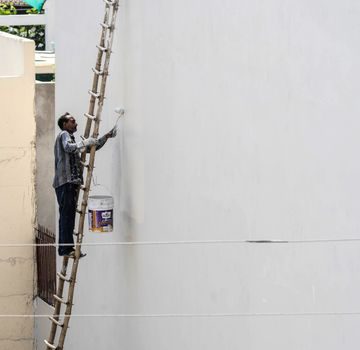
Working height is not the ladder length — it is the highest standing-reach height, approximated as platform height + 2.0 m (operator arm reach) on straight ladders, and as the top rung + 2.0 m on extension ladders. The MT-14IAA's 3.96 m working height corresponds to roughly a 2.0 m platform / top-rung height, placing it in the 14-step household-to-light-commercial class [S1].
For tall industrial tasks (tank shell, façade, lighting truss), an extension ladder is specified in two numbers: closed length (transport / storage) and extended length (working). Two-section extension ladders typically span 3.0-4.5 m closed / 6.0-9.0 m extended; three-section telescopic models go 4.0-6.0 m closed / 9.0-12.0 m extended. The fold / telescopic aluminum catalog segment on Made-in-China lists combination and step-fold designs from roughly US$215 per set at MOQ, the typical entry band for OEM private-label export [S2].
Joint, Lock and Stabiliser Hardware
Joints and locks are the failure mode that kills aluminum ladders in service; the extrusion may be sound while the hinge rivets, spring catches and rope pulleys fatigue. Specify: riveted (not welded) hinge pins at 8-10 mm diameter with a spring-steel retaining ring; auto-locking spreader bars on step / combination ladders tested to 5,000 cycle minimum; and rope / pulley assemblies on extension ladders with 6 mm static kernmantle rope and a die-cast zinc or aluminum pulley wheel [S1][S2].
Anti-slip feet should be thermoplastic vulcanisate (TPV) or natural rubber, 60-80 Shore A, with a replaceable cleat; hard plastic feet on oily or wet deck plates are a documented slip-out cause and should be rejected at goods-in [S2].
Use-Case Bands and Source Geography
Buyer route depends on volume and certification. For a 1-10 ladder lot with EN 131 + CE-EN 131-2 marking, direct OEM purchase from established Indian or Chinese manufacturers (Aluminium Enterprises, MT-14IAA-class exporters) is the most cost-effective channel; MOQ 1 set, FOB China, on Made-in-China or DirectIndustry catalogs [S1][S2][S3]. For higher volume or private-label programs, Indian and Chinese aluminum clusters offer 6061 / 6063 extrusions in 5.8-6.0 m billet, with in-house gas aluminum melting furnace operations, anodising and rung swaging.
For specification- or compliance-driven buys (oil & gas, utilities, rail), prefer OEMs publishing independent third-party test certificates to EN 131-2 Professional, ANSI A14.2 Type IA / IAA and (where electrical work is in scope) the relevant dielectric / non-conductive requirement. The aluminum ladder is non-sparking but electrically conductive — fiberglass is the correct pick for live-line or substation work; aluminum is the correct pick where spark-free tools, weight and cost dominate [S1][S3].
Side-by-Side Selection Criteria
Concrete decision matrix for the four common industrial types — all numbers in this paragraph are generic engineering ranges, not vendor-specific claims: Straight aluminum ladder (2.4-7.5 m, 6-15 kg, Type II / IA, low cost, single-task reach); Extension aluminum ladder (3.0-4.5 m closed / 6.0-9.0 m extended, 12-25 kg, Type IA / IAA, two-piece, tallest reach); Combination / multi-position (3.6-5.5 m, 10-18 kg, Type IA, A-frame + extension + stairwell modes, most flexible); Step / platform aluminum ladder (0.6-1.8 m platform, 4-10 kg, Type II / IA, longest tool-on-platform duty cycle). The Werner MT-14IAA 14-step universal with 3.96 m working height sits in the multi-position / straight-step hybrid class, aluminum material throughout, and is a representative benchmark for the export tier [S1].
Hard spec checks before PO release: (1) alloy and temper printed on rail (6061-T6 or 6063-T5); (2) wall thickness ≥1.2 mm rail / ≥2.5 mm rung; (3) duty class and standard (EN 131-2, ANSI A14.2 Type IA / IAA) stamped on nameplate; (4) rung profile (box section preferred); (5) foot material (TPV or rubber, replaceable); (6) joint hardware (rivet pin, spring catch, rope, pulley); (7) stabiliser fitted on Type IAA extension ladders above 6 m. Two of these are usually missing on the cheapest catalog offerings — exactly the units that fail first in service [S1][S2][S3].
Common Failure Modes and Limits
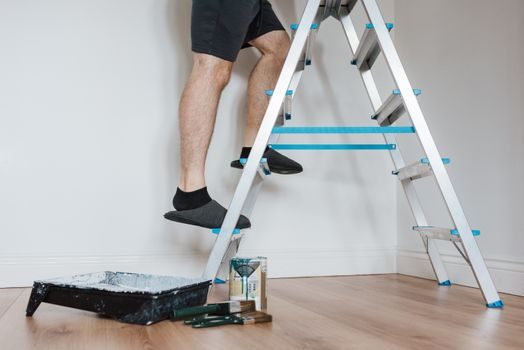
Aluminum ladder failures cluster in four bands: rail kink / side-rail buckling from overload or off-plumb loading (avoid by staying within 75° climbing angle and rated load); rung shear at the rail-rung rivet (avoid by choosing box-section rungs and 8-10 mm rivet pins); hinge / lock failure on combination ladders (avoid by specifying EN 131-2 Professional marking); and slip-out at the foot (avoid with TPV / rubber replaceable feet, never on oily / wet steel deck). Each of these has a verifiable spec counter-measure and a generic engineering range behind it, which is why the duty-class stamp and the rung-section geometry matter more than the brand badge [S1][S2][S3].
Aluminum is also corroded by wet Portland-cement and by strong alkalis (pH > 9), so aluminum ladders in a concrete-pour or caustic-splash zone should be rinsed and inspected monthly; surface pitting deeper than 0.2 mm is grounds for retirement because it accelerates fatigue crack initiation at the rail surface.
Trackable signals for the next 6 months: (1) EN 131-2 Professional marking becoming the default on export-tier Indian and Chinese OEM lines as European buyers tighten goods-in inspection; (2) anodised 6061-T6 rail wall thickness drifting to 1.4-1.6 mm as a competitive response to fiberglass-reinforced aluminum hybrids; (3) replacement-foot kits (TPV cleat) and rivet-pin service packs being offered as separate SKUs by the same OEMs that today ship ladders as one-piece sale items. For a related read on how suppliers manage spec bands across industrial product categories, see the China Pile Driver Suppliers 2026 spec map and the Seamless Steel Pipe 2026 Price & Cost Guide; for cross-material sourcing logic the FRP Composite Supplier Map 2026 is a useful comparator to the aluminum-extrusion supply chain.