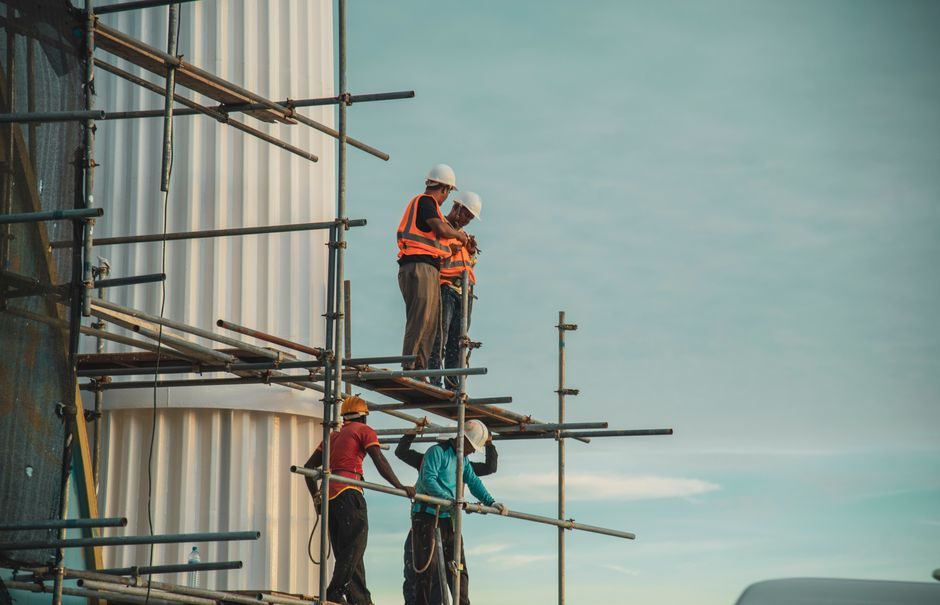
Data center exterior envelope and atrium glazing are typically serviced by ZLP-series permanently installed suspended working platforms, with a rated load band of 630 kg, 800 kg and 1000 kg on a standard 6 m × 0.69 m cradle, and a working hoist lift speed around 9–11 m/min on 220 V / 380 V three-phase supply [S1][S2].
For new hyperscale builds with hot-aisle containment and modular white-space halls, specifiers usually select a permanently-roof-suspended gondola system over a ground-tied mast climber because the cradle travels the full facade line and clears overhead bus-duct and cable trays without fouling the building envelope [S1]. Chinese OEM catalogues published 2026-06 confirm that Powered Suspended Working Platforms, Suspended Access Equipment and Suspended Cradles remain grouped as a single product family with shared hoist and safety-lock architecture [S2].
Working envelope and load band for data center facades
Most data center shells are 8–35 m clear height with a column grid of 12 m × 12 m, which places the typical suspended cradle stroke at 10–30 m and the standard platform length at 2 m, 2.5 m, 3 m, 6 m, 7.5 m modules that can be coupled in series to cover a 12 m column bay [S1]. The platform is suspended from the roof parapet or a dedicated steel outrigger beam via two independent wire-rope hoist units, each rated at 1.5 kW to 2.2 kW for a total installed power under 5 kW per cradle, which keeps the auxiliary feed compatible with any 63 A three-phase service drop already provisioned for HVAC [S1][S2]. Rated payload options cluster at 630 kg (single hoist type), 800 kg and 1000 kg, with the 800 kg unit covering a two-person crew plus a 200 kg tools-and-glass-pane allowance, which is the typical case for atrium skylight and mullion cleaning [S1]. For higher-altitude white-space buildings above 30 m, the same OEM tier also offers a 2500 kg twin-cradle configuration built from two coupled 6 m units, with a secondary safety rope and overspeed governor that trip at about 1.4× the nominal descent rate.
Hoist, safety device and electrical spec band
The lifting mechanism is a worm-geared electric hoist pulling a 8.3 mm or 9.1 mm galvanised wire rope over an aluminium/cast-alloy sheave, with an integrated anti-tilt safety lock (LTD type) that engages within ≤100 mm of free fall when the suspension rope tension drops [S1]. Phase protection, over-load cutoff at 110% rated load and an upper/lower travel limit switch are mandatory in the control panel, which is typically IP55 rated and built to EN 1808 / EN 14502-1 logic for the safety circuit and IEC 60204-1 for the electrical panel [S1][S2]. Most 2026 OEM catalogues still quote a 380 V / 50 Hz three-phase motor at 1.5 kW per hoist, with a 220 V single-phase variant offered for indoor atrium work where only a 16 A service outlet is available on the data-hall ceiling [S1]. The cradle is hot-dip galvanised steel with aluminium guardrails 1.1 m high and a toe-board 150 mm tall, which matches the European EN 1808 guardrail geometry and the GB/T 3811 Chinese standard for working-platform construction [S2].
Material, finish and corrosion protection for white-space environments
Data center atria are typically sealed, humidity-conditioned envelopes, so the cradle hot-dip galvanising (≥85 µm zinc coating) is the corrosion baseline, with optional epoxy powder coating in light grey (RAL 7035) or white to blend with the interior finish [S2]. Wire rope is 6×19 IWRC or 6×19S IWRC construction with a minimum breaking force of 50 kN for the 8.3 mm size, which gives a 5× safety factor against the 1000 kg rated load. Aluminium-alloy sheaves and stainless-steel safety-lock pins are commonly substituted on indoor data-hall units to prevent zinc-Whisker fallout into white-space aisles, and that variant is the one most European data-center operators request in their facade-access specification [S1]. For outdoor cooling-tower and chiller-yard access, the standard galvanised cradle without epoxy is usually accepted and gives a 15–20 year first-coat life in C3 corrosivity per ISO 12944.
Suspended platform vs mast-climbing vs scissor lift — when each wins
For a 10 m to 80 m data center facade the permanent ZLP suspended platform scores best on footprint (zero ground obstruction, critical when the perimeter houses emergency generators and chiller pipe racks) and on per-metre cost over a 10-year service life, but it requires roof steelwork designed for the suspension load, typically 2× to 3× the cradle weight at the suspension beam [S1]. A mast-climbing work platform is preferred on new builds below 30 m where no roof steel exists and a ground-tied mast can share the loading with a raft foundation, but it blocks vehicle access and needs a 4 m clear lane along the facade. A diesel or electric scissor lift is the right answer only for spot maintenance under 12 m and for indoor raised-floor service work; for facade glazing it cannot reach the upper register of a hyperscale hall. A permanently suspended platform trolley running on a ceiling-mounted I-rail is the most space-efficient option for indoor atrium glazing because the rail is fully above the ceiling plenum and the cradle parks flush with the soffit, but it requires the rail to be coordinated at the structural design stage, which is rarely possible on retrofit tenant-fit-out projects.
Manufacturer map and 2026 sourcing signal
On the 2026-06-08 DirectIndustry manufacturer listing, GEDA GmbH appears as the benchmark European OEM with 7 indexed suspended-platform products, Fixator (FR) holds 6 entries, and ACTEL is listed with 3, while Asian catalogues led by Guangdong Sunli and the Made-in-China supplier base populate the mid-tier 630–1000 kg volume segment [S1]. The Made-in-China 2026-07 product detail still groups Powered Suspended Working Platform, Suspended Access Equipment, Suspended Cradle and Suspended Gondola as a single export family, with negotiable MOQ and lift-type configuration as the two commercial levers [S2]. The china-rigid.com manufacturer site, last indexed 2026-07-07, lists Construction and Building Suspended Platform, Thermal Power and Chemical Industry Platform, Wind Power and Elevator Installation Hoist as adjacent product lines built on the same hoist platform, which is a useful signal that the data-center facade variant is a configuration choice rather than a different machine [S5].
Selection criteria checklist for a data center build
Confirm facade height and column bay width to size cradle length (2 m / 2.5 m / 3 m / 6 m / 7.5 m modules) and rated load (630 / 800 / 1000 / 2500 kg) [S1]. Verify roof steel capacity at the suspension beam for 2× to 3× cradle dead load plus dynamic 1.5 kN worker load, and coordinate the suspension beam location with the lightning-protection down-conductor and the bus-duct route. Specify IP55 control panel, phase protection, overload cutoff at 110% rated load, and an overspeed governor that trips at about 1.4× nominal descent speed, all wired in fail-safe logic to EN 1808 [S1][S2]. For indoor white-space specify aluminium sheaves and stainless safety-lock pins to prevent zinc whisker release, and add epoxy powder coating in RAL 7035 to match the interior finish. Require a 2-rope independent suspension with 5× safety factor on the wire-rope minimum breaking force, and ask the OEM for the type-test certificate per GB/T 3811 and the EN 1808 design verification [S2]. A useful cross-reference for the equipment category itself, including its working envelope and the suspended-access regulation context, is the suspended platform encyclopedia entry, which decodes the cradle, hoist and safety-lock terminology used by both European and Chinese OEMs.
Trackable signals to watch after July 2026

Three signals are worth monitoring over the next two quarters: first, the DirectIndustry manufacturer count for GEDA and ACTEL new product SKUs in the 2500 kg twin-cradle band, which has been the fastest-growing tier on the 2026-06-08 listing [S1]. Second, the Made-in-China and Okorder wholesale enquiry volume for the 630 kg and 800 kg Powered Suspended Working Platform, which is the export-tier indicator for data-center retrofit work in South and Southeast Asia [S2][S3]. Third, the EN 1808 / EN 14502-1 alignment status of any new Chinese OEM entering the European data-center market, because the safety-circuit verification step is the most common reason shipments are held at EU port-of-entry, and the China-rigid product catalogue published 2026-07-07 confirms the OEM tier is already mapping its thermal-power and wind-power variants toward the same compliance envelope [S5].
For related coverage, see China Pile Driver Suppliers 2026: Hydraulic Static, Bored Rig and Monkey Driver Spec Bands.