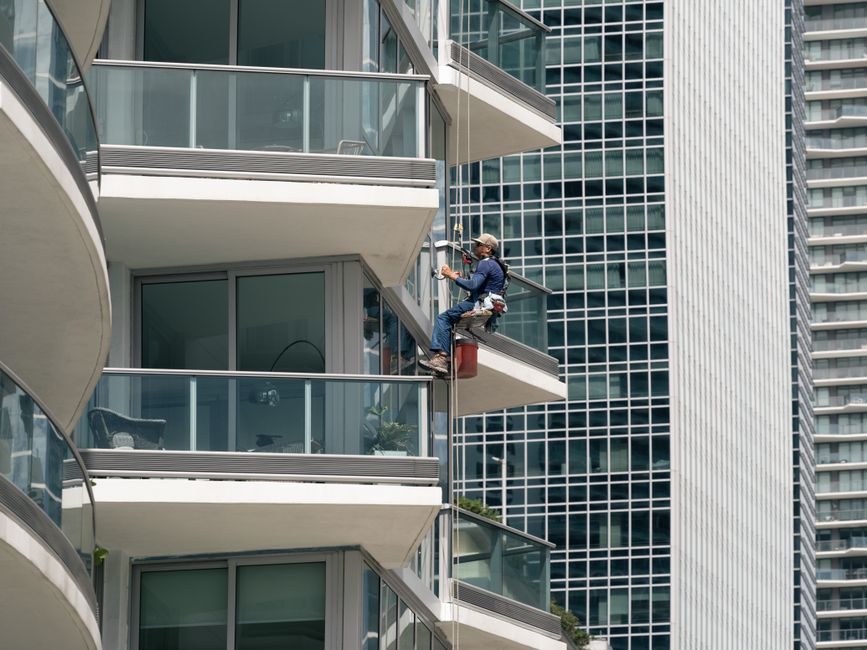
Suspended working platforms in 2026 are sized first by platform length, second by rated load per section, and third by hoist climb speed; the common modular band runs 2-10 m length, 250-1000 kg working load per platform, and 6-10 m/min hoisting, with 1.5-2.2 kW hoist motors driving twin wire ropes through a centrifugal friction brake [S2][S4].
Selection is driven by facade height, duty cycle and the governing safety code (EN 1808 in Europe, OSHA 1926.451 in the US, GB/T 19155 in China), and the 2026 OEM base is concentrated in Jiangsu and Shanghai — Jiangsu Shenxi (since 1988), Shanghai Hongwei, and Powerston being three actively listed suppliers [S1][S2][S3]. Custom builds (length, width, load) remain widely offered for non-standard facade geometry [S6].
Platform Geometry and Modular Length Bands
Standard suspended cradle sections are typically 1.0 m, 1.5 m, 2.0 m and 2.5 m long, bolted end-to-end to reach total platform lengths of 2 m (single short), 5-7.5 m (typical twin-hoist building facade unit), and 10 m+ (multi-section curtain-wall or chimney units) [S4]. A representative build shown in 2026 catalog data is 7.5 m overall length made from three 2.5 m sections at 1.15 m width and 1.81 m toeboard height, giving 800 kg rated load at 8.6 m/min climb speed with 1.8 kW hoist motors and 15 kN brake torque [S4].
For irregular facades — curved glass atria, tapered chimneys, ship-hull blasting — OEMs offer non-standard lengths and load ratings rather than re-engineering the hoist; Okorder's 2026 buyer guidance notes "the customization can involve adjusting the length, width, and load capacity of the platform to meet the specific requirements of" the project [S6]. A working suspended platform is therefore best treated as a configurable kit: standard hoist + variable section count, not a single fixed SKU.
Rated Load, Hoist Power and Brake Torque
The rated load band clusters around 250 kg (single-person inspection cradles), 500 kg (decorating / painting), 630 kg (light glazing), 800 kg (general construction, two tradesmen plus materials), and 1000 kg (heavy curtain-wall replacement or stone cladding) [S2][S4]. Hoist power scales with load: light units use 1.1-1.5 kW motors, mid-range 1.8 kW, and heavy / BMU units 2.2 kW and up, typically two independent hoists per platform for redundancy.
Brake torque on the centrifugal safety device is the single most safety-critical number; 15 kN is the common band for 800 kg platforms, and the brake must engage on rope overspeed or power loss to lock the cradle to the secondary safety rope. Compare that to a fixed linear guide or a crossed-roller guide, where positioning accuracy and repeatability are the headline specs; on a suspended platform, the brake torque and the safety-rope diameter are the headline specs, because the consequence of failure is a free fall of the cradle and crew.
Suspension Geometry, Rigging and Counterweight
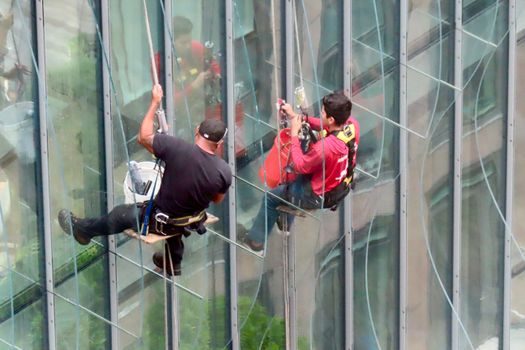
Suspension is by two independent wire ropes per hoist: a working rope (Ø 8-9 mm, 6x19 or 6x36 WS construction, galvanised) and a safety rope of the same diameter running through a separate overspeed brake. Top suspension is by parapet clamps, roof-outrigger beams, or counterweighted jibs sized to 1.5x the maximum platform load plus a 1.5x dynamic factor per common European guidance [S3].
Outrigger reach is typically 1.2-3.0 m from the facade, with adjustable saddle beams to clear parapets and balustrades. Counterweight is usually cast-iron or concrete blocks in 25 kg / 50 kg stackable units, with the total counterweight mass stamped on a fixed plate on the jib. For very tall drops (>150 m) or BMU applications on high-rise curtain walls, OEMs move from the standard ZLP cradle to a building maintenance unit (BMU) with a powered telescopic jib and a traversing trolley on a roof rail [S3].
Duty Cycle, Climb Speed and Motor Selection
Climb speed in the 2026 catalog band runs 6-10 m/min for standard platforms (1.8 kW hoist, 50 Hz single-phase or three-phase supply), with 8-9 m/min as the most common mid-range value [S4]. Fast 10-12 m/min hoists exist for tall BMU builds but they increase rope wear and require larger safety-rope brakes, so they are a deliberate trade-off, not a default upgrade.
Duty cycle is typically rated at 30 min continuous / hour (S3-30% ED), which matches a normal painting or glazing shift with frequent stop-starts; for sandblasting or fire-protection spraying, drop to a slower hoist (6 m/min) with a larger motor to avoid thermal cutout. On a suspended platform, choosing the hoist is therefore less about speed and more about matching the motor's thermal rating to the actual hours-on / hour-off pattern the crew will run.
Compliance: EN 1808, OSHA 1926.451 and GB/T 19155
Three codes dominate 2026 export bidding: EN 1808 (EU safety requirements for suspended access equipment), OSHA 1926.451 (US scaffolds and suspended scaffolds), and GB/T 19155 (China, suspended platforms for construction). The common substantive requirements across all three are: dual independent wire ropes, overspeed safety brake with manual reset, overload limiter set at 1.25-1.5x rated load, anti-tilt interlock on outriggers, and a secondary safety rope of equal diameter to the working rope. [S1]
EN 1808 and OSHA 1926.451 also require a nameplate on each platform stating rated load, number of persons, platform mass, and the date of last thorough examination (typically 12 months max). For procurement, the simplest 2026 acceptance check is: EN 1808 certificate + CE declaration for EU projects, UL / OSHA-compliant labelling for US projects, and the OEM's GB/T 19155 test report for China-domestic builds. Reference standards for rope and brake materials are typically ISO 2408 (wire rope) and the brake performance clause inside EN 1808 itself.
Who It Is For and Who It Is Not For
Suspended cradles are the right tool for facade work on mid-rise to high-rise buildings (4 to 60+ storeys) where the work is localised, short-duration, and linear along a vertical face: painting, plastering, window cleaning, sealant replacement, light cladding repair, and rope-access inspection. They are not the right tool for horizontal access across a wide floor, for heavy lifting of plant modules (use a gantry crane selection process instead), or for indoor ceiling-grid work where a mobile scaffold or a suspended ceiling access tower is faster and safer. [S2]
Suspended platforms are also a poor choice for sites with no viable roof anchor points, for very windy exposed locations (most OEMs cap safe use at 12-17 m/s wind speed, with work stopped above that), or for one-off low-rise jobs where a scaffold or a scissor lift is cheaper when mobilisation is included. For those cases, the procurement decision goes to a mobile elevating work platform or a fixed scaffold, not a cradle.
Comparison: Standard Cradle vs BMU vs Rope-Access Seat

Three options compete for the same facade work. Standard ZLP cradle: 2-10 m length, 250-1000 kg load, 6-10 m/min hoist, lowest unit cost, needs top rigging per job, suited to repetitive facade painting and glazing on mid-rise. BMU (building maintenance unit): telescopic jib, traversing roof trolley, 2-15 m/min powered traverse, 500-1500 kg load, 5-10x the cradle price, suited to long-term high-rise curtain-wall maintenance contracts. Rope-access seat (single technician on two ropes): 100-150 kg load, 0 m/min (manual descent), no platform, suited to inspection, sealing, and short bolt-on tasks where bringing a cradle to site is uneconomic. [S3]
Selection rule of thumb: if the work is >50 m drop and >3 months duration on a high-rise, the BMU wins on total cost of ownership; if the work is 4-30 storeys and project-based, the modular cradle wins; if the work is short inspection or spot repair, rope access wins. The cradle's edge is that it can be reconfigured on site by adding or removing 1-2 m sections without changing the hoist, which is why the suspended platform format remains the volume SKU in 2026 OEM catalogs [S1][S2][S3].
2026 Sourcing Signals and Chinese OEM Base
Three Chinese OEMs were actively listed with 2026-05 to 2026-07 timestamps: Shanghai Hongwei Construction Machinery in Minhang District (Ms. Shirley Wang contact, Fox Business Building, Duzhuang Road), Jiangsu Shenxi Construction Machinery (established 1988, one of the leading Chinese suspended platform manufacturers), and Powerston (which builds both suspended platforms and full BMU cradles, plus material hoists) [S1][S2][S3]. For buyers looking to cross-check rope hoists, brake suppliers, and electrical control panels, a parallel cable drag chain vs cable gland selection note helps on the festoon-cable side of the same cradle.
Customisation remains the dominant signal: Okorder's 2026 buyer guidance for the Somalia market states the platform "can be customized for specific projects" by adjusting length, width and load [S6]. The practical 2026 trackable signals are: (a) EN 1808 + CE pack availability per order, (b) hoist serial number and brake test certificate per hoist, not per platform, and (c) the OEM's willingness to ship 2.0 m and 2.5 m sections as separate line items so the buyer can stock a kit rather than a fixed cradle.