
Aluminum die casting and aluminum sheet forming serve different geometries: die casting on machines from 400 to 1,200 tons clamping force produces net-shape 3D parts from 1 oz to over 25 lb at 3–4 shots per minute [S3][S6], while rolled aluminum sheet typically covers flat stock from 0.2 mm up to 6.0 mm for stamping, deep-drawing, and CNC-formed panels. For complex thin-wall geometries with tight tolerances, the aluminum die casting machine is the dedicated tool; for flat covers, brackets, and enclosures, sheet stock processed on press brakes and stamping lines is the lower-cost route.
The decision between the two therefore comes down to geometry, volume, tolerance, and surface requirement, not which alloy is "better" in the abstract.
Process Boundaries: What Each Route Actually Does
Aluminum die casting uses a steel mold capable of producing tens of thousands of castings in rapid succession, with two die halves clamped by hydraulic cylinders and molten aluminum injected into the cavity [S1]. Cold-chamber die casting is the dominant configuration for aluminum because the melt sits well above the safe immersion temperature of a gooseneck; the die casting machine platform covers both hot-chamber (zinc, magnesium) and cold-chamber (aluminum) variants, and machines in the 400–1,200 ton range handle part weights from 1 oz to over 25 lb [S3].
Aluminum sheet forming covers a separate scope: coils and blanks rolled to gauges typically from 0.2–0.5 mm (foil and packaging) through 1.0–3.0 mm (general enclosures) up to 6.0 mm (structural panels), processed on stamping presses, deep-draw tooling, CNC panel benders, or turret punches. For parts that are flat or singly curved, sheet is faster to tool, cheaper per square meter, and easier to weld; for 3D net-shape parts with internal features, cored holes, and bosses, die casting removes most secondary machining.
Spec Comparison: Casting vs Sheet on the Criteria That Matter
Surface finish: as-cast aluminum die casting routinely reaches Ra 6.3 and can hit Ra 1.6 on critical cosmetic faces, with no heat treatment required to achieve dimensional stability on many alloys [S5]. Rolled aluminum sheet typically comes in mill finish (Ra 0.8–3.2 µm depending on temper) and accepts anodize, paint, or powder coat readily. If the cosmetic face is flat and large-format, sheet + finish is usually cheaper; if the cosmetic face is 3D with undercuts, die casting wins.
Tolerance and repeatability: die casting holds ±0.1 mm on small features and ±0.3 mm on larger dimensions across the cavity, with cored holes sized close to tap drill to minimize drilling [S3]. Sheet metal stamping with proper tool design holds ±0.05–0.15 mm on hole location and ±0.1–0.2 mm on flat dimensions, so for purely 2D features sheet can be tighter, but for 3D die casting has the advantage because no secondary fixturing is needed.
Mechanical performance: die castings deliver the strength of the alloy directly because there are no welded or fastened joints, and thin-wall casting makes parts both lighter and stronger than equivalent fabrications [S3]. Sheet metal parts gain strength through folds, beads, and stiffeners, with the trade-off that welded or fastened joints become the weak link. For a given weight, a die cast part generally outperforms a welded sheet assembly on impact and fatigue.
Material Selection Inside Each Process
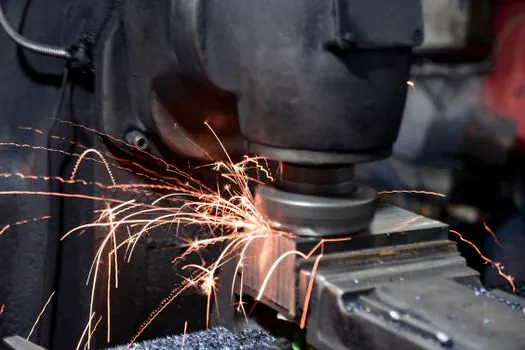
Aluminum die casting alloys are specified for high dimensional stability on complex geometries and thin walls, with corrosion resistance and recyclability as built-in benefits [S1]. For 3D parts that need extra machinability, 6061 is a common reference alloy, but it requires more robust equipment because of higher density relative to magnesium [S4]. The typical alloy menu at a die casting shop includes A380, A383, A384, A360, and ADC12, with A380 dominating for general-purpose parts in the 1 oz to 25 lb range [S3].
Aluminum sheet alloys are a different family: 5052 for marine and sheet metal work (good formability, weldable), 6061 for structural panels needing machinability and modest strength, 3003 for general-purpose forming, and 1100 for chemical and food-grade applications. Temper designation (O, H32, H34, T6) drives final strength: 5052-H32 yields around 193 MPa tensile, while 6061-T6 can exceed 310 MPa, so structural decisions often go to sheet even when the geometry is simple.
Cost and Lead-Time Trade-Offs
Aluminum die casting has a higher startup cost because of lengthy tooling, but per-unit cost drops sharply at volume because less machining is required per unit and cycle times hit 3–4 shots per minute [S2][S6]. The break-even against sheet metal typically lands somewhere between 1,000 and 5,000 parts depending on geometry, with the heavier the part and the more 3D the feature count, the sooner die casting wins. For a steering column, EV battery housing, or agricultural assembly where complexity is high, die casting is the default choice; for an enclosure, bracket, or cover where the part is essentially flat, sheet is the default [S2].
For sheet metal, tooling cost is lower and lead time is shorter, especially for laser-cut + brake-formed parts where no hard tooling is needed at all. The economic limit of sheet tends to be when too many secondary operations stack up: welding, hardware insertion, and finish on a complex sheet assembly can erase the tooling-cost advantage of going with sheet in the first place.
Use-Case Map: Pick the Process, Then Pick the Machine
If the part is a 3D housing, a heat sink with integrated fins, an LED display cabinet frame, or an automotive structural node, specify the aluminum die casting machine with cold-chamber configuration in the 400–1,200 ton range, and expect a surface finish of Ra 6.3 standard / Ra 1.6 cosmetic [S3][S5]. If the part is a flat panel, a stamped bracket, a deep-drawn cookware body, or a telecom enclosure door, stay in sheet metal and select temper and alloy around the strength and formability requirement. For high-temperature or corrosion-critical work where you want a vacuum die casting machine to minimize porosity in safety-relevant structural nodes, the case for die casting over sheet is even stronger because sheet welds are the typical crack-initiation point.
For high-mix low-volume prototyping or for parts in heavier zinc or magnesium alloys, a gravity die casting machine is the right alternative and trades cycle time for thicker wall capability; for zinc-only high-speed work, the zinc die casting machine hot-chamber configuration is the dedicated platform. When the geometry is genuinely sheet-friendly but the alloy is magnesium for weight, magnesium die casting machine options exist, but the 33% weight saving over aluminum [S4] must be large enough to justify the corrosion-protection overhead and the lower melting point of about 650°C.
Limitations and Failure Modes
Die casting fails when the part geometry forces undercuts that the slide system cannot release, when wall sections drop below about 1.0–1.5 mm without proper gating, or when cosmetic requirements exceed what as-cast surfaces can deliver without secondary machining. Porosity is the recurring defect mode in cold-chamber aluminum die casting, which is why vacuum-assisted and squeeze-cast variants are specified for safety-critical parts; the vacuum die casting machine class exists specifically to drop gas porosity below the threshold that causes pressure-leak failures in sealed components. [S3]
Sheet metal fails when the bend radius is too tight for the alloy/temper combination (causing cracking, especially on 6061-T6), when the part needs too many spot welds and the joint becomes the reliability bottleneck, or when flatness requirements exceed what roll-forming and stretching can hold. For telecom enclosure mold base work where the frame is essentially sheet metal, a hybrid approach (die cast corner nodes + sheet panels) is common, and the spec decision pivots on how much hardware you are willing to assemble versus how much you want cast in.
Standards, Sourcing, and Sizing Discipline
Both routes are anchored in the same alloy specifications: ASTM B85 for aluminum die casting alloys (A380, A383, A360, etc.) and ASTM B209 for aluminum sheet and plate. For procurement, the per-part price difference between the two routes narrows as volume rises; for low-volume sheet is almost always cheaper, and for high-volume complex 3D parts die casting almost always wins. The mold base selection question is upstream of both decisions because the die casting die frame size and the sheet stamping die footprint both depend on the mold base standard. [S3]
Decision signal: if the part has more than four 3D features, internal coring, or a target weight under 25 lb with thin walls, route to an aluminum die casting machine in the 400–1,200 ton range. If the part is flat or singly curved, fits a standard sheet gauge from 0.2–6.0 mm, and can be assembled from brake-formed panels, stay in sheet metal and skip the die casting tooling cost entirely. Verify cosmetic surface requirement against Ra 6.3 standard / Ra 1.6 premium on casting side and against mill finish plus coating on sheet side before locking the process.