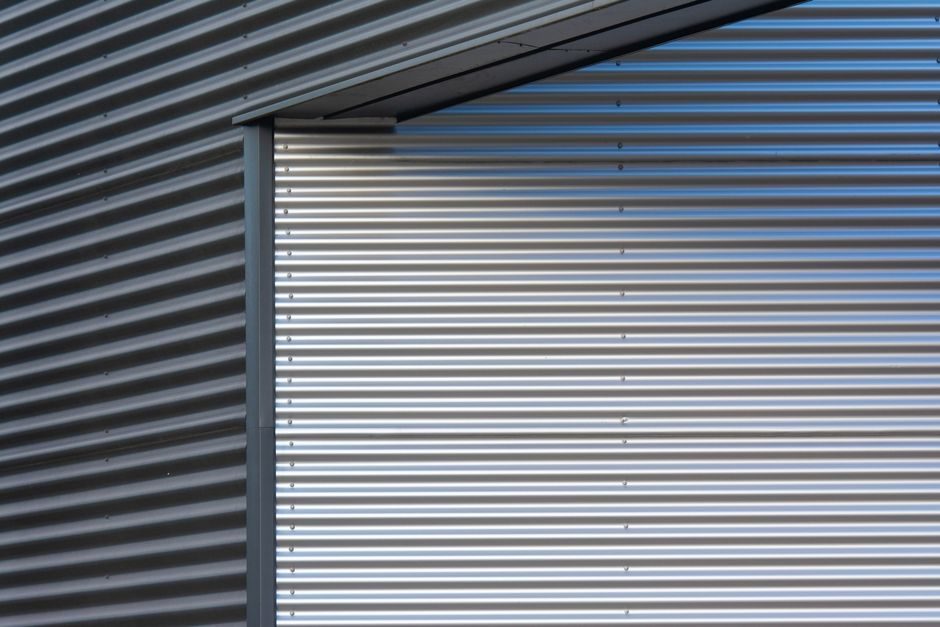
Aluminum sheet (rolled flat product) and aluminum window/door systems (extruded profile assemblies) are two distinct product families stocked and quoted separately on industrial B2B platforms, with different alloys, tolerances and unit prices [S5][S2].
Sheet is sold by ton or by square meter with thickness tolerances per ASTM B209; window/door systems are sold by linear meter of profile or by finished opening with glazing, hardware and thermal-break options, typically built on 6063-T5 extrusions [S2][S5]. Treating them as substitutes is the most common spec error on small commercial fit-outs.
Form, Alloy and Temper: Why They Are Not the Same Product
Rolled aluminum sheet and extrusions for aluminum window and door systems diverge at the mill: sheet is cast, hot-rolled and cold-rolled to gauge, while profiles are heated billets pushed through a die and cut to length [S2]. The dominant sheet alloys for enclosures, signage and truck panels are 5052, 5083, 6061 and 7075; the dominant profile alloy for architectural frames is 6063, with 6061 used where higher strength is needed and 5052/7075 appearing only in specialty hardware [S5].
Standard tempers differ as well: sheet commonly ships as H32 (strain-hardened, quarter-hard) for 5052, or T6/T651 for heat-treated 6061 plate, while window/door profile extrusions are overwhelmingly 6063-T5 (cooled from extrusion and artificially aged) for dimensional stability in long lineal runs [S5].
Price Bands and MOQ: Sheet vs Finished Window/Door Set
Raw aluminum profile and ceiling-tile extrusion on the China export market is quoted in the US $2,100-2,900/ton band for the same 6063 and 6061 grades, with minimum order quantities of 1 ton, while small accessory extrusions (roller-shade and zebra-blind components) list in the US $0.80-2.90/m range with 1,000 m MOQ [S2]. These are unfinished profile prices, not installed system window and door prices.
Finished commercial aluminum window/door systems from U.S. and Asian vendors carry a different price stack: profile + glazing + hardware + thermal break + factory assembly + crating. Boyd Aluminum, manufacturing since 1961, sells made-to-order commercial storefronts, thermally broken XT window lines, blast-resistant systems and historic-replica assemblies priced per project, not per meter [S1]. Small residential-style aluminum window and door sets from Asian trading platforms are listed on a per-piece or per-square-meter basis with negotiable MOQ, but profile cost remains a minority share of the final assembly [S3][S4].
Selection Criteria: Which Form Fits the Job

Use the following decision criteria, taken from current vendor catalogs and extrusion product listings, when choosing between rolled sheet and extruded profile [S1][S2][S5]:
1. Geometry: flat panel or large planar surface → sheet; long lineal section with internal chambers, screw ports or thermal breaks → extrusion. A 1.5 m × 3 m equipment enclosure panel is sheet work; a 6 m vertical mullion on a curtain wall is profile work.
2. Alloy-driven strength: 5052-H32 sheet (yield ~193 MPa) for marine and chemical-resistant enclosures; 6063-T5 profile (yield ~145 MPa) for standard architectural frames; 6061-T6 plate (yield ~276 MPa) for structural brackets and heavy-duty panels [S5].
3. Surface and finish: powder-coat, anodize, PVDF and wood-grain transfer are routinely applied to 6063/6061 extrusions for aluminum window and door frames, with the same finishes available on sheet but at higher per-square-meter cost for large flat panels [S2].
4. Tolerance: sheet thickness per ASTM B209 (typical ±0.05 mm to ±0.30 mm depending on gauge); profile wall thickness per the extrusion die, commonly ±0.10 mm on architectural sections, with T5 temper giving better dimensional stability than as-extruded [S5].
Comparison: Sheet vs Window/Door System Across Four Buyer Criteria
Side-by-side, rolled aluminum sheet and finished aluminum window/door systems differ on the four criteria that drive purchasing decisions: [S1]
• Unit cost reference: US $2,100-2,900/ton for mill-grade profile and ceiling extrusion stock [S2]; finished commercial window/door assemblies from a U.S. maker like Boyd are project-quoted with hardware, glazing and factory assembly bundled [S1]. Small-piece retail-style aluminum windows on Made-in-China sit at negotiable per-piece pricing with low MOQ [S3].
• Lead time: mill-extrusion profile in 6063 ships in 15-25 working days for standard dies; custom die tooling adds 10-15 working days for die manufacture. Rolled sheet in 5052/6061 from stock distributors can ship in 5-10 days for common gauges [S2][S5].
• Fabrication effort: sheet is cut, bent and welded; profile is cut, machined and assembled with corner cleats and gaskets. A finished aluminum window and door assembly adds glazing, weather-stripping and hardware that sheet does not require [S1].
• Application fit: sheet for enclosures, cladding, panels, marine and truck bodies; profile for fire-rated door frames, system window and door frames, curtain-wall mullions and storefronts, with 6063-T5 dominating the architectural extrusion catalog [S1][S2][S5].
Real Use Cases: Where Each Form Is Specified
On commercial buildings, Boyd's U.S. catalog pairs 6063-based storefront framing with a thermally broken XT window line for new construction and renovation, and adds blast-resistant and impact-rated systems for hurricane-coastal and government work [S1]. These are all extrusion-based assemblies, not sheet panels.
On Asian export channels, the same 6063 extrusion family also feeds roller-shade cassettes, zebra-blind headrails and ceiling-baffle profiles at the US $0.80-3.90/m small-component price band, while ceiling-tile and baffle extrusions sit in the US $2,100-2,900/ton band [S2]. A separate stream of small vendors lists finished aluminum casement windows, sliding doors and folding-door systems on a per-piece basis with mixed alloy and hardware content [S4].
For rolled sheet, common B2B categories are 5052-H32 (enclosures, marine), 6061-T6 (structural plates, brackets) and 7075-T6 (high-stress aerospace and tooling fixtures); these never substitute directly for window-frame profile because the temper, finish and geometry are designed for flat-panel work, not lineal section [S5].
Limits, Failure Modes and Common Spec Errors
Specifying 6061-T6 sheet where 6063-T5 profile is required is the most frequent alloy mismatch in small commercial fit-outs: the buyer pays for higher strength they will not use, and may struggle to source profile dies in 6061 [S5]. Specifying bare 6063 profile for a fire-rated door frame without an intumescent seal or fire-rated glazing voids the assembly rating, regardless of how good the extrusion is [S1].
Surface-finish failure modes also differ: powder-coat adhesion on improperly cleaned 6063-T5 extrusion peels within 2-3 years in coastal exposure; anodized 5052 sheet holds up but is more expensive per square meter than equivalent extrusion finishes [S2][S5]. For aluminum alloy selection in chemically aggressive interior environments, 5052 outperforms 6063 in pitting resistance but is harder to extrude into thin-walled frame sections.
Sourcing, Standards and Verifiable Next Signals
ASTM B209 governs rolled aluminum sheet and plate tolerances; EN 12020-2 governs 6063-T5 architectural extrusion tolerances for system window and door profiles; AAMA 2603/2604/2605 cover powder-coat performance on architectural extrusions [S1][S5]. Boyd Aluminum publishes project-specific CAD details and specifier documentation for its commercial window, door and storefront lines [S1].
Trackable next signals: (1) Q3 2026 updates to Made-in-China extrusion price bands in the US $2,100-2,900/ton range, especially for 6063 ceiling-tile and baffle stock [S2]; (2) new blast-resistant and Florida Product Approval listings from U.S. commercial window makers [S1]; (3) revised MOQ thresholds for 6063 small-component extrusions, currently anchored at 1,000 m for roller-shade and zebra-blind parts [S2].
For related comparison reading, see Aluminum Extrusion Profile vs Aluminum Window & Door: Spec Decision Map and ALC Wall Panel vs ALC Panel: Spec Decision Map for adjacent building-envelope spec work.