
PU sandwich panels and ALC panels are not interchangeable products — they are two different building systems sharing a wall slot, and a spec-first comparison on thermal conductivity, density, fire classification, and structural role settles the choice in most projects [S1][S3].
PU sandwich panels are factory-laminated composite units: a polyurethane or polyisocyanurate (PIR) foam core bonded between two profiled metal skins (typically pre-painted galvanized steel or aluminum), produced on continuous double-belt lines at throughputs up to 1,000,000 m²/month per major Chinese supplier [S1][S6]. ALC panels, by contrast, are autoclaved lightweight aerated concrete slabs with no metal facing, cut to size off a steel-reinforced casting line, and the ALC encyclopedia entry gives the full grade B04–B06 density range and 100–200 mm thickness band used in non-load-bearing partitions [S1].
Material Construction and Density
PU sandwich panels are a three-layer composite consisting of an insulating core material with inner and outer metal skins, using a PUR/PIR foam core, and are single-piece factory-engineered units in which the facings are fully bonded to the core so that the panel acts compositely under load [S3][S4]. The same factory-composite principle applies to the broader insulated sandwich panel family that Australian EPS-panel literature describes as “single piece factory engineered units typically comprised of two metal faces bonded to a fully insulating core” [S4].
ALC panels are a single-material homogeneous slab of autoclaved aerated concrete with embedded anti-crack steel mesh; published grades run B04 (400 kg/m³ nominal dry density) up to B06 (600 kg/m³), with declared thermal conductivity 0.10–0.14 W/(m·K) depending on grade and equilibrium moisture. By direct comparison, PU foam at 0.018 kcal/mh·°C ≈ 0.022 W/(m·K) is roughly 5× more insulating per unit thickness than ALC B04, which is why 30–50 mm PU frequently replaces 100–200 mm ALC where the wall is not carrying fire-rating duties [S3].
Thermal Performance and Fire Behaviour
PU sandwich panels are spec-driven for cold rooms, freezers, and clean rooms: continuous PU/PIR lines run foam temperatures up to 200 °C in high-pressure injectors, and the resulting λ-value (≈ 0.022 W/(m·K)) is the headline reason specifiers pick PU over mineral wool for tight thermal budgets at low thickness [S6]. The same panels also carry the practical merits their manufacturers publish: outstanding insulating efficiency, water and noise resistance, easy installation, and a bolt-free appearance that suits food-grade and pharmaceutical interiors [S3].
ALC panels win the fire-and-mass comparison. Aerated concrete is non-combustible (Euroclass A1) and contributes thermal mass plus 100 mm fire-rating performance on standard partitions — properties no foam-core sandwich panel can match regardless of PIR formulation, since the metal skins conduct heat and the foam core is at best Euroclass B-s1,d0 with fire-retardant additives. Where the fire strategy requires a non-combustible lining or a 2-hour partition, ALC is the default, and the ALC panel reference lays out the grade-to-fire-rating mapping used in Chinese and European partition practice. Conversely, where the wall is a thermal envelope on a steel-frame shed, lightweight partition panel alternatives including PU and EPS-core laminates win on λ-value per millimetre.
Mechanical Strength and Structural Role
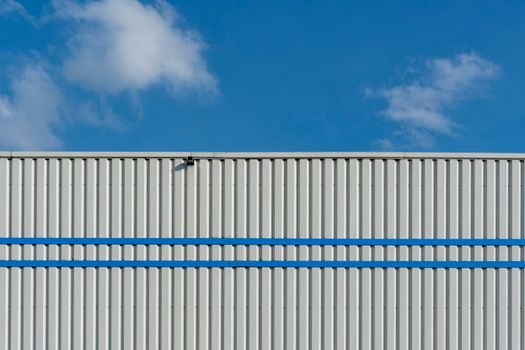
PU sandwich panels carry out-of-plane loads through composite action: the bonded metal skins develop the bending stiffness while the foam core transmits shear, and typical published physical properties list compressive strength 1 kg/cm² (≈ 0.1 MPa), bending strength 2–2.5 kg/cm², shear strength 2 g/cm², and a modulus of elasticity around 20 kg/cm² for the foam itself [S3]. Those foam-only numbers are low, but the composite panel rating is dominated by the 0.4–0.6 mm steel skins, which is why PU sandwich panels are routinely used as cladding and roofing on light-gauge steel-frame industrial buildings rather than as load-bearing walls [S8].
ALC panels are specified for non-load-bearing internal partitions and external infill only: the manufacturer’s own data sheet for B04–B06 grades caps allowable axial load well below reinforced-concrete limits, and design codes require the surrounding frame (concrete or steel) to carry vertical loads. In partition duty the comparison flips: ALC delivers a rigid, fixable, impact-resistant wall that takes standard wall-hung loads, while a PU sandwich partition is essentially a metal-clad thermal envelope and is rarely used for internal load-bearing. The same load-path logic appears in adjacent spec-first comparisons, e.g. stainless steel sheet vs steel section, where the structural section handles framing and the sheet handles envelope.
Decision Matrix: PU vs ALC on Four Criteria
On thermal insulation per mm, PU wins (λ ≈ 0.022 W/(m·K) vs ALC B04 at 0.10–0.14 W/(m·K)) — pick PU when the wall is in a freezer, clean room, or steel-frame shed with tight λ-targets [S3]. On fire class and partition rigidity, ALC wins (A1 non-combustible, mass 400–600 kg/m³, fixable surface) — pick ALC when the wall is a non-load-bearing fire-rated partition inside a multi-storey frame. On lead time and unit cost, PU sandwich panels ship faster off a continuous line (supply capability 1,000,000 m²/month per major manufacturer) and the minimum order on export channels is typically 1,000 m², while ALC requires autoclave curing cycles of 8–12 hours per charge and longer project-tail delivery [S5][S6]. On site adaptability, ALC is cut on-site with hand tools for service penetrations, while PU panels are factory-cut to length and any field modification compromises the metal skin seal — the comparison that parallels the shrink wrapping machine vs vacuum packaging machine “factory-engineered vs field-configured” split.
Application Fit and Common Failure Modes

PU sandwich panels are the right pick for cold-storage warehouses, freezers, food-processing plants, cleanrooms, poultry houses, prefabricated steel-structure workshops, and any envelope where the wall must be a continuous thermal barrier on a light steel frame [S1][S3]. ALC panels are the right pick for non-load-bearing internal partitions, external infill between structural columns, fire-rated corridor walls, and floors/roofs in residential builds where Euroclass A1 lining is required.
Common PU failure modes: delamination at the skin-core interface if the high-pressure foam mix is off-ratio, condensation on the cold side when the metal skin has no thermal break, and reduced λ-performance if the foam density drifts outside 0.04 ± 0.002 g/cm³ [S3][S6]. Common ALC failure modes: shrinkage cracking at panel joints if the laying mortar and jointing are not per the manufacturer’s detail, water uptake in high-humidity service (ALC is vapour-open and should not be used in direct wet zones), and surface spalling under repeated freeze-thaw if the grade is mismatched to climate. Note that ALC is not a stand-in for a freezer lining: its λ is too high and its moisture behaviour wrong for sub-zero service. The same project-coordination logic that drives motor protection relay selection vs microcomputer protection relay choice in adjacent spec work — e.g. motor protection relay vs microcomputer protection relay — applies here: each panel type handles a defined scope, and a single product cannot cover both.
Selection Rules and Specification Checklist
Use PU sandwich panel when the wall function is (a) thermal envelope on a steel frame, (b) cold-room or cleanroom lining, (c) fast-track project where the 1,000,000 m²/month supply channel matters, or (d) the design λ-target per 100 mm is below ≈ 0.03 W/(m·K) [S1][S6]. Specify the panel to EN 14509 for factory-made self-supporting double-skin metal-faced insulating panels, request λ-value, foam density 0.04 ± 0.002 g/cm³, fire class, and skin steel grade (typical DX51D + Z275 or equivalent).
Use ALC panel when the wall function is (a) non-load-bearing partition, (b) fire-rated compartment wall, (c) wall requiring fixable surface for cabinets and services, or (d) project where A1 non-combustible lining is mandated by code [S1]. Specify the panel to the relevant ALC product standard used in your jurisdiction, with grade (B04/B05/B06), declared dry density, λ-value, and the manufacturer’s joint-and-mortar detail. The 30 mm threshold is the practical spec rule: below 30 mm use foam-cored sandwich, above 100 mm use ALC, and the 30–100 mm band is where the project’s fire strategy and structural frame should decide.
Trackable next signals to watch: (1) PIR core fire-class upgrades reaching Euroclass B-s1,d0 on 100 mm+ panels without mineral wool inserts, (2) ALC grade B03 extensions below 400 kg/m³ for thinner partition partitions, and (3) hybrid systems where a PU sandwich acts as the external cladding over an ALC internal partition, using the sandwich for envelope λ and the ALC for fire-and-mass — a pattern that mirrors the stainless steel sheet vs steel section “two products, one wall” logic.
For component-level specifications, see hmi panel.