
Robotic sortation driven by autonomous mobile robots can shrink the physical sorting footprint by 50–70% and reach operational status in under two weeks, against the multi-month structural install window of a fixed conveyor sorter [S1].
For mid-market 3PLs, e-commerce fulfilment hubs, and parcel volumes in the 5,000–25,000 parcels-per-hour range, the choice between an AMR swarm and a conveyor-based sorting system is now a standard decision node, not a future-tense question [S1][S3].
Core Architectural Difference
A traditional fixed-conveyor sorter moves parcels sequentially along a bolted steel track: each parcel enters an induction cell, is read by a scanner, and is diverted to a chute or destination by a cross-belt, tilt-tray, or shoe-sorter actuator [S1][S4].
An AMR sortation layout replaces that single path with a fleet of self-navigating mobile robots that each carry one parcel from a loading station to a drop-off point, running in parallel on an open floor or a two-tier mezzanine [S2][S3]. The two-tier model used at Deppon Express places robots on the upper mezzanine and routes parcels to roll containers on the lower tier via spiral conveyors, with drop-off points distributed across the platform [S2].
That single shift from sequential to parallel processing is the root cause of every downstream trade-off in footprint, redundancy, and peak-hour behaviour [S1][S7].
Throughput: Where Each Architecture Wins
Fixed conveyor sorters remain the throughput king for very high, predictable volumes: cross-belt and tilt-tray systems in express hubs routinely sustain 10,000–20,000 parcels per hour per sorter lane, with very stable behaviour at saturation [S2][S4].
AMR sortation throughput scales linearly with fleet size: each robot handles roughly one parcel trip per cycle, and a Tabu-search assignment algorithm tested against random and closest-assignment rules cut system throughput time by 7.09% and 8.76% respectively, with manual cost reductions of 11.99% and 17.50% [S2]. In a real-world case study on the same architecture, throughput time dropped about 25% and manual cost about 16% versus the legacy assignment rule [S2].
The penalty shows up at sustained peak: as robot density rises, aisle congestion and queuing at drop-off points become the bottleneck, so AMR layouts are typically specified below the throughput ceiling where a conveyor sorter would saturate [S2][S7].
Footprint, Density, and Vertical Stacking
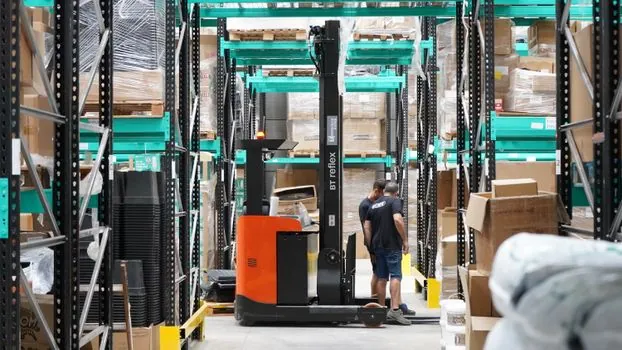
Swarm AMRs can fold sortation into vertical multi-level smart racks, which is the mechanism behind the 50–70% footprint reduction cited by integrators, and the reason mid-market 3PLs can defer facility expansion [S1].
Conveyor sorters demand a single-level induction-to-chute geometry, with the physical chute count limiting destination density; expanding destinations means cutting into the floor and rewiring the divert lanes, which is expensive once commissioned [S1][S4].
For brownfield sites with low ceilings, irregular column grids, or shared tenant space, the vertical AMR layout often reclaims usable square metres that a conveyor matrix simply cannot use [S1][S3].
Redundancy, Resilience, and Single Points of Failure
A conveyor sorter is a single point of failure by construction: one jammed belt or failed divert actuator can halt the whole line, and Mean Time To Repair is bounded by mechanical access and spare-parts inventory [S1].
An AMR fleet degrades gracefully: when one robot drops out, the Warehouse Control System re-routes the remaining units around the failed node with no hard stop, and the system continues to function at reduced capacity [S1][S7]. This is a material advantage for sites with mixed labour shifts, uneven inbound volume, or no on-site controls team.
The trade-off is software complexity: the robotic control system plus the WMS or WES link is what generates the shortest routes, and that integration effort is a real capex line item, not a free option [S7].
Deploy Time, Capex Shape, and Use-Case Fit

Conveyor sorter installations typically run 3–9 months from purchase order to first parcel sorted, dominated by structural steel, permitting, and electrical build-out [S1][S4].
AMR deployments are quoted at under two weeks for the fleet rollout once the floor is mapped, with capex weighted toward robot count, fleet management software, and charging infrastructure rather than civil works [S1][S3]. This shifts cost from a one-time capital spike to a more modular spend, which fits operators scaling volume in stages [S1].
Use-case fit is clear: AMRs suit operations with parcel mix dominated by boxes and lightweight packages under roughly 30 kg per item, with destination counts in the tens to low hundreds, and where order profiles shift weekly [S6]. Conveyor sorters win on heavy, uniform parcels, destination counts in the hundreds, and saturating peak lanes where every metre of induction belt must run flat-out [S2][S4].
Comparison Matrix: Decision Criteria Side by Side
Across four binding criteria, the two architectures split predictably: peak throughput per lane favours the conveyor sorter at 10,000+ parcels/hour, while footprint, deploy time, and breakdown resilience all favour AMR sortation [S1][S2][S4].
On capex shape, conveyor sorters front-load spending on steel and divert actuators, while AMRs spread cost across a robot fleet and software licences that can be expanded in tranches [S1][S7]. On integration, AMRs require a live link between the robotic control system and the WMS or WES, and conveyor sorters need only scan-and-divert commissioning against the WCS [S7].
Operators running express hub cross-dock with 1,000+ daily destinations and a 70/30 peak-to-average ratio should still spec a conveyor sorter; operators running 3PL or e-commerce fulfilment with 30–200 destinations and a 2x peak-to-average ratio will see faster payback on AMR sortation [S1][S2][S4]. For a deeper dive into related automated storage equipment, see this stacker crane cycle comparison which uses the same throughput-vs-flexibility framing.
Limitations and Failure Modes

AMR sortation has three known weak spots. First, battery endurance: most sorting robots run 8–12 hour shifts with opportunity charging, so a poorly sized charging pool will throttle the whole fleet. Second, aisle congestion at high robot density, which is why fleet size is the lever integrators tune most carefully. Third, parcel weight and dimension constraints: the typical AMR cell tops out around 30 kg and roughly 600×400 mm in deck plan, so non-conforming parcels must be pre-sorted out [S6][S7].
Conveyor sorter limitations are well documented too: jam-induced downtime, fixed chute geometry, and high changeover cost when destination sets shift. The strategic question is which set of failure modes your operation can absorb more cheaply [S1][S4].
Watch in 2026: integrators rolling out denser top-module configurations (conveyor top, lift top, tugger top) on standard AMR chassis, which extends the addressable parcel mix without a new robot platform; and the emergence of tighter WMS-native routing APIs that reduce the RCS-to-WMS integration tax flagged by operators [S7].