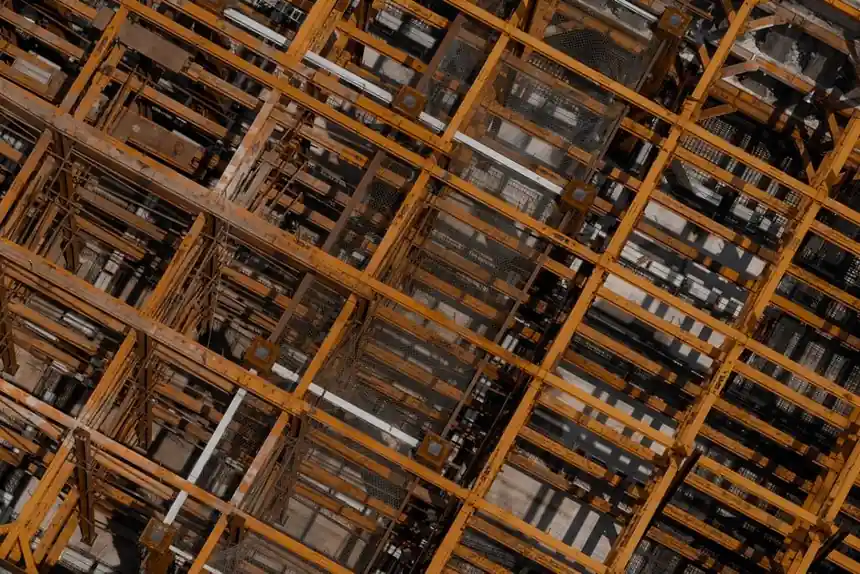
An AMR-led goods-to-person cell runs on free LiDAR/SLAM navigation with no floor hardware, while a stacker crane AS/RS bolts to a fixed rail and pulls from racking it physically owns.
The two architectures solve the same problem, "bring the bin to the operator", with completely different cost, density, and adaptability profiles, and the right pick depends on SKU count, ceiling height, order variability, and brownfield constraints rather than brand loyalty.
Where Stacker Cranes Still Beat a Free-Roaming AMR Fleet
Stacker cranes handle vertical storage up to roughly 40 m in standard miniload builds, with the SSI SCHAEFER RackBot (an AMR-shuttle hybrid) reaching 11.5 m picking height and triple-deep storage in narrower aisles than a conventional crane can manage [S5]. Conventional unit-load cranes pair with racking that defines the storage envelope, so footprint is fixed and aisle widths are engineered to a few millimetres of clearance, giving the highest storage density in the comparison [S2].
Cycle times on single-deep miniload cranes regularly fall under 10 s per single-cycle retrieve when dual devices are deployed in the same aisle, a result documented in 2026 dual-device miniload throughput analyses and tied to regenerative braking on the hoist and travel axes [S4]. A gantry crane over a fixed grid takes that concept further into very long, very heavy pallet loads, but the principle is the same: rails and racking define repeatability.
Where an AMR Goods-to-Person Cell Wins on Throughput per Operator
AMRs run SLAM-based free navigation, so adding a robot adds capacity without civils work, and a failed unit does not block an aisle the way a stalled crane does [S1]. SSI SCHAEFER's RackBot handles up to 9 bins per tour across 8 onboard trays plus 1 on the load handling device, with payload options up to 30 kg or 50 kg per bin, and a working temperature window of 0 to 45 degrees Celsius [S5].
That multi-case-handling math is the core reason AMR G2P cells out-pick fixed-crane cells on variable orders: the robot batches 6 to 9 picks per trip instead of one bin per crane cycle. The Conveyco Stacker-Bot and similar AMR-AS/RS hybrids apply the same pattern to higher-density tote stacks, retrieving into the same pick-station footprint while keeping the shuttle fleet independent of any single aisle [S6].
Comparison Matrix: Four Decision Criteria
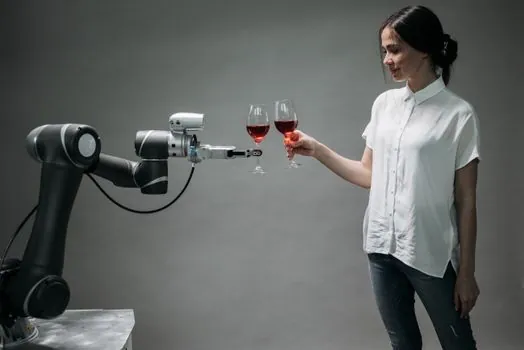
Four decision criteria separate the two, and the table below condenses the trade-offs that warehouse engineers actually score on a vendor RFI:
1. Footprint density: a fixed-rail stacker crane plus its racking delivers the highest storage density per square meter, especially above 10 m, and is the right pick when floor cost dominates. 2. Adaptability: an AMR robot cell reconfigures around seasonal SKU changes, returns handling, and cross-docking without civils; the crane cannot. 3. Per-bin throughput: a single-deep miniload crane returns a single bin in under 10 s on a dual-device aisle, while an AMR tour of 6 to 9 bins spreads that travel time across more picks, so per-bin latency is comparable but per-operator throughput is higher on the AMR side [S4][S5]. 4. Scalability: adding AMRs is a capex line item, while a new crane aisle is a structural expansion project with associated racking, conveyors, and WCS re-commissioning [S1][S7].
Selection Criteria That Push Engineers Toward One Side or the Other
SKU count is the first gate. Below roughly 1,000 active SKUs in a single temperature zone, a single-aisle miniload stacker crane remains the lowest-cost-per-pick, and single-deep versus double-deep crane choice locks in access-versus-density trade-offs that cannot be reversed without a racking rebuild. [S4]
Order profile is the second gate. If average order line count per pick is one to two and throughput targets are predictable, the crane wins on consistency. If order profiles swing between single-line replenishment and multi-line e-commerce picks, the AMR fleet absorbs that variance because robots can be reassigned mid-shift. Swisslog's 2026 shelf-to-person comparison frames this as a robotics-versus-fixed-aisle decision, with shelf-to-person AMRs prioritising flexibility over the raw density a crane aisle delivers [S7].
Use Cases That Map Cleanly to Each Architecture
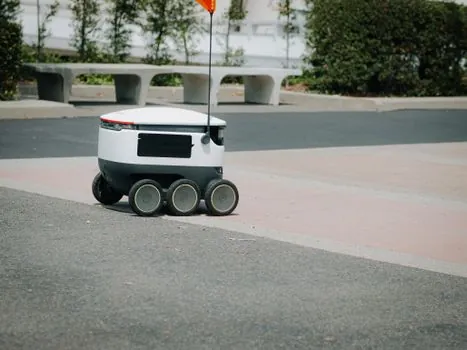
Pharmaceuticals, micro-fulfilment, and spare-parts operations under roughly 10 m ceiling height tend to ship rackbot- or shelf-to-person AMR cells because the operator brings the rack, not the robot, and aisle width for an AGV-class vehicle is around 70 cm rather than the crane's rail gauge. Coolyne's 2026 AS/RS guide notes that shuttle-based AS/RS can lift parallel handling capacity by stacking more vehicles in the same aisle, a hybrid pattern that closes the gap with single-aisle cranes without giving up the free navigation that AMRs need [S4].
Cold storage, pallet reserve, and high-bay finished-goods buffers stay on the crane side. Ceiling height above roughly 12 m, deep-lane pallet reserve, and ambient temperatures outside the 0 to 45 degree Celsius AMR window, including frozen and chilled zones, are best served by fixed-rail stacker cranes, and Crane-side dual-device miniload throughput math shows that two cranes in one aisle keep the per-bin cycle time in single-digit seconds while doubling peak dispatch.
Integration Reality: WMS, WCS, and Pick-Station Footprint
Both architectures need the same upstream stack: a warehouse management system that issues tasks, a warehouse control system that schedules equipment, and PLCs that drive the hardware, so integration cost is roughly comparable on a greenfield site. The difference shows up at the pick station: a crane cell needs a fixed conveyor or lift at each end of the aisle, while an AMR cell can deliver racks or totes to any free station and rebalance as queues form [S4].
KNAPP positions its AMR solutions specifically for facilities that want to scale internal transport without modifying the building, a useful framing for brownfield projects where the existing racking, fire-compartmentation, and floor loading were not designed for a 40 t stacker crane [S1]. In greenfield builds with no ceiling constraint, a hybrid where AMRs feed a crane-served reserve zone often scores best on total cost per pick.
Trackable Signals for the Next Planning Cycle
Three engineering signals to watch through 2027: published AMR payload ratings above 50 kg per bin with multi-case tours still above 6 units, stacker crane dual-device miniload cycle times staying under 10 s with regenerative braking on both axes, and vendor disclosures of WCS hand-off latency between AMR fleet managers and crane-dispatch schedulers. Two of those three numbers already appear in 2026 OEM documentation and will tighten as more sites go live. [S2]