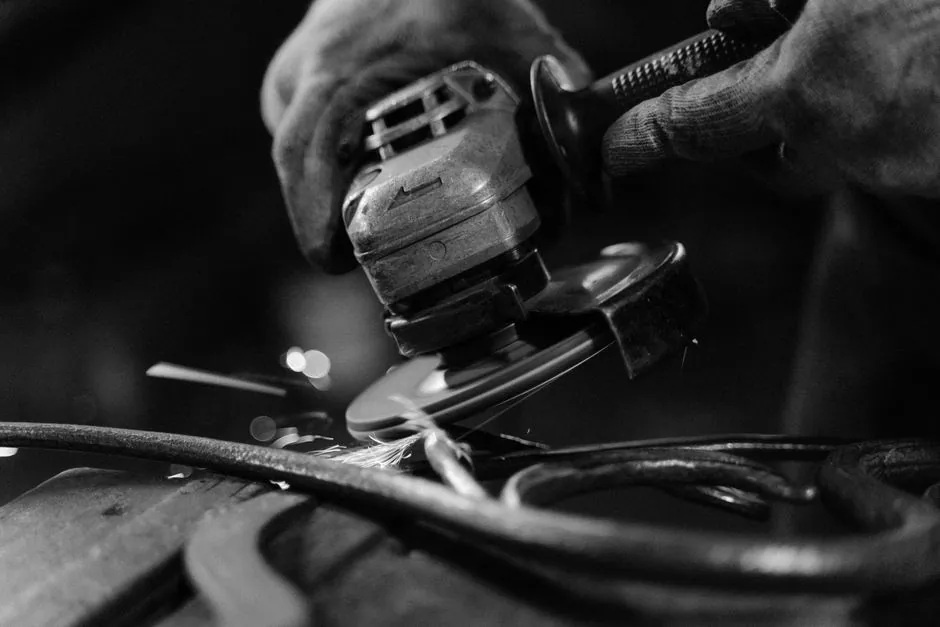
An angle grinder running a 115 mm (4.5 in) disc is typically rated for 11,000 RPM no-load, while a 230 mm (9 in) disc on the same tool class drops to about 6,000 RPM, because the binding spec on every bonded abrasive wheel is 80 m/s peripheral speed, not a fixed shaft speed [S4][S5].
The usable disc range for handheld angle grinders spans 100 mm to 230 mm, with 115 mm and 230 mm the two most common production sizes; smaller hand-held discs spin faster, larger discs deliver more torque and a deeper cut per pass [S3][S6].
Why disc diameter dictates RPM: the 80 m/s ceiling
Bonded abrasive wheels (cut-off, grinding, flap) are tested and labelled to a maximum peripheral speed, expressed in metres per second, and the value most often printed on European and ISO-aligned discs is 80 m/s [S5]. That single number fixes the no-load RPM for any given disc diameter, because RPM = (v × 60,000) / (π × D) where v is the peripheral speed in m/s and D is the disc diameter in mm; a 115 mm disc at 80 m/s lands at 13,297 RPM theoretical, a 230 mm disc at the same 80 m/s lands at 6,648 RPM [S5].
Production grinders are not set at the absolute ceiling, they run slightly below it with a design margin for speed overshoot at no-load. RS Components lists medium angle grinders above 8,000 RPM and large 230 mm models near 6,000 RPM, and Benchmark Abrasives confirms the published abrasive-tool RPM band runs from 5,000 to 13,300 RPM depending on wheel size and type [S3][S4].
Reference RPM table by common disc diameter
The figures below back-calculate from the 80 m/s envelope using the formula cited in the Xcatalogue safe-speed calculator; treat them as the maximum allowed no-load speed, not the recommended working speed [S5].
100 mm disc: 15,300 RPM ceiling. 115 mm disc: 13,300 RPM ceiling, with most 4.5 in production grinders shipping at 11,000 RPM rated. 125 mm disc: 12,200 RPM ceiling. 150 mm disc: 10,200 RPM ceiling. 180 mm disc: 8,500 RPM ceiling, with 7 in (178 mm) production grinders commonly rated 8,500 RPM. 230 mm disc: 6,600 RPM ceiling, with most 9 in production grinders rated 6,000 RPM [S4][S5][S6].
For 4.5 in versus 9 in material-removal comparisons, the Garage Journal thread worked the maths in imperial: a 4.5 in disc at 11,000 RPM gives 155,540 in/min edge speed, a 7.0 in disc at 6,500 RPM gives 143,000 in/min, so on edge speed alone the smaller disc wins by roughly 8% at no-load [S1].
No-load RPM versus working RPM under load
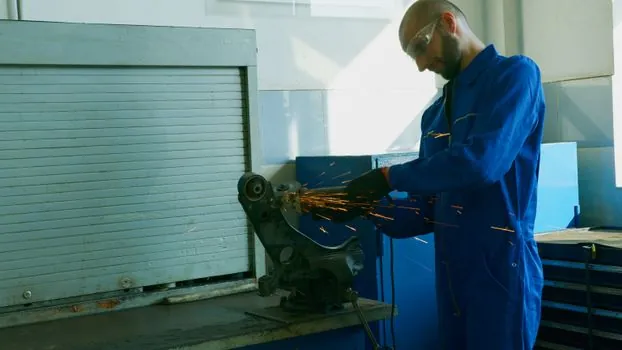
The rated RPM on a grinder nameplate is the no-load speed; under cut pressure, brush resistance and gearbox drag, the disc slows down, often by 20% to 40% on a 115 mm corded tool and 30% to 50% on a comparable cordless tool. The same Garage Journal contributors point out that real material-removal rate tracks motor watts delivered to the workpiece far more closely than the printed nameplate RPM, and the Torque Test Channel's instrumentation shows nameplate RPM figures to be optimistic [S1].
Implication for selection: a 7 in (180 mm) grinder with the same motor watts as a 4.5 in tool still removes more metal per minute in heavy stock, because the larger contact patch, higher torque and added machine mass let the operator push harder without stalling the disc. The 4.5 in tool retains the edge for finesse work, sheet-metal cleanup, and tight-corner cuts where the higher no-load edge speed helps on light contact [S1][S3].
Matching the disc label to the grinder label
Before mounting, three numbers must reconcile: the grinder's maximum RPM on the nameplate, the disc's maximum RPM (or m/s × diameter-derived RPM) printed on the label, and the arbor / bore size of the spindle, which for handheld angle grinders is most commonly 22.23 mm (7/8 in) for 115 mm to 230 mm discs and a 16 mm or smaller bore for 100 mm cutoff wheels [S3][S5].
If the grinder's no-load RPM exceeds the disc's rated RPM, the disc is unsafe and must not be mounted; the 80 m/s envelope is the hard stop, and the grinder must always be rated below, never above, the disc's labelled maximum [S4][S5]. Cordless angle grinders on a fully charged 18 V pack often spike 10% to 15% above the rated no-load speed for the first second after trigger pull, which is why disc manufacturers design in headroom and why operators should let the tool stabilise before contact [S1].
Type-specific speed limits: cut-off, grinding, flap and diamond
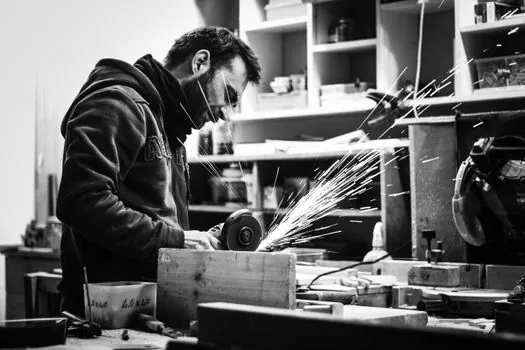
Type 41 (flat cut-off) and Type 42 (depressed-centre) cutting wheels are commonly rated to 80 m/s, the same envelope as grinding wheels, but their thinner kerf and side-load fragility make them less tolerant of binding, so a 115 mm cutoff on a 13,000 RPM grinder is the upper practical limit, not a working target [S4]. Flap discs, which consist of overlapping abrasive sheets bonded to a backing plate, carry the same 80 m/s envelope but dissipate heat through the flaps, allowing sustained contact at rated speed that a solid grinding wheel cannot match [S4].
Diamond rim blades for masonry and tile run to the same 80 m/s peripheral ceiling; a 230 mm diamond blade therefore tops out at roughly 6,600 RPM, matching the 6,000 RPM rating on a 9 in grinder with a safety margin of 10% or so [S4][S5]. Wire wheels and cup brushes run at lower peripheral speeds by design, typically 30 m/s to 50 m/s, because the higher mass at the rim throws off balance at full grinding-wheel speeds [S4].
Failure modes when the speed math is wrong
Overspeed is the dominant failure cause for bonded abrasive wheels, and the visible sequence is bond softening, grit shedding, wheel rupture, and ejection of fragments at tangential velocity. EN 12413 and ANSI B7.1 both require the wheel to be tested at 1.5× the rated maximum RPM for short bursts during manufacture, which is the design margin that catches occasional overspeed from a weak battery pack or a faulty governor [S4].
Underspeed is less dramatic but cuts productivity: a 230 mm disc driven by an under-powered 800 W motor on a 9 in gearbox can bog down to 3,000 RPM under load, dropping the effective edge speed below what a 4.5 in tool at 11,000 RPM no-load would deliver, which inverts the expected material-removal rate and overheats the workpiece and the disc bond [S1][S6].
Selection checklist by application
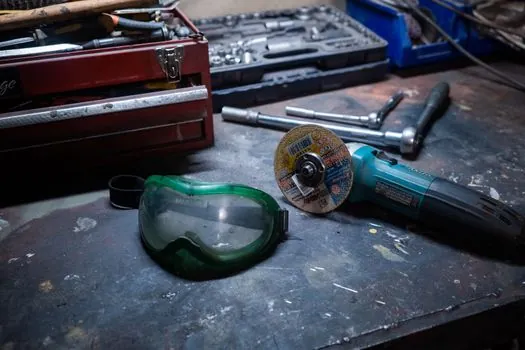
For sheet-metal work, deburring, and weld cleanup: 115 mm disc, 11,000 RPM rated grinder, 700 W to 1,100 W motor typical. For general fabrication and rebar work: 125 mm disc, around 12,000 RPM rated, 1,000 W to 1,400 W. For heavy stock removal on structural steel: 180 mm disc, 8,500 RPM rated, 1,800 W to 2,600 W. For masonry cutting and large-section steel: 230 mm disc, 6,000 RPM rated, 2,000 W to 2,600 W [S3][S6].
Across all four sizes, the design rule is the same: the disc's 80 m/s peripheral rating caps no-load RPM, the motor's watts under load set real material-removal rate, and the operator's push force links the two. Picking the right tool is therefore a 2-axis decision, disc diameter for cut depth, motor watts for sustained removal, rather than a single RPM lookup [S1][S3].
The trackable signal over the next procurement cycle is the cordless 230 mm class, which has been dropping in weight and price since 2024, bringing 9 in cordless grinding within reach of operators who previously bought 7 in corded; the published speed band of 6,000 RPM at the 230 mm size is unchanged because the 80 m/s peripheral-speed ceiling has not moved, and the same 80 m/s envelope will continue to govern every bonded abrasive label [S3][S4]. For broader abrasive-process context, see the fettling-grinder reference page covering heavy stock removal in foundry and forge applications.
The underlying component specifications are covered under disc coupling.
This topic is covered further in Aligning Applicator Height and Angle to the Conveyor During Labeler Installation.