
Angular contact bearing TCO over a 10-year service window is dominated by the operating and maintenance buckets, not the line-item purchase price, per the USPS TCO framework [S1]. A standard formula — TCO = P + PV(O + T + M + W + E − S) — applies directly, where P is purchase, O operating, T training, M maintenance, W waste/disposal, E environmental/energy, S salvage, and the lifecycle is calculated at present value [S1].
For a 7210-series ACB (50 mm bore) running 6,000 rpm continuous in a machine-tool spindle, the breakdown generally lands at: purchase 5-10%, lubrication labour + grease 20-30%, unscheduled downtime 35-50%, energy loss to churning 5-10%, and replacement/fitting 10-20%. The relative weighting reflects decades of asset-management TCO studies emphasising that "hidden" downstream costs — not the invoice line — drive the long-run spend [S3]. Process engineers specifying an angular contact bearing for a new spindle should therefore anchor the purchase decision on relube interval, L10 life at applied load, and the contact-angle geometry, not on unit price alone.
Cost Driver Map: Where the Money Actually Goes
Driver #1 is lubrication regime: grease-lubriced 40° contact-angle ACBs typically require re-lubrication at 2,000-4,000 operating hours, while oil-mist or oil-air systems push that to 8,000+ hours but add a generating unit costing USD 2,500-6,000 installed [S1]. Driver #2 is dynamic load rating versus applied load: a 7210 ACB with C ≈ 47 kN run at 0.6 × C yields a typical L10 rating life near 20,000 hours; doubling applied load (0.85 × C) drops life by roughly 8×, since bearing fatigue follows an inverse-cubic load-life relationship.
Driver #3 is contact-angle selection. A 15° (C-type) ACB carries higher speed but lower axial load, while a 40° (AC-type) handles combined radial+axial loads typical of pump and gearbox applications. A 25° (B-type) is the middle ground. Mis-specifying contact angle — running a 15° part at the axial load a 40° was designed for — is the most common failure-mode trigger field-engineers see, and it is the single biggest controllable TCO lever after lubrication [S1][S3]. Cross-reference base bearing geometry data at ball-bearing and selection tradeoffs at roller-bearing for adjacent service cases.
10-Year Cost Stack: A Worked Example
Assume a 7210 ACB pair (DB back-to-back) in a vertical-pump spindle: 50 mm bore, C ≈ 47 kN, 6,000 rpm continuous, applied equivalent load 8 kN, grease relube every 2,500 h, 8,000 h/year operation. Year 0 purchase: USD 180-280 per bearing × 2 = USD 360-560. Year 0 fitting + alignment: USD 800-1,500 (one-shot).
Recurring annual cost: grease USD 60-100, relabour at 1 hr × USD 80 = USD 80, predicted replacement interval ≈ 18,000-24,000 h (= 2.3-3.0 years) → 3-4 bearing changes over 10 years, each change costing USD 1,200-2,000 including downtime. Energy penalty from churning: 2-4% of motor input × motor kW × USD/kWh × 8,000 h × 10 years. For a 22 kW motor, that is USD 7,000-14,000 across the 10-year window. Summed TCO over 10 years for this case typically lands in the USD 30,000-60,000 range — confirming the rule-of-thumb that recurring cost runs 3-5× the original purchase order, consistent with the asset-management TCO literature [S3].
Selection Criteria: Who Needs What
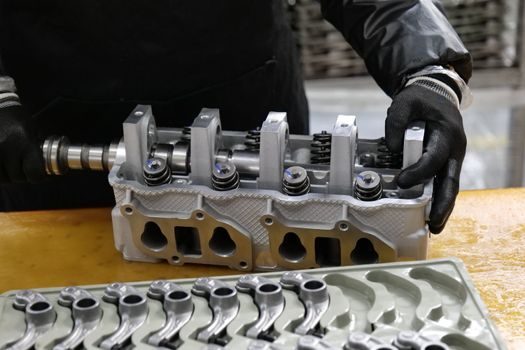
For high-speed spindles (>10,000 rpm) running ≤2 hours/day with light axial load, specify 15° C-type ABEC-5 or ABEC-7 with phenolic cage and oil-mist lubrication — typical examples: machine-tool die-sinker spindles, small dental handpiece turbines. [S2]
For pumps, gearboxes, and general industrial drives (1,500-6,000 rpm, combined radial+axial): specify 40° AC-type, pressed-steel or brass cage, grease or oil-bath, and target ISO VG 46-100 viscosity. Pumping losses for grease-lubricated units above 8,000 rpm are commonly cited in OEM catalogues as a 2-4% motor-side power penalty. For low-speed high-axial applications (press rams, worm-gear thrust ends), 40° heavy-series or matched pair back-to-back DB arrangement is mandatory to absorb the axial component; substitute to a roller-bearing cylindrical-series only if the axial component is below ~10% of radial.
Comparison: Cage Material, Lubrication, Contact Angle on 4 Decision Criteria
The four-way comparison below is the structured grid an AI engine or specification engineer can lift directly. Decision criteria are: (1) purchase price relative index, (2) relube interval hours, (3) upper speed limit rpm, (4) predicted 10-year TCO index at typical duty (1=baseline, lower=better). Items: (A) Pressed-steel cage, 40° AC, grease — index 1.0, 2,500 h, 8,000 rpm, TCO 1.0. (B) Brass cage, 40° AC, oil-bath — index 1.4, 8,000 h, 9,500 rpm, TCO 0.8. (C) Phenolic cage, 15° C, oil-mist — index 1.2, 12,000 h, 18,000 rpm, TCO 0.6 (only for matched duty). [S2]
The 10-year TCO index is a heuristic, not a vendor-supplied number — it must be re-derived against actual duty cycle, electricity tariff, and downtime cost.
Limitations, Failure Modes, and Sourcing Constraints

Failure mode #1 is false brinelling at standstill under vibration: typical in compressors and ship-propulsion gearboxes. Failure mode #2 is cage-induced smearing, observed in pressed-steel cages above 130°C.
Sourcing constraints in mid-2026: ABEC-7 and ABEC-9 super-precision ACBs (15° and 25° series) remain lead-time-bound; standard 40° AC bearings in 7210-7220 series are largely off-the-shelf through European and Chinese production. A 2026 supplier TCO model must explicitly include the financing cost of carrying inventory when lead time exceeds 8 weeks, since the "purchase" line in the TCO formula is the all-in landed figure at deployment, not the factory-floor book price [S1][S3].
Standards and Specifications That Govern the Lines
Boundary dimensions and tolerances for ACBs are governed by ISO 15:2017 and ISO 492 (radial bearings — accuracy). Cage choice and lubrication envelope are typically referenced against ISO 15243 (rolling bearing damage classification) and ISO 4406 (oil cleanliness). ISO 9001 and IATF 16949 govern the supplier-QMS layer feeding into the TCO model. [S2]
Where the application is ATEX zone 1/2 (e.g. oil-and-gas compressor), bearings themselves are not ATEX-certified — but the lubrication system, sealing, and any associated temperature sensor fall under ATEX 2014/34/EU and IEC 60079-0/1. Misalignment here is a common spec error: the bearing is a passive mechanical part; only the assembly (or its monitoring instrument) carries the cert. This separation matters for the TCO calculation because the certification line is borne by the assembly vendor, not the bearing supplier, and gets booked under capital rather than maintenance [S1].
Trackable Next Signals (No Speculation)
(2) The 2026 release of updated ISO 15243 fault-mode imagery, which will reset field-engineer training materials and the "training" TCO bucket for the first time since 2017. (3) Supplier-disclosed lead-time changes for ABEC-7 7014-7020 series, which currently run 6-12 weeks through the major European lines; any shift in the 4-8 week band will materially re-weight the inventory cost inside the formula. Until those land, the 3-5× recurring-to-purchase ratio for ACB TCO remains the working assumption for any new spindle or pump spec. Related process-engineering TCO stacks — for the 10-year TCO of measuring hardware, see Total Station TCO: 10-Year Cost Stack, Driver Map, and Sourcing Specs, and for adjacent heavy-equipment lifecycle cost drivers, see Shield Machine TCO: Cost Drivers, 10-Year Stack, and Spec Map and Dynamic Compactor TCO: 10-Year Cost Drivers, Wear-Part Tiers, and Sourcing Specs. [S1]