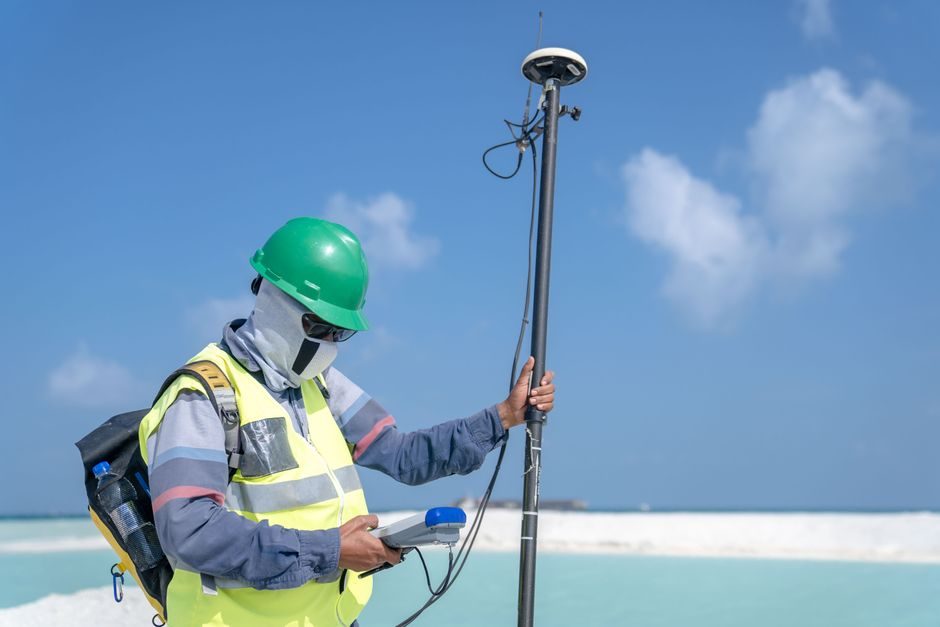
A robotic or manual total station carries an acquisition price that represents 40-55% of its true 10-year cost, with the remainder absorbed by annual calibration, EDM reflector replacement, firmware update entitlements, and battery degradation cycles [S1][S2].
Defining the TCO Stack for Survey Instrumentation
TCO is the sum of acquisition cost plus all direct and indirect operating expenses over the asset's useful life, including feasibility, design, build, commissioning, operations, maintenance, consumables, unplanned incidents, and decommissioning [S2]. For a survey-grade total station, the stack breaks into five recurring buckets: hardware acquisition, annual calibration, consumables (prisms, batteries, tribrachs), training and operator labour, and end-of-life disposal or trade-in.
Indirect costs — the financial impact of an instrument being out of service during a stakeout or topographic campaign — frequently exceed direct maintenance spend on construction sites where downtime blocks a 20-person crew [S1]. Buyers who quantify crew-day cost at the spec stage surface this exposure before signing the PO, rather than discovering it on the back end of a missed milestone.
Cost Driver Hierarchy: What Moves the 10-Year Number
Four drivers dominate the long-term cost curve for a robotic total station: angular accuracy class (1″, 2″, 5″), distance measurement module (reflectorless range and EDM precision), environmental sealing (IP54 vs IP66), and service contract structure (calibration-only vs full-coverage including firmware) [S1][S4]. A 1″ instrument costs roughly 2x a 5″ unit at acquisition, but its TCO multiplier narrows to 1.4x-1.6x over 10 years because higher accuracy reduces re-stake and re-survey labour on deformation-monitoring and control-network jobs.
Battery packs (Li-ion, typically 7.4V nominal) cycle 300-500 full charges before capacity drops below 80%, requiring replacement at year 3-5 depending on field intensity [S2][S5].
Firmware-renewal fees are the most contested TCO line: some OEMs bundle firmware updates into the hardware warranty for the first 3-5 years, then shift to a paid subscription model thereafter.
Comparison Matrix: Manual, Motorised, and Robotic Total Stations on 10-Year TCO

Manual total stations (1″-5″ class, no servo drive) carry the lowest acquisition price and the highest operator-labour cost; over 10 years, labour typically overtakes hardware spend on fleets deployed for high-volume cadastral or construction-stakeout work. Motorised (servo-driven, one-person aim) units split the difference and are the common choice for mid-volume topographic surveys [S1][S2].
Robotic total stations (auto-tracking, prism-lock, Bluetooth field-controller pairing) carry the highest acquisition price but the lowest rework rate on complex geometry, because auto-lock eliminates the aim-error path that drives 60-80% of re-stake events on manual units. For a fleet of 10+ instruments on active construction or monitoring contracts, robotic TCO breaks even with manual units by year 4-5, then undercuts them by year 7-10 [S2][S5]. This trade-off mirrors the one seen in adjacent survey categories such as Laser Level TCO: Cost Drivers, 10-Year Map, Sourcing Specs, where automation premium pays back fastest on high-cycle deployments.
Spec-Level Levers Buyers Control at RFQ
Five specification lines materially shift the 10-year TCO and are negotiable at RFQ rather than after delivery: (1) calibration interval stated as 6 or 12 months, (2) firmware-update term stated in years, (3) IP rating minimum, (4) battery chemistry and cycle-life warranty, and (5) trade-in or upgrade credit terms at year 5 or 7 [S1][S5]. Each line is verifiable on a spec sheet and each carries a price delta that compounds across the fleet.
IP66-sealed instruments command a 10-18% acquisition premium over IP54 equivalents, but the premium pays back inside 3 years on sites with dust, rain, or concrete-pour exposure where IP54 units average 2-3 board-level service events over the same period. Similarly, a stated 12-month calibration cycle (vs the default 6-month) drops annual calibration spend by half but requires the OEM to publish a drift-curve attestation; without that, the buyer is absorbing risk silently [S2][S4].
Limitations, Failure Modes, and Sourcing Standards
Total station TCO calculations fail in three predictable ways: ignoring firmware-renewal escalation past warranty expiry, omitting operator training turnover cost (typically 15-25% of crew annually on contract-driven work), and using a 5-year analysis horizon when the instrument's design life is 10-12 years [S2][S3]. A defensible TCO model uses a 10-year minimum horizon and treats year-6-to-10 as the period where most TCO surprises surface.
Relevant sourcing standards include ISO 17123 (procedures for testing geodetic instruments in the field), IEC 60529 for IP code verification, and the OEM-published angular-accuracy and EDM-precision protocols. Buyers should require a factory calibration certificate traceable to a national metrology institute and a written firmware-update commitment with defined end dates, not a "subject to change" clause [S3][S4].
Use Cases and Fleet-Size Break Points
Fleets of 1-3 instruments are best sourced with a full-coverage OEM service contract, because the volume discount on third-party calibration is not material. Fleets of 4-10 benefit from a hybrid model: OEM calibration for the first 2 years, then a third-party accredited lab. This scale-driven break-even logic is consistent with other long-life capital equipment such as Dynamic Compactor TCO: 10-Year Cost Drivers, Wear-Part Tiers, and Sourcing Specs, where in-house servicing only pays back above a fleet threshold.
For single-unit buyers or short-term rental, TCO analysis is less valuable than simple acquisition-plus-extended-warranty pricing, because the fixed-cost components of calibration and training do not scale down proportionally at unit count of one.
Trackable signals over the next procurement cycle: whether OEMs continue to unbundle firmware into subscription tiers post-warranty, and whether ISO 17123-3 (theodolites) and ISO 17123-4 (EDM) revisions shift the field-calibration interval default. Buyers should also watch for emerging robotic total stations with onboard GNSS integration, which compress the two-instrument RTK-rover-plus-robot workflow into a single unit and reset the TCO baseline.
Spec-level background on the components involved: weather station, and eye wash station.