
Specifying door hardware for K-12 and higher-education buildings collapses to six decision axes: lock grade, lever geometry, fire egress, material/finish, latch type, and classroom lockdown function. The wrong call on any one axis (for example, a knob on an ADA route, or a rim panic device on a non-fire-rated leaf) will fail inspection or lockdown drills.
Because school door sets carry both safety-of-life and daily-abuse loads, selection is not a finishes-and-aesthetics exercise. It is a layered decision: traffic tier first, lock function second, lever geometry third, material fourth, finish and anti-microbial coating fifth. The sequence is the same whether the project is a single classroom retrofit or a 2,000-student campus build [S3] (2022-08).
Lock grade and function by opening type
ANSI/BHMA A156.36 Grade 1 and Grade 2 auxiliary locks, and the matching A156.2 lever-and-lockset grades, are the baseline for school exterior and classroom doors; Grade 1 is the higher-cycle rating and is the conservative pick for main entries [S2]. Cylindrical or mortise locksets with a classroom function (F86 in legacy ANSI nomenclature) give a key outside and a thumb-turn inside, which is the configuration used for in-classroom lockdown from inside the room [S2].
Exterior man-doors and high-traffic entries should pair a Grade 1 lockset with a separate heavy-duty deadbolt, since deadbolts give a positive secondary throw and resist jimmying better than a lockset alone [S1]. For classroom security doors, a thumb-turn or push-button interior with a keyhole exterior is the standard pairing; specify the inside trim so it can be operated without a key, a hand, or fine motor control during a lockdown event [S2].
Note: ANSI/BHMA grade numbering and function codes are the conventional shorthand used across the three sources; pin your submittal to the exact A156 series number on the cut sheet. See the broader architectural hardware landscape at architectural hardware for adjacent product families (hinges, closers, exit devices) outside the lockset itself.
Lever geometry, ADA, and child-scale ergonomics
Lever handles with a return feature (the lever curves back toward the rosette) eliminate the snagging risk of a straight lever catching a backpack strap or sleeve, which is a documented injury vector in primary-school corridors [S3] (2022-08). Grip diameter should sit at or below 19 mm so small hands can wrap and pull the lever; larger diameters defeat the geometry for K-2 users [S3] (2022-08).
ADA-compliant lever height, return-to-door clearance, and operable-force limits are non-negotiable for any door on an accessible route. Operable force on interior hinged doors is typically capped at 5 lbf to comply with the ADA accessibility standards; confirm the exact figure against the current ADA Chapter 404 reference on the submittal, not against marketing copy [S2]. Round, radiused lever tips and concealed (in-floor or in-jamb) doorstops remove the trip hazards that floor-mounted stops and sharp lever ends create in busy corridors [S3] (2022-08).
Edge guards on the hinge and latch stiles close the finger-pinch gap between leaf and frame; they are a low-cost add-on that prevents the most common door-related crush injuries in primary schools [S3] (2022-08). For toilet-room and wet-area doors, pair the lever spec with a moisture-rated lockset to keep the spring cartridge from corroding within the first three to five years of service.
Fire-rated egress and panic hardware
Panic exit devices (rim, mortise, and surface vertical rod) are required on any egress door serving an occupancy load that the code path treats as a means of egress; fire-rated exit devices add the listing for use on a labeled fire door assembly [S2]. For schools, the practical rule is: any door on the egress path that also serves as a security door needs a fire-rated exit device, not a plain panic bar, so the listing does not get voided by the wrong listing label [S2].
Single-action egress is the operative principle: a mortice lockset that opens with one downward lever movement from the inside, even when the outside cylinder is locked, is the safest match for a child occupant during evacuation [S3] (2022-08). Pair the exit device with a door closer set to meet the closing-force and opening-cycle tune that the labeled assembly was tested for; an oversized closer voids the fire label and an undersized closer leaves the door propped open in normal use.
Electrified hardware (EL latch retraction, electrified lever trim, request-to-exit sensors) integrates with access control but must be listed for the same fire door as the mechanical base. Specify the exact UL 10C or NFPA 252 listing reference on the hardware schedule, since the AHJ will check it at sign-off [S2].
Material, finish, and anti-microbial surface
Stainless steel (typically 304 or 316 grade for corrosive interior pools, science labs, or coastal sites) and solid brass are the two material families that survive the constant-touch, high-abuse school duty cycle [S2]. Solid brass is softer and develops a patina, so specify it where appearance matters more than scratch resistance; stainless is the default for corridors, washrooms, and science rooms [S2].
Anti-microbial coatings (silver-ion or copper-infused finishes such as Agion or equivalent) reduce bacterial colonization on high-touch levers and push plates; in K-2 and healthcare-adjacent school settings (nurse's office, special-needs suites) this is a real hygiene input, not a marketing bullet [S3] (2022-08). Color-coded or themed finishes for lower-grade corridors add wayfinding value (e.g. year-group color) without breaking the base material spec [S3] (2022-08).
Self-lubricating hinge and closer components cut the annual maintenance hours per opening; on a campus of 200+ doors this is the difference between a dedicated hardware tech and a quarterly service walk-through [S2]. Specify ball-bearing or continuous-geared hinges on high-traffic exterior doors so the door does not sag within the first five years.
Access control, classroom lockdown, and electrified options
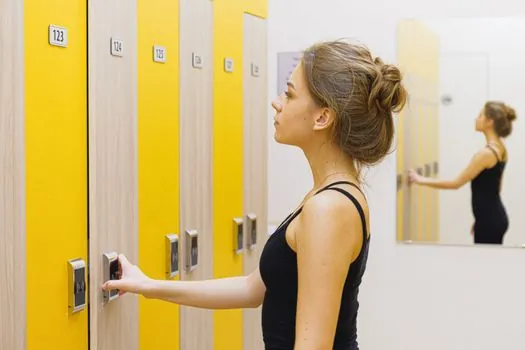
Electronic access control (card readers, keypads, BLE mobile credentials) on main entries, admin suites, and science wings gives administrators revocable access without re-keying; the electrified lockset or strike must match the door's fire listing or the listing is voided [S2]. Classroom lockdown hardware layers onto the mechanical lockset: an inside thumb-turn or push-button, an outside key override, and (optionally) a remote lock-down signal from the front office or a teacher fob [S2].
Magnetic mortice locks with no projecting latchbolt eliminate the snagging hazard that a standard latchbolt creates at child-head height (typical classroom lock centers sit around 1100 mm above finish floor, exactly where a small child's face or eye is on the closing side) [S3] (2022-08). Latchless magnetic latches are not a code substitute for the fire-rated latch on a labeled fire door; use them on non-fire-rated classroom and corridor doors only [S3] (2022-08).
Card reader and electrified hardware typically add 250-600 USD per opening above the mechanical base, with electrified panic devices on the high end. Budget the electrified count on the door schedule, not as a late change order, since the wiring pathway (conduit in the frame, low-voltage power supply, network switch port) is set during wall and frame shop drawing review [S2]. For more on the broader mechanical-and-electrical spec dance across a campus build, see this walkthrough of spec-anchored product selection across adjacent building systems in PVC-U pipe selection for hospital plumbing, which covers the same submittal-discipline problem in a different product family.
Decision matrix: hardware by opening type
The matrix below lines up the four main door tiers in a typical school against the six selection axes. Use it to drive the hardware schedule before finish selection, not after [S1] [S2] [S3].
Failure modes and inspection pitfalls

The four most common spec failures on school hardware submittals are: (1) a knob lockset on an accessible route, which fails ADA; (2) a non-fire-rated exit device on a labeled fire door, which voids the door listing; (3) an oversized closer that breaks the labeled closing force and speed, which also voids the listing; (4) a missing edge guard or finger-pinch guard on classroom doors, which the AHJ increasingly flags during safety inspections [S2] [S3] (2022-08). Each of these is a one-line correction on a submittal log, but a re-fabrication if it reaches the installer.
Anti-microbial coatings and color-coded finishes are not code-required and should be listed as "value-add" on the schedule, not as substitutions for the required material grade. If a substitution is unavoidable, file it as a formal substitution request with the specifier before ordering; verbal "or equal" approvals are a common source of late-stage delivery delays on school projects [S3] (2022-08).
Trackable signals for the next review cycle: ANSI/BHMA's periodic A156 series updates, the next ADA Chapter 404 revision, and the model code adoption cycle in your specific state (IBC and NFPA 101 cycle together roughly every three years). Pin the exact edition on the cover sheet of the hardware schedule so the AHJ's edition and the specifier's edition cannot drift apart.
Spec-level background on the components involved: building pipe hardware, and pressure transmitter.