
ASTM A820/A820M defines five steel fiber types for fiber-reinforced concrete (Type I cold-drawn wire, Type II cut sheet, Type III melt-extracted, Type IV mill cut, Type V modified cold-drawn wire), all sharing a 345 MPa (50,000 psi) minimum average tensile strength and a 10% length/diameter tolerance, with fibers required to survive a 90-degree bend around a 3 mm (1/8 in.) rod without fracture [S1][S3].
The classification is by manufacturing route rather than by application, so performance differences between types come from geometry, surface deformation, and base material, not from the standard itself [S7]. The current revision in wide circulation is A820/A820M-22, while the 2016 edition remains the historical reference cited in most specifications [S1][S8].
What the five types actually are
Type I fibers are produced by cold-drawing steel wire, a process that work-hardens the section and typically yields higher tensile strength than other routes, with suppliers such as Sika positioning Novocon CHE in this category for that reason [S4]. Type II fibers are slit from cold-rolled sheet steel into rectangular strips, which gives a flat cross-section that bonds differently to the cement matrix than round drawn wire [S2][S3].
Type III covers melt-extracted fibers, where a molten steel disc is spun and shaved to form crescent-shaped, variable-thickness fibers. Type IV covers mill-cut fiber produced from steel bar or billet slice stock, and Type V is a modified cold-drawn wire with enhanced end anchorage or surface deformation, sold as deformed steel fiber for industrial slabs and pavements [S3][S5][S6].
Mechanical property rules that apply to every type
ASTM A820 requires every lot of steel fiber, regardless of type, to meet three baseline mechanical criteria: an average tensile strength of at least 345 MPa (50,000 psi), the ability to be bent 90 degrees around a 3 mm (1/8 in.) mandrel without breaking, and dimensional tolerances of plus or minus 10% on specified length and diameter (or equivalent cross-section dimension) [S1][S3].
These floors apply across the classification, so a Type I cold-drawn wire and a Type V modified cold-drawn wire must both clear the same 345 MPa bar and pass the same bend test, the only type-specific variable being the forming process and the resulting geometry. Because the standard sets the bar at the same altitude for all five routes, performance ranking in practice depends on aspect ratio, end-hook geometry, and dosage, not on the type label [S7].
Type I vs Type II: the comparison that comes up in every spec meeting
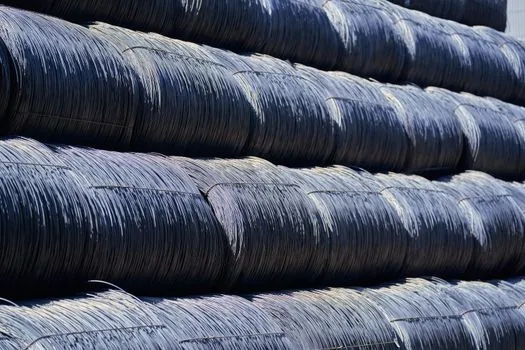
On tensile capacity, Type I cold-drawn wire typically outperforms Type II cut sheet because drawing strain-hardens the steel, raising yield and ultimate strength; Type II starts from annealed sheet stock and inherits a lower base strength before any work hardening [S2][S4]. On bond behavior, Type II rectangular sections develop mechanical interlock differently than round Type I fibers, and deformed versions of either type can match or exceed undrawn alternatives at the same dosage [S7].
On cost and lead time, Type I cold-drawn wire is the more common commodity in the U.S. market for industrial floor and tunnel applications, while Type II cut sheet tends to be specified where flat geometry is wanted, for example in thin overlays or where pumpability is a concern [S2][S3]. For a direct head-to-head at equal dosage, the standard itself does not rank them, and Concrete Fiber Solutions states outright that the belief that Type I always outperforms Type II is a myth [S7].
Types III, IV, and V: where each fits
Type III melt-extracted fibers are irregular, crescent-shaped, and produced as a by-product-style geometry, generally specified in refractory and shotcrete applications where the rough surface and variable cross-section improve mechanical anchorage in the matrix [S3]. The melt extraction route produces a fiber whose tensile strength sits at the A820 minimum because there is no subsequent drawing step, so designers typically compensate with higher dosage or longer fiber length [S3].
Type IV mill-cut fiber is sliced from bar or billet stock, giving a rectangular cross-section similar in concept to Type II but starting from heavier gauge material; it is common in heavy industrial pavement and precast where thicker cross-sections help with impact and abrasion [S3]. Type V modified cold-drawn wire is the modern workhorse for industrial floors and pavements, where the drawing step provides the 345 MPa-plus tensile floor and the modification (end hooks, flattened ends, or other deformations) raises pull-out resistance [S6]. For the underlying fiber reinforcement physics, see the steel fiber reference page, which covers aspect ratio, critical fiber volume, and post-crack behavior common to all five types.
What the standard does not cover
ASTM A820 is a material specification: it sets fiber property floors, dimensional tolerances, sampling, and bend/tensile test methods, but it does not specify dosage, fiber length for a given application, or structural design values [S1][S3]. Dosage is typically expressed in kg/m3 (or lb/cy) and converted from volume-based callouts in the specifier's mix design, while structural use of fiber-reinforced concrete in slabs on ground follows ACI 360R-10, and composite steel deck slabs follow SDI C-2011 [S3].
A820 is also agnostic to corrosion resistance, alkaline attack, or surface coating. Stainless steel, galvanized, and other coated fibers fall under the same type classifications but require additional specification text for the coating system and any associated testing, since the standard's tensile and bend requirements apply to the finished fiber regardless of substrate. For broader fiber-reinforcement context covering polymer and macro-synthetic alternatives, the concrete fiber reference is the right starting point.
Selection map: which type to specify when
For industrial slabs, distribution centers, and composite metal deck, Type V modified cold-drawn wire is the default because it combines the 345 MPa-plus tensile floor with deformed ends that raise post-crack load capacity [S6]. For shotcrete and refractory linings, Type III melt-extracted gives the rough surface and irregular anchorage that suit those matrices, with dosage used to recover the strength that melt extraction does not deliver [S3].
For thin overlays and tight-radius pumping where flat geometry helps, Type II cut sheet is a fit; for heavy precast or pavement where thicker cross-section and impact resistance dominate, Type IV mill-cut covers that brief [S2][S3]. Type I undrawn round wire remains a cost-driven commodity choice where bond is not critical and the specifier is comfortable relying on the 10% dimensional tolerance and the 345 MPa minimum [S4][S7]. In all cases, the specifier should reference ACI 360R-10 for slabs on ground and SDI C-2011 for composite deck, since A820 covers the fiber, not the design.
For an example of how an adjacent reinforcement standard handles a different product class, the ASTM A1035 Grade 100 vs Grade 120 comparison walks through the same kind of grade-by-strength selection logic, but for low-carbon chromium rebar rather than steel fiber. A useful cross-standard fiber comparison is the carbon fiber reference, which highlights where steel and carbon fiber reinforcement split on modulus, density, and corrosion behavior.