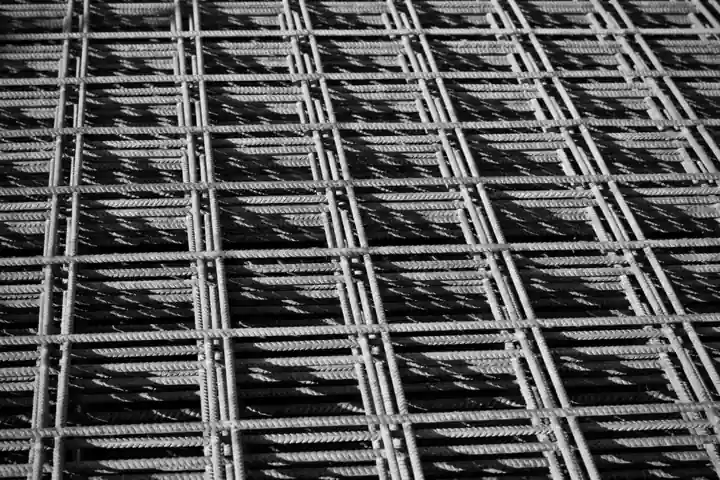
ASTM A1035/A1035M-23a is the governing standard for low-carbon, chromium, deformed and plain steel bars for concrete reinforcement, and it defines only two minimum yield-strength levels: Grade 100 [690 MPa] and Grade 120 [830 MPa] [S3]. Both grades share a 150,000 psi [1030 MPa] minimum tensile strength, a minimum 0.2% offset yield, and the same 7% elongation requirement on bar designations #3 through #11 [S4]. Selecting between the two is therefore not a chemistry question, it is a strength, congestion, and code-acceptance question.
Three alloy types (CL, CM, CS) are layered on top of the two grades, with chromium content the only meaningful chemical split: CL 2.0-3.9% Cr at 0.30% max C, CM 4.0-7.9% Cr at 0.20% max C, and CS 8.0-10.9% Cr at 0.15% max C [S4]. A1035CS is what most engineers mean when they talk about ChromX 9100/9120; A1035CM maps to ChromX 4100/4120; A1035CL maps to ChromX 2100 series [S2]. For a primer on standard rebar sizing and grade conventions, the cascade of ASTM specs reads chronologically from A15 through A615 and A1035 [S1].
Mechanical Properties: Where 100 and 120 Actually Diverge
Grade 120 raises the minimum yield by 20% over Grade 100, from 100,000 psi [690 MPa] to 120,000 psi [830 MPa], while the minimum tensile strength stays flat at 150,000 psi [1030 MPa] for both [S3][S4]. That compresses the tensile-to-yield (T/Y) ratio: A1035 specifies a T/Y minimum of 1.25 across both grades, contrasted with ASTM A615 Grade 100 at a 1.15 T/Y ratio [S4]. The practical effect is that Grade 120 retains a wider safety margin past yield than A615 Grade 100, even though both share the same 150 ksi tensile floor.
Elongation requirements are identical at the bar-size level: 7% minimum in 8 in. [200 mm] for #3 through #11 bars, and 6% minimum for the larger #14, #18, and #20 designations [S4]. The standard explicitly carries a Note 1 cautioning that welding "should be approached with caution since no specific provisions have been included to enhance its weldability" [S3]; that warning is a hard ceiling on fabrication assumptions regardless of which of the two grades is ordered. A standard rebar bender works on A1035 stock the same way it works on A615, but field welding parameters do not.
Chemistry Bins: CL, CM, and CS Are Not Strength Grades
The three alloy types are corrosion bins, not strength bins. CL (ChromX 2000) is positioned at "about twice the service life of black bar at an economic price," CM (ChromX 4000) is the "direct substitute for epoxy or galvanized rebar" in moderate corrosion, and CS (ChromX 9000) targets "severe corrosive environments caused by seawater, aggressive soils and deicing salts," with a 100-year service life target on infrastructure [S4]. The carbon ceiling drops as chromium rises, from 0.30% max C in CL to 0.15% max C in CS, which is what allows CS to carry the higher chromium without forming the carbide networks that drive galvanic corrosion [S1][S4].
AASHTO M 334M/M 334-17 raises the chromium floor for highway-grade CS to a 9.2% minimum [S2]. For bridge and highway work, that effectively narrows the CS window to 9.2-10.9% Cr, and it is the chemistry bin that matters for selection, not the grade. A 4100 (CM, Grade 100) bar in a parking deck and a 9120 (CS, Grade 120) bar in a coastal bridge substructure are both "A1035," but the engineer is buying two different things.
Quantitative Comparison: Grade 100 vs Grade 120
The CMC ChromX FAQ puts a concrete number on the material savings: "Using Grade 100 or Grade 120 reinforcing steel can reduce rebar requirements from 20 – 40 percent" relative to conventional Grade 60 design [S2]. That 20-40% range comes from the higher allowable steel stress permitted in flexural design. Grade 120 sits 20% above Grade 100 in yield; the bar count reduction between Grade 60 and Grade 100 is in the 30%+ band on a typical beam, and pushing to Grade 120 compounds the savings only where the design is strength-limited, not deflection- or fatigue-limited.
Here is the side-by-side, as the spec actually reads:
• Yield strength: 100,000 psi [690 MPa] for Grade 100; 120,000 psi [830 MPa] for Grade 120 [S3].<br/>• Tensile strength: 150,000 psi [1030 MPa] minimum, identical for both grades [S4].<br/>• T/Y ratio minimum: 1.25 for A1035 both grades, vs 1.15 for A615 Grade 100 [S4].<br/>• Elongation (#3-#11): 7% minimum for both [S4].<br/>• Available alloy types: CL, CM, CS in both grades [S3].<br/>• Material reduction potential vs Grade 60: 20-40% per CMC [S2].
The interesting cross-grade move is substituting Grade 120 for Grade 100, which gains another 20% yield but does not change the tensile ceiling. Where that pays off is in confinement ties, column longitudinals at high axial load, and top reinforcement on long-span flexural members where congestion is the controlling limit state. The Cascade Steel presentation shows a 100 ksi [690 MPa] confinement tie at #5 @ 4 in. vertical spacing replacing a 60 ksi [420 MPa] tie at #5 @ 2-1/4 in. [S1], which is the same 20% yield gain in a different geometry.
Code Acceptance: Where the Two Grades Are NOT Equivalent
ACI ITG-6R (2010) is the design guide explicitly written for "Use of ASTM A1035/A1035M Grade 100 (690) Steel Bars for Structural Concrete" [S1]. AASHTO LRFD Bridge Design Specifications, 7th Edition (2014), and AASHTO MP 18M/MP 18-09 cover bridge use of Grade 100 [S1]. Grade 120 is not covered by those 2010/2014 documents under the same title; ACI 318 and AASHTO LRFD clauses that permit A1035 Grade 100 do not automatically extend to Grade 120 without project-specific approval.
For buildings, ACI 318 and the IBC (2009, 2012, 2015, 2021) are the governing design references, and ChromX documentation specifically calls out "ACI 318 and IBC 2009, 2012, 2015 and 20..." as the compliance basis for Grade 100 [S2]. Designers specifying Grade 120 should expect a special-provisions review on most state DOT and building-department submittals, and should pre-clear with the building official on member types. The standard itself flags that the largest bar size, No. 20 [64], "may require approval of the building official or other appropriate authority" [S3], which is a useful proxy for how aggressive the spec is on the upper end.
Selection Rules of Thumb
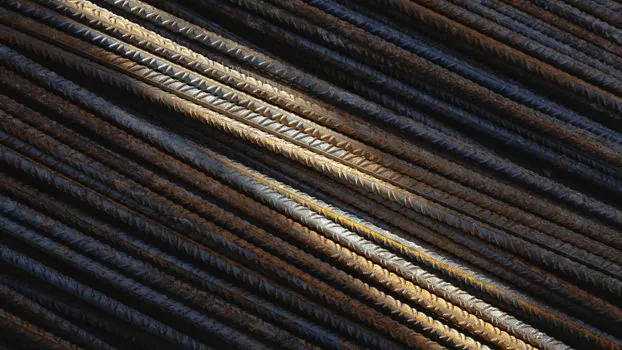
Specify Grade 100 when the design is ACI 318-19 / AASHTO LRFD-conforming without project-specific code approval, when welded splices are required in volume, or when chromium corrosion resistance is the primary driver (select CS, CM, or CL for the environment, lock Grade 100 as the strength). Grade 120 fits the same code envelope but with one extra layer of approval friction, so it pays off in member-count-driven projects: high-rise columns, bridge piers with congested bar schedules, and mat foundations where rebar tonnage is a bid-line item. On a standard cast-in-place parking deck with A615 Grade 60 baseline, swapping to A1035 Grade 100 already gets the 20-40% material reduction [S2]; the marginal jump to Grade 120 is justified only when congestion, not steel weight, is the controlling cost.
For mechanical splicing on either grade, the same constraint applies: rebar couplers rated for 100 ksi are common, 120 ksi-rated mechanical splices require explicit manufacturer data. And the chemistry choice (CL/CM/CS) is independent of the grade choice, so a typical spec reads "ASTM A1035 CS Grade 120" for the harshest combination or "ASTM A1035 CL Grade 100" for the lightest-touch budget option. A standard carbon steel rebar specifier moving to A1035 should think of it as two independent dials: a strength dial (100 vs 120) and a corrosion dial (CL vs CM vs CS).
Failure Modes and Field Constraints
The dominant failure mode for A1035 is not yield, it is bond and crack-width serviceability. Because the allowable steel stress is roughly 60 ksi for Grade 100 and 72 ksi for Grade 120, service-load crack widths in flexural members can exceed code limits if the designer keeps the same bar spacing as a Grade 60 design. ACI 318 crack-control provisions govern in either case, but a Grade 120 design at the same bar size and spacing as Grade 60 is more likely to flag a crack-width noncompliance at service loads, particularly on bridge decks and parking structures exposed to chlorides. [S1]
Welding is the second hard constraint. The standard's Note 1 on weldability is not a procedural note, it is a property statement: "no specific provisions have been included to enhance its weldability" [S3]. For typical A615 Grade 60 work, welders run standard E9018 or E11018 procedures. For A1035, the chromium and the martensitic-austenitic lamellar microstructure [S1] change the preheat and interpass rules, and most fabricators will request a procedure qualification record (PQR) specific to the A1035 heat. That adds lead time and cost independent of which of the two grades is selected.
Third, bendability on the larger bar sizes. Supplementary requirement S1 in the standard allows the purchaser to specify bend testing for #14, #18, and the Annex A1 large sizes (#40, #50, #60) [S3]. Grade 120 bends back further than Grade 100 at the same bar size, and field-rebar bending for architectural shapes is easier at Grade 100. The 2014 ASM coverage of ChromX 9000 noted the product line was launched in 2014 with both Grade 100 and Grade 120, so supply is no longer a gating factor at any bar size up to #18 [S7].
Standards, Sourcing, and Trackable Signals
The current ASTM designation is A1035/A1035M-23a, published November 2023, and it is the reference every mill certificate should cite [S3]. The earlier A1035-20 revision is the one most ChromX documentation explicitly names [S2], and a 2019-issued engineering bulletin from MMFX/CMC remains in active circulation as a specifier's quick reference [S4]. ICC-ES ESR-2107 is the evaluation report that Cascade Steel Rolling Mills in McMinnville, Oregon, and CMC Steel in Cayce, South Carolina, both hold for A1035 production [S5], which is the practical answer to "who actually makes this in the US."
For code tracking, the next concrete signals to watch are the ACI 318 and AASHTO LRFD cycles that explicitly reference A1035 Grade 120: until those land, Grade 120 specifications carry special-provisions review overhead even when the mill and chemistry are standard. A second trackable signal is the AASHTO M 334M/M 334 series for low-chromium highway rebar, which currently sits at the 9.2% Cr minimum for the CS-equivalent bin [S2] and tends to be the lead indicator for state DOT adoption. A third is mill-cert language: a 2026-dated A1035 certificate citing A1035/A1035M-23a is the cleanest confirmation that the bar is produced to the current revision.
For related coverage, see Bump cap vs ANSI Z89.1 hard hat: protection level and selection map.