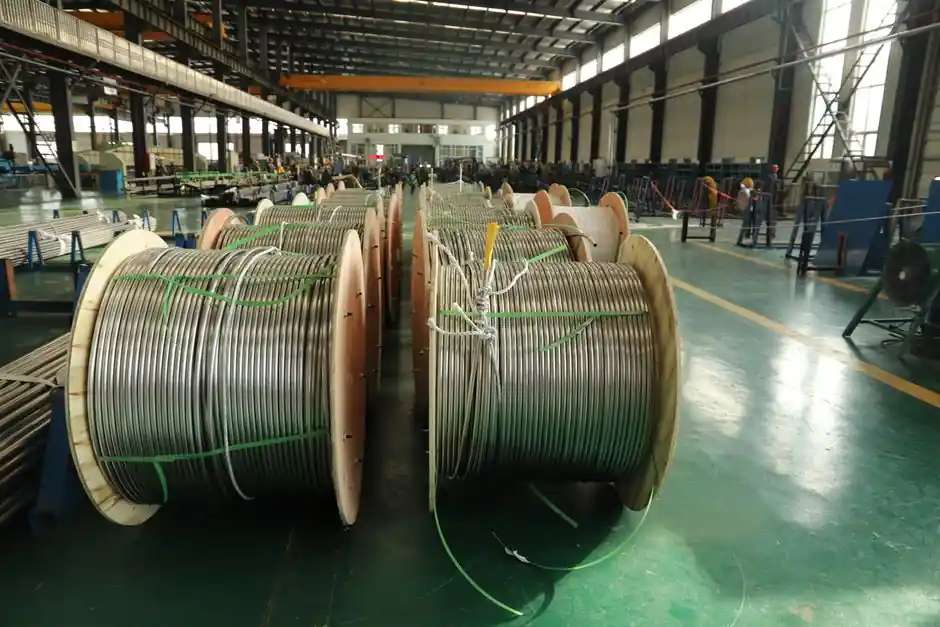
ASTM B159/B159M-17 governs round, square, and flat phosphor bronze wire in three alloys, UNS C51000, C52100, and C52400, for general-purpose and spring applications [S1][S3]. The two workhorse grades, C51000 (Phosphor Bronze 95/5) and C52100 (Phosphor Bronze 92/8), differ in tin content, mechanical strength, and available size range, so the pick depends on whether the part is a current-carrying spring contact or a high-stress coil [S4].
Under B159/B159M-17, rectangular and square wire of either alloy is generally available up to 0.188 in. [5 mm] thick and 1.250 in. [32 mm] wide, while round wire from UNS C51000 is generally available up to 0.500 in. [13 mm] in diameter [S3]. General requirements such as workmanship, sampling, and packaging roll up from ASTM B250/B250M, and rod/bar/shape stock is covered separately by ASTM B139/B139M, not B159 [S2]. For deeper context on copper-tin wire forms, see the tin bronze reference page.
Chemical Composition: Tin and Phosphorus Drive the Difference
The defining chemistry split between the two grades sits in tin, with phosphorus set narrowly as a deoxidizer [S3]. UNS C51000 nominally contains 4.2-5.8% Sn, 0.03-0.35% P, iron to 0.10%, lead to 0.05%, zinc to 0.30%, and copper as the balance [S5]. UNS C52100 raises tin to the 7.0-9.0% window, with iron capped at 0.10%, lead at 0.05%, and zinc at 0.20%, balance copper [S4]. The roughly 3-point lift in tin is what pushes C52100 toward harder tempers and higher strength, while still keeping the alloy within the phosphor bronze family that resists corrosion and stress relaxation.
Because phosphorus acts primarily as a deoxidizer during melt, its residual range is tight (0.03-0.35% for C51000) and the spec does not require it as a strengthening agent [S5]. Tin, in contrast, is the workhorse strengthener through solid-solution and precipitation effects, which is why the two grades are often labelled by the copper-to-tin ratio: 95/5 for C51000 and 92/8 for C52100 [S4]. For spec writing, lock the UNS number first and let the chemistry follow, since naming "phosphor bronze wire" without the UNS designation frequently leads to a C51000 default that may not match the design stress. For related wire-form definitions, the wire rod and cable wire entries cover adjacent forms that are NOT covered by B159.
Mechanical Properties and Temper Selection
Published tensile data for UNS C51000 wire at 2 mm (0.08 in.) thickness gives a usable envelope across four tempers [S5]. In the H01 (¼ hard) condition, C51000 reaches 469 MPa (68 ksi) tensile with 414 MPa (60 ksi) yield and 24% elongation; in H02 (½ hard), tensile climbs to 586 MPa (85 ksi) and yield to 552 MPa (80 ksi) at 8% elongation; in H04 (hard), tensile reaches 758 MPa (110 ksi) at 3% elongation, with a published fatigue strength of 186 MPa (27 ksi); in OS035 (annealed), tensile is 345 MPa (50 ksi) with 138 MPa (20 ksi) yield and 58% elongation [S5].
The tempers published in B159/B159M-17 itself are O61 (annealed), H01 (¼ hard), H02 (½ hard), H03 (¾ hard), H04 (hard), H06 (extra hard), H08 (spring), and H10 (extra spring) [S3]. C52100 is typically specified when H06, H08, or H10 spring tempers are needed at small wire diameters, where C51000 would be on the lower-strength side of the design window. For spring contact or relay applications, the draw wire sensor reference covers the displacement-sensor side, not the spring wire itself, but illustrates why spring temper selection matters for repeatable force.
Availability and Size Range
B159/B159M-17 sets a 0.500 in. [13 mm] ceiling for round C51000 wire and a 0.188 in. [5 mm] by 1.250 in. [32 mm] ceiling for rectangular and square wire in all three alloys [S3]. Round C52100 wire is generally available below that 13 mm ceiling as well, but practical mill stock drops quickly above 5 mm because most C52100 demand is in fine spring wire, not large round. Manufacturer-published ranges track that reality: phosphor bronze round wire is offered from 0.8 to 5 mm, flat wire from 0.30 x 0.05 mm to 4 x 2 mm, and square wire from 0.30 x 0.30 mm to 2.50 x 2.50 mm [S7].
If a drawing calls for round wire above 5 mm in C52100, expect a mill quote rather than off-the-shelf stock, and consider stepping down to C51000 in the larger diameter, or moving to B139/B139M rod/bar form [S2][S7]. For the fine-wire side, both C51000 and C52100 are commonly drawn below 0.5 mm for woven screens, music wire strings, and instrument components, which is one of the standard B159 application buckets [S4].
Selection Decision: C51000 vs C52100 by Use Case
The first decision is service environment. Both alloys are corrosion resistant with high electrical conductivity, low elastic modulus, and high tensile strength, so for general current-carrying springs, electrical contacts, switches, and relays, C51000 in H01-H04 temper is the default and the most cost-effective pick [S4][S5]. The roughly 2% absolute lift in conductivity that C51000 retains over C52100 is small but real, and matters in low-voltage signal paths.
The second decision is stress level. For higher-stress springs, fasteners, and instrument parts where the design needs H06, H08, or H10 spring temper at fine diameters, move to C52100 (8% Sn) to gain tensile headroom without going to the less workable C52400 (10% Sn) [S3][S4]. A 2 mm C51000 wire in H04 already reaches 758 MPa (110 ksi) tensile but only 3% elongation, so any further hardening step typically means switching alloy, not just upping the temper [S5]. For C52100 spring wire in music or relay applications, plan for the higher tin cost and tighter size range rather than assuming a drop-in for C51000.
Cross-Reference to Other Specs and Equivalents
UNS C51000 has a long list of cross-references that procurement teams should align before ordering, including AMS 4720, ASTM B100, ASTM B103, ASTM B139, ASTM F467, ASTM F468, MIL B-13501, MIL W-6712, QQ W321, SAE J461, and SAE J463 [S5]. ASTM B159 is the wire spec, B139 is rod/bar/shapes, B103 is the older flat product, and B250/B250M is the general wrought copper-alloy wire wrapper that B159 invokes for shared sections [S2][S5]. Naming a single spec on the print without the UNS number is the most common error when sourcing across these standards.
Unit discipline is also explicit in B159/B159M-17: inch-pound and SI values are to be regarded separately, and combining values from the two systems may result in non-conformance with the specification [S3]. For design teams working in mixed unit environments, lock to one system per print, then convert at the QA step, not in mid-calculation.
Limits, Failure Modes, and What B159 Does Not Cover
B159/B159M-17 explicitly states that the specification is general and that the product is used for many applications where ordinary mechanical tests do not capture the real operating conditions, so the standard recommends submitting samples or drawings to the manufacturer to adjust temper for the actual application [S3]. That is a working engineer's way of saying: don't expect a one-temp-fits-all solution for a tight-tolerance spring contact. Also, B159 does not cover rod, bar, or shape forms, which are produced to B139/B139M; if a print says "phosphor bronze" without a form, the mill will default to whichever form they stock first, which may not be wire [S2].
For the higher-tin C52400 (10% Sn) grade, the same B159 envelope applies for chemistry and temper, but the working range and formability narrow, and procurement should expect longer lead times than for C51000 or C52100. For decisions on adjacent copper alloy families (brass, beryllium copper, copper-clad steel) the tin bronze page is the right entry point. Trackable signals to watch over the next two quarters: any ASTM B05.02 ballot revising B159/B159M-17 temper tables or chemical limits, and mill-side announcements on C52100 fine-wire capacity, both of which historically move when connector and relay demand cycles shift.
For related coverage, see C5 vs C9 Hydrocarbon Tackifier Resins for Hot Melt Adhesives: Spec Decision Map.