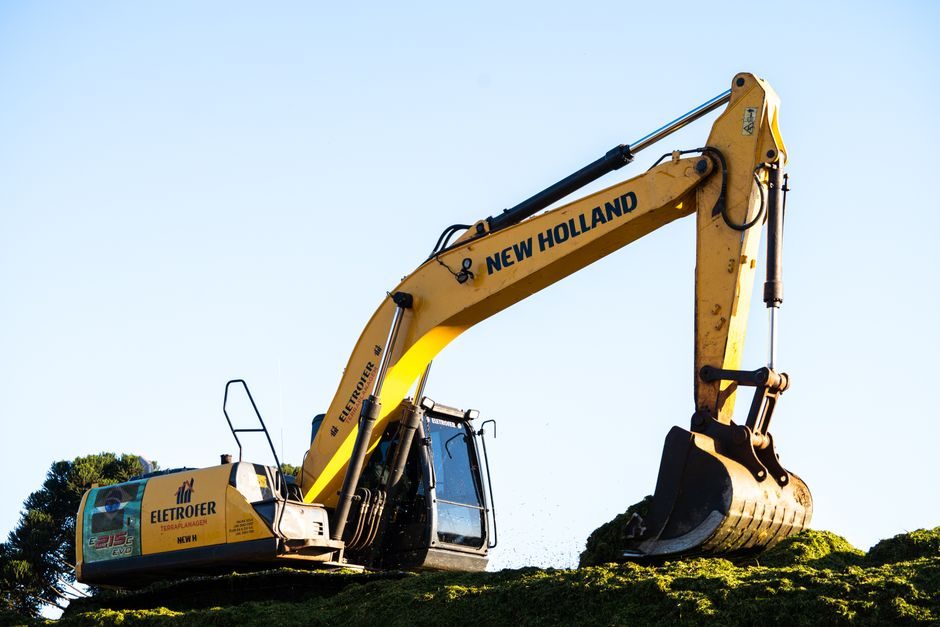
A 70-110 HP backhoe loader with a 14-15 ft dig depth and 7,300-12,200 lbf backhoe bucket force is the practical baseline for light structural demolition, slab breaking and selective interior teardown [S3].
For demolition duty the limiting hardware is the auxiliary-hydraulic tool circuit and the boom geometry, not the loader arm; a public-sector equipment specification requires demolition hammers to deliver a minimum 750 ft-lbf per blow at ≥700 BPM, with the bare hammer mass ≥965 lb and full bench testing before acceptance [S1]. The carrier must feed that hammer with continuous hydraulic flow at the correct back-pressure, which is why machines in the 70+ HP / 13,500-16,300 lb operating-weight band dominate the segment [S3].
70-100 HP Carrier Specs That Match a Demolition Hammer
Spec sheets from the 70+ HP class show operating weights clustered between 13,514 lb (John Deere 310L EP, JCB 3CX Compact) and 16,279 lb (CAT 415), with backhoe dig depths of 14 ft to 14 ft 11 in and backhoe bucket forces from 7,363 lbf up to 12,207 lbf on the CAT 415 [S3]. Loader hinge pins sit at 10 ft 6 in to 11 ft 5 in, and loader breakout force ranges 8,285-12,207 lbf, which is the figure that actually drives how aggressively the front bucket can pop slabs and kerbstones during cleanup phases [S3].
Machines in the 90-110 HP band push operating weights above 8 t, with Komatsu WB97R-2 at 7.5 t / 1.03 m³ bucket, WB93S-5 at 8.55 t / 1.1 m³ and Hydrema 906 E-ESD at 9.2 t / 1.4 m³, the latter being the high-stability end of the segment for breaker work on uneven demo decks [S2].
Demolition Hammer as the Defining Attachment
Specifying the carrier without locking the hammer rating is the most common error: a backhoe loader is a tool carrier, and the demolition hammer is the tool. The South Carolina state procurement specification sets a hard floor of 700 BPM, 750 ft-lbf per blow and 965 lb bare hammer mass, with mandatory on-machine bench testing prior to acceptance [S1]. Anything below that envelope will struggle on reinforced concrete and will over-stress the boom mount on the first sustained production shift.
For pairing decisions, the 70+ HP class delivers 8,285-12,207 lbf of loader breakout, which is the right front-end complement to a mid-size hammer in the 750-1,200 ft-lbf class; the 40+ HP compact class (4,001-9,572 lb operating weight, 4,201-5,825 lbf backhoe bucket force) is only adequate for asphalt breakup and shallow trench rock [S3].
Bucket and Loader-End Configuration for Demo Cleanup
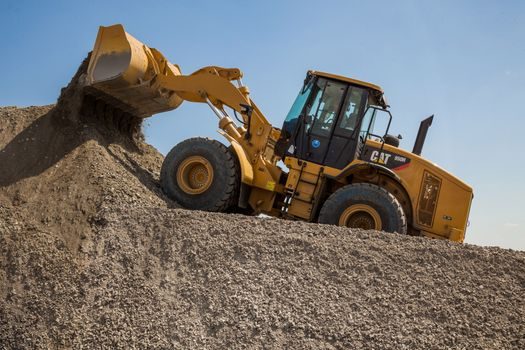
General-purpose loader buckets in this machine class carry 1 to 1.75 cubic yards of material, measure 89-96 in wide, and rate 780-1,470 lb payload, which sets the practical limit on a single cleanup pass after hammer work [S6]. Multipurpose (4-in-1) buckets extend that envelope by allowing the operator to clamp, doze and grade without a tool change, which is the typical ask on selective interior demolition where hammer, bucket and grab cycles alternate inside the same shift.
For a dedicated demolition carrier the wide 89-96 in GP bucket paired with the 11 ft 5 in hinge-pin height on the CAT 415 gives the largest truck-loading envelope in the 70+ HP band; a contractor prioritising reach over payload should look at the JCB 3CX Compact 14 ft 2 in dig depth, accepting the lower 7,363 lbf bucket force as the trade-off [S3].
Application Fit and Limits on Demo Sites
Backhoe loaders are commonly specified for small-scale demolition projects where mobility, single-operator setup and a mixed tool inventory matter more than pure reach or impact energy [S7]. They sit below dedicated excavators in raw demolition productivity, but the combination of a roadable chassis, a front loader and a rear hammer circuit lets one machine replace a skid-steer, a small excavator and a breaker-rig on tight urban or interior jobs.
They are NOT the right pick for: heavy structural collapse on 3+ storey buildings, high-cycle reinforced-concrete bridge demolition, or any scope where the OEM breaker rating would have to be exceeded to maintain production. For those scopes an excavator-based demolition rig sized to the hammer's hydraulic demand is the correct reference architecture; for a broader view of how backhoe loaders compare on the spec map the mining-duty spec map is the closest adjacent article in this catalogue.
Selection Criteria: Carriers vs Demolition Hammers
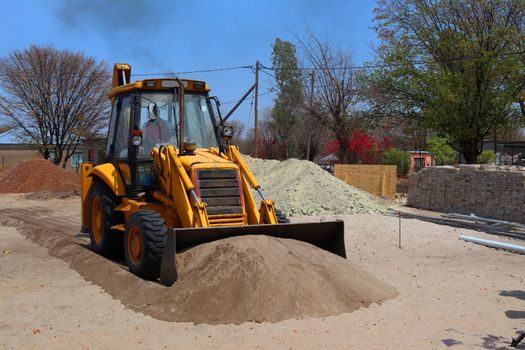
Decision criteria fall into four axes, and the right answer depends on which axis dominates the project: (1) carrier operating weight 13,500-16,300 lb for 70+ HP class, scaling to 8-9 t in the 90-110 HP band [S2][S3]; (2) backhoe bucket force 7,363-12,207 lbf, which sets pop-and-tear productivity [S3]; (3) hammer energy ≥750 ft-lbf per blow at ≥700 BPM with bare mass ≥965 lb, the procurement floor [S1]; (4) hydraulic auxiliary flow and pressure at the rear tool circuit, which is the spec the carrier OEM must confirm before the hammer is bolted on.
A 70+ HP class carrier with an 11,317-12,207 lbf backhoe bucket force and 14-15 ft dig depth is the correct pairing for a hammer at the 750-1,200 ft-lbf class, while a 40+ HP compact carrier (4,201-5,825 lbf bucket force) should only be matched to hammers rated below the procurement floor and only on non-structural scopes [S3]. Larger 90-110 HP / 8-9 t machines (Komatsu WB93S-5 8.55 t, Hydrema 906 E-ESD 9.2 t) extend the upper limit of stable hammer mounting on uneven demo decks [S2].
Standards, Sourcing and Verification Trail
Public-sector procurement documents remain the most reliable baseline for hammer acceptance criteria; the South Carolina attachment-H specification requires 700 BPM minimum, 750 ft-lbf per blow minimum, 965 lb bare hammer mass minimum, and on-machine functional testing before delivery is accepted [S1]. Manufacturer and rental-fleet spec aggregators confirm the 70+ HP class envelope: 13,514-16,279 lb operating weight, 14-14 ft 11 in dig depth, 7,363-12,207 lbf backhoe bucket force, and 10 ft 6 in to 11 ft 5 in loader hinge-pin height on representative CAT, John Deere, JCB and CASE models [S3]. Independent spec databases such as LECTURA back the 90-110 HP / 8-9 t carrier band with Komatsu WB97R-2, WB93S-5 and Hydrema 906 E-ESD operating weights and bucket capacities in the 1.03-1.4 m³ range [S2].
For full backhoe-loader architecture and option taxonomy, the backhoe loader reference entry in this catalogue lists the structural variants and OEM naming conventions; for projects that overlap earthmoving and demolition the skid-steer loader spec map is the natural complement when a smaller, more manoeuvrable carrier is needed for interior phases. Verify any hammer's flow/pressure demand directly against the carrier OEM's published auxiliary-hydraulic curve before committing to a spec line; this is the single most common cause of under-performing demo rigs.
Spec-level background on the components involved: demolition hammer.