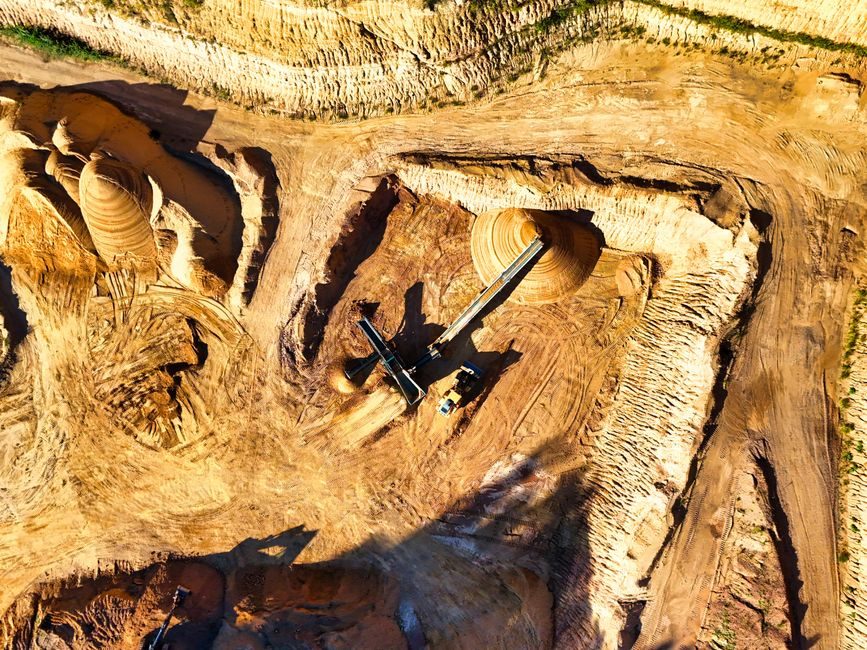
Backhoe loaders in mining are auxiliary support machines, not primary loading tools, and procurement specs should reflect that role [S5][S6].
For pit-floor support around haul trucks in the 90–160 t class, a 70+ HP backhoe with ≥14 ft dig depth, ≥7,000 lbf backhoe bucket force, and a reinforced front bucket is the realistic minimum [S2][S3].
What "backhoe loader for mining" actually means in 2026
Backhoe loaders in mining sites handle drainage trenching, bench clean-up, ramp grading, and small-scale shot-rock loading — they are not matched against 90–160 t haul trucks as primary loading tools [S6].
Komatsu loading-tool guidance pairs dedicated mining shovels (12–50 m³ bucket class) with 85–240 t trucks, leaving backhoe loaders to support the periphery, not the face [S6]. The mining-rated backhoe offered on Made-in-China carries a 1.0 m³ loader bucket, 2,500 kg rated load, and 7,600 kg total weight — sized for utility work, not face loading [S3]. JCB's 3DX Plus Stage V backhoe is also positioned as an adaptable support unit across mining, quarry, and infrastructure tasks, not a primary production machine [S8].
Engine power and powertrain floor: 70+ HP class
Engines below 70 HP (40+ HP class: Kubota B26 24.3 HP, Kubota L47 47.1 HP, JCB 1CXT 49 HP) are too light for sustained mining support work and are oriented to landscaping and farm duty [S2].
At the 70+ HP floor, the CAT 415 delivers 70 HP at 16,279 lb operating weight with 14 ft dig depth and 12,207 lbf bucket force; the John Deere 310L EP and JCB 3CX Compact at 74 HP weigh 13,514 lb with 14' 2" dig depth and 7,363 lbf bucket breakout; the CASE 580N EP at 74 HP reaches 14' 11" dig depth with 11,317 lbf bucket force and a 6,503 lb loader lift rating [S2]. Tier 2/Tier 3 diesel offerings in this class (CAT 3054C, C4.4) span 68.5–74.5 kW gross per SAE J1995, with net power at 2,200 rpm per SAE J1349 ranging 64–70 kW [S4]. A mining-duty Chinese-built unit offers engine options from 70 kW (Weichai) to 82 kW (Cummins) and 74.9 kW (Deutz) [S3].
Selection criteria: dig depth, breakout force, structural reinforcement
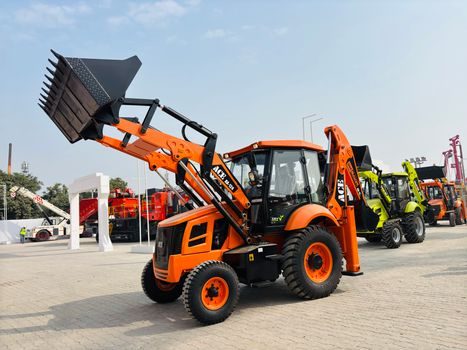
Backhoe dig depth should be ≥14 ft to reach drainage sumps and bench toe without repositioning; the CASE 580N EP at 14' 11" and the 90+ HP class push deeper, while 40+ HP units cap out at 14' 2" (Kubota M62TLB) [S2].
Backhoe bucket force is the structural limit that drives production in hard digging: the CAT 415 at 12,207 lbf and CASE 580N EP at 11,317 lbf sit well above the 7,363 lbf baseline of the 310L EP / 3CX Compact, and reinforced bucket options (heavy-plate, wear-resistant cutting edge) are specified on mining-rated offerings [S2][S3]. Loader-side breakout force on the 70+ HP class ranges 8,285–12,207 lbf; the CAT 415 ties its backhoe and loader breakout at 12,207 lbf, which simplifies cycle-time modeling when the same machine faces mixed duty [S2]. Procurement specs commonly require hydraulic power steering, an electric quartz shock-proof hourmeter readable to 9,999.9 hr, and an electronic monitoring system covering at minimum fuel level and engine hours [S1].
Cycle math: how a backhoe supports a haul-truck fleet
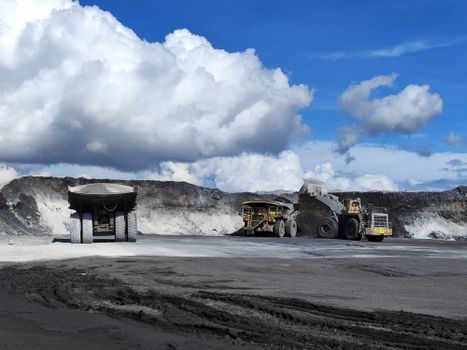
Wheel-loader payload should be sized to 50–85% of truck payload for optimal cycle matching when a loader is the primary tool — and a backhoe loader cannot fill that role on a 90–160 t truck, which expects a 12 m³+ mining shovel bucket [S5][S6].
Where the backhoe adds value is peripheral cycle work: trenching, ramp spot-loading, fines cleanup. Correct load distribution on similar utility-class machines has been shown to improve average cycle speed by 5.2% per cycle, a gain that compounds across multi-shift operation [S5]. On a 1.0 m³ loader bucket with 2,500 kg rated load (the mining-rated Chinese unit), realistic shift output is dozens of tonnes — three orders of magnitude below a 12 m³ mining shovel paired with a 90–160 t truck [S3][S6]. The 110+ HP class extends dig depth and lift further; smaller classes (40+ HP, 4,001–9,572 lb) are reserved for landscaping and farm duty and should not be specified for any mining role [S2].
Operating envelope and structural limits
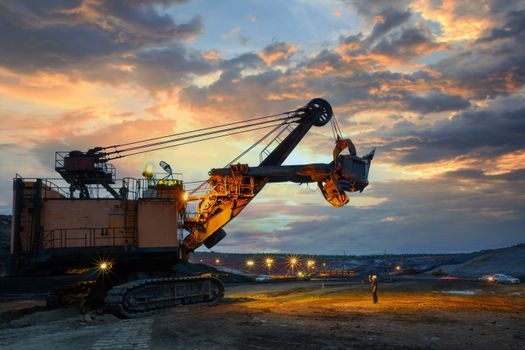
Tipping load at full dump height is the structural ceiling that defines a loader's rated capacity, and the backhoe loader's loader lift capacity (6,503 lb on the CASE 580N EP, 6,730 lb on the CAT 415) is two orders of magnitude below a mining wheel loader sized to a 90–160 t truck [S2][S5].
Travel speed ≥40 km/h, wheelbase 2,180 mm, and overall dimensions 7,440 × 2,350 × 3,450 mm on the Chinese mining-rated unit reflect a roadable utility machine, not an off-road production loader [S3]. For comparison, a CAT R1700G underground loader is built to a 3,680 mm wheelbase, 11,207 mm overall digging length, and 4,412 mm height — purpose-built for confined hard-rock tramming at production rates far above a backhoe [S7]. Procurement specifications should require a sealed, shock-proof engine monitoring package, foot and hand throttles, and hydraulic power steering as baseline operator-station features for any backhoe going onto a mine site [S1].
Who should NOT specify a backhoe loader for mining
If the application is primary face loading on 90–240 t trucks, the backhoe loader is the wrong tool — a dedicated hydraulic mining excavator (12–50 m³ bucket) or a mining shovel is required [S6].
Underground hard-rock production tramming is a job for purpose-built LHDs like the R1700G class, with overall digging length >11 m and tramming geometry designed for confined headings, not a roadable backhoe loader [S7]. Buyers who need long-haul stockpile building at high cycle rates should look at wheel loaders with payload sized 50–85% of the haul truck, with the structural envelope and powertrain built for that duty cycle, not a 7,600 kg backhoe with a 1.0 m³ bucket [S3][S5]. For comparison with other support equipment classes, see this road roller selection map for agricultural field prep and this urban-infrastructure roller spec map.
Recommended spec profile and decision checklist
Baseline: 70+ HP class minimum (74 HP preferred), operating weight ≥13,500 lb, dig depth ≥14 ft, backhoe bucket force ≥11,000 lbf, loader breakout ≥10,000 lbf, and a reinforced front bucket option [S2][S3].
Engine: Tier 2/Tier 3 diesel in the 68.5–74.5 kW gross (SAE J1995) band, with documented net power at 2,200 rpm per SAE J1349 [S4]. Operator station: hydraulic power steering, foot and hand throttle, electronic monitoring covering fuel and engine hours, shock-proof quartz hourmeter to 9,999.9 hr [S1]. Match the spec to duty: 70+ HP for pit-floor support, 90+ HP when dig depth must exceed 15 ft, and reject 40+ HP units (4,001–9,572 lb, 24.3–63 HP) outright for any mining role [S2]. For a broader utility-equipment context relevant to mining-site concrete and slab work, this concrete fiber spec map covers the material side of supporting infrastructure.
Trackable signals for the next planning cycle: monitor whether JCB's 3DX Plus Stage V emits a hard-rock mining variant in 2026, and watch for Chinese OEM announcements of a 90+ HP mining-rated backhoe with 1.5 m³+ bucket capacity above the current 1.0 m³ ceiling [S3][S8]. For related heavy-equipment procurement frameworks, this concrete release agent selection map and this overhead conveyor spec map for cold chain show how spec-driven selection is applied in adjacent industries.
Spec-level background on the components involved: backhoe loader, mining dump truck, and wheel loader.