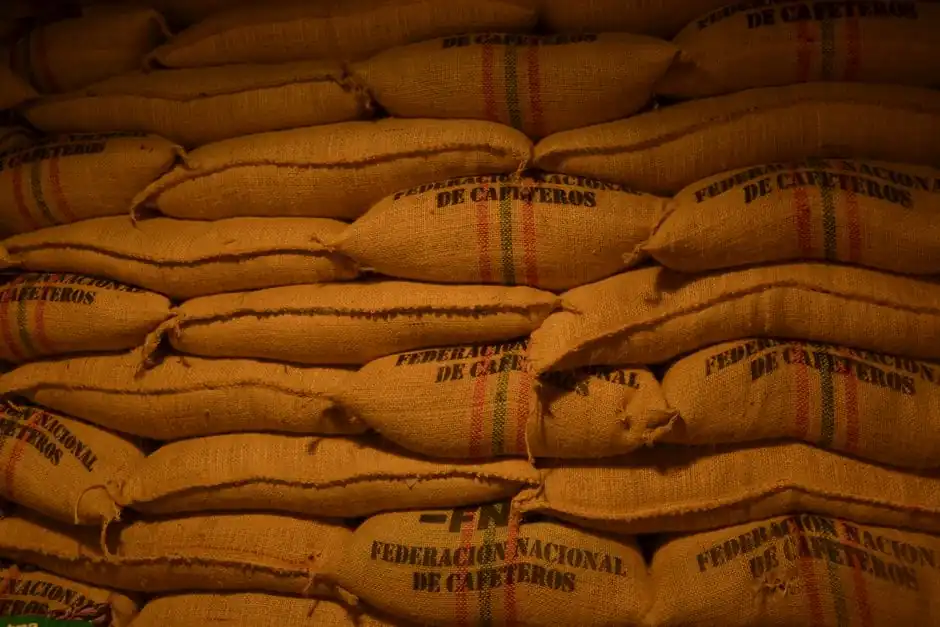
A baffle FIBC maintains a square footprint when filled by adding internal fabric panels to each corner, whereas a standard FIBC bulges outward under its own load, and the difference dictates how high a stack you can safely build in a warehouse or 20-ft container [S1][S2].
Across supplier guidance published between February 2026 and September 2026, baffle construction is consistently tied to multi-high stacking of 3-4 layers, up to 30% better floor-space density, and 10-20% more bags per 20-ft shipping container versus a round-bulge standard FIBC, at a per-unit cost premium of roughly 5-15% [S3][S4][S10].
How Baffles Change the Filled Geometry
Internal baffles are woven-polypropylene panels or net strings sewn into each of the four corners, connecting the top and bottom of the bag and acting as tension members that restrain the sidewalls from bowing outward when product pressure builds [S1][S3][S4]. A standard FIBC, whether U-panel, 4-panel, or circular/tubular, has no such constraint, so its woven shell expands into a barrel or pillow shape the moment it is filled to rated capacity [S1][S2][S3]. The terms baffle bag, Q-bag, and form-stable FIBC all describe the same construction concept, and baffled bags are frequently specified for sand, minerals, chemicals, food ingredients, seed, rice, carbon black, calcium stearate, soda ash, talc, resin pellets, and bentonite [S1][S4].
Shape retention directly controls stacking: a flat-walled bag sits flush on the one below, whereas a bulging bag creates a convex contact patch that rolls, settles, and transmits uneven point loads to the layer above [S3][S7]. Supplier guidance notes the 4-panel baffle variant delivers the straightest edges and the most consistent cubic form of the three outer-shell constructions, followed by the U-panel baffle, with the circular (tubular) baffle holding an adequate but less square profile because its corners remain slightly rounded [S1][S2].
Decision Matrix: Baffle vs Non-Baffle FIBC
The four criteria that drive the choice in practice are filled shape, achievable stack height, storage density, and unit cost, and the table below lines them up against the data published across 2026 supplier guides. [S2]
On filled shape, a baffle FIBC holds a square or cuboid profile throughout fill, transit, and storage, while a standard FIBC rounds outward under load [S3][S4]. On stack height, baffle bags are commonly stacked 3-4 high in warehouses and shipping containers, against a practical limit of 1-2 layers for non-baffled bags because of the rounded base [S3][S4][S7]. On storage density, multiple guides cite gains of up to 30% per floor area and 10-20% more bags per 20-ft container for baffle construction [S3][S4][S10]. On cost, the per-unit premium for adding baffle panels and stitching is reported in the 5-15% band over an equivalent standard FIBC [S4][S5]. Critically, baffle panels improve shape retention and stability, not the safe working load: SWL and the safety factor are still set by the base fabric, construction, and the 5:1 (single-trip) or 6:1 (multi-trip) ratios defined under ISO 21898 [S3][S9].
Construction Variants That Change Stacking Behavior
Baffle panels are an internal feature that can be added to any of the three outer-shell constructions, and the choice of shell still sets the stacking ceiling. The 4-panel baffle bag delivers the best stacking performance and the squarest filled profile, the U-panel baffle bag balances cost and stability for general-purpose loads, and the circular/tubular baffle bag has the fewest seams (only at top and bottom) but slightly rounded corners that reduce flush contact between stacked bags [S1][S2][S8]. Within those shells, suppliers distinguish four-baffle corner designs for general bulk packaging, full-panel baffles for maximum dimensional stability on high-value powders, Q or box baffles that form locked corners for automated filling lines, and removable or modular baffles for food-grade reuse and hygiene-sensitive applications [S2][S5].
For bag-on-bag handling inside a standard bulk bag workflow, the practical effect is that baffle construction is what lets you add a second, third, or fourth tier without racking, without shrink-wrap interlocks, and without the manual restacking that bulging non-baffled bags require after a few weeks in storage [S3][S7][S8].
When a Non-Baffle FIBC Is Still the Right Call
Baffle construction is not a default upgrade; it earns its premium only when the application actually uses the cubic geometry. A standard FIBC remains the better fit for short-haul, single-tier, low-density warehouse storage where the rounded profile is tolerable, for low-value fill where the 5-15% per-unit premium cannot be recovered, and for any product whose flow characteristics do not benefit from straight walls [S3][S4]. Coarse or heavy materials such as sand, gravel, and large resin pellets handle acceptably in either bag type, so the choice should default to non-baffled unless stacking or container-packing density is on the requirement list [S3].
Baffle bags are also not a free lunch for fine powders: while baffle construction prevents lateral migration of fines during transit, it does not change the electrostatic classification, so a Type C or Type D conductive bag specification still governs any dust-explosion risk, a topic covered in detail in the Type A vs Type B vs Type C FIBC comparison [S3][S4].
Filling, Discharge, and Handling Integration

Baffle bags accept the same top and bottom options as standard FIBCs: duffle tops for spill and contamination control, spout tops for low-dust filling and discharging, and full-open tops where surge loading is acceptable, so swapping in a baffled construction rarely forces a change to fill or discharge equipment [S2][S3]. On the discharge side, the flat walls that baffles enforce reduce bridging and ratholing in powders, leaving less residue stuck in the corners, and they keep inner PE or aluminum-foil liners taut rather than bagging into the corners the way liners do in a non-baffled shell [S2][S4].
For automated filling lines and high-bay warehouses, the practical win is repeatable geometry: a baffle bag presents a consistent square footprint to palletizers, stretch wrappers, and conveyors, while a non-baffled bag presents a variable pillow that confuses vision systems and can settle unevenly on a plastic pallet or inside a carton box outer pack [S2][S3][S5].
Standards, Safety Factors, and Sourcing
Both bag types are manufactured under ISO 21898, with single-trip bags carrying a 5:1 safety factor and multi-trip designs rated at 6:1, and adding internal baffles does not alter these load-bearing requirements [S3]. Within that envelope, SWL and safety factor are set by the fabric weight, weave, and base construction, not by the baffle panels, so any spec sheet that lists baffle construction as the SWL driver is misquoting the standard [S3][S9]. For UN-certified dangerous goods, the UN certification governs over and above the baffle choice, so a UN-rated FIBC must be specified whether it is baffled or not [S2][S3].
When sourcing, the spec to put on the RFQ is the outer-shell construction (4-panel, U-panel, or circular), the baffle type (corner, full-panel, Q-box, or removable), the SWL and safety factor under ISO 21898, the top and bottom fitment, the liner requirement, and the maximum intended stack height in storage and in the 20-ft export container [S3][S4][S6]. Supplier-published guidance is converging on 3-4-high warehouse stacks and 10-20% more bags per 20-ft container as the working numbers to validate against on a trial pallet before scaling [S3][S4][S7][S10].
Track these signals next: published 2026 supplier data on baffle-bag stack-height failures under real warehouse vibration, any update to ISO 21898 test loads for baffled constructions, and container-loading case studies that quantify the 10-20% density gain against a controlled non-baffled baseline.