When a warehouse carries a long tail of slow SKUs alongside 20% hot movers, neither a pure four-way pallet shuttle nor a pure AMR fleet is optimal, and the equipment choice must follow the velocity profile, not the budget line [S3].
Integration vendors have already begun to formalize the split: Interlake Mecalux's Easy WMS now exposes a dedicated bridge between its Pallet Shuttle and fork-equipped AGVs/AMRs, treating the two as a single orchestrated flow rather than separate islands [S4].
What Each System Actually Moves
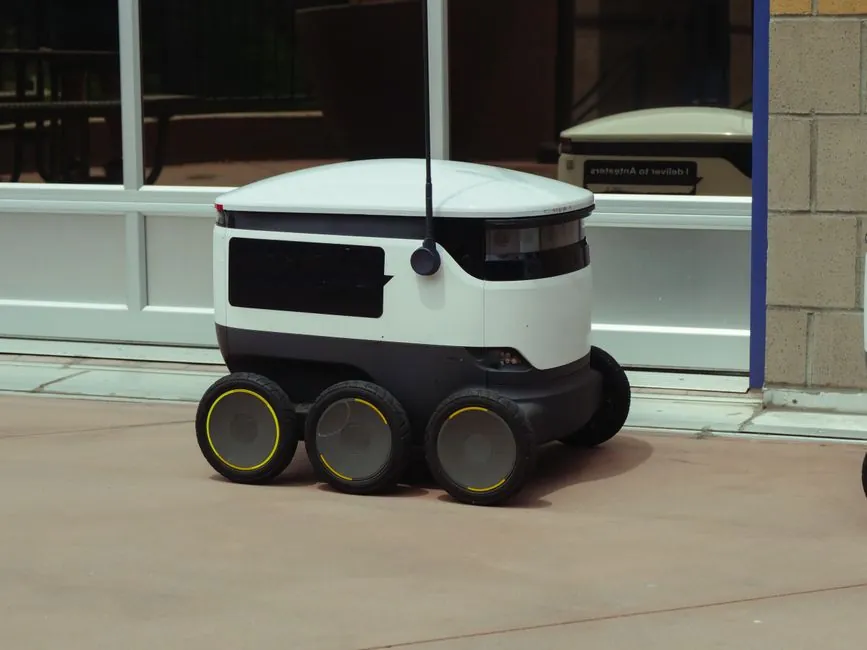
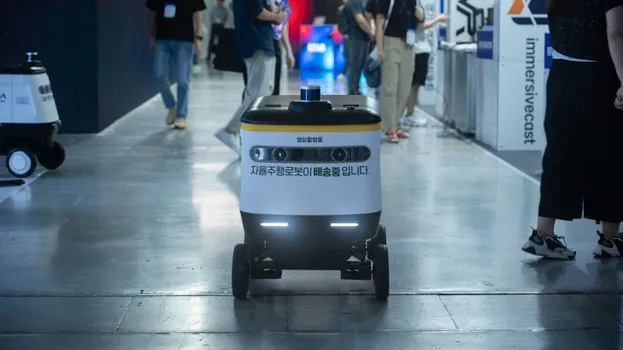
Pallet shuttles are rail-guided, four-way mobile platforms that ride inside a rack structure and move unit loads horizontally across lanes and vertically via elevators; AMRs, by contrast, are free-navigating vehicles that use onboard sensors (LiDAR, 2D/3D cameras, IMU) to map and traverse warehouse floors [S2][S9].
Shuttles own the storage transaction. Prime Robotics' RackBot, for example, is rated for pallets up to 3,000 lb (1,361 kg) and runs continuous vertical put-away and retrieval inside deep-lane racks [S1]. AMRs own the horizontal transaction, carrying pallets, cases, or totes between receiving, storage aisles, production buffers, and shipping docks without fixed guides [S9].
Prime Robotics' MobilePallet extends the AMR role to full-pallet transport, picking up loads at receiving and hand-off points to feed a high-density rack served by the shuttle, which is the canonical split in mixed-velocity sites [S1].
Throughput, Density, and Accuracy: The Quantitative Split
On density, shuttle storage can push single-deep utilization above 80% of building footprint because aisle volume is collapsed into rack volume, while conventional forklift-served selective pallet rack rarely exceeds 45% once aisles, staging, and dock zones are netted out [S3].
On accuracy, manually operated warehouses typically post 97 to 98% location accuracy, while a WMS-governed shuttle installation routinely runs at 99.5%, with every pallet move tracked and validated by software rather than by scanner discipline alone [S3].
On throughput consistency, shuttle fleets deliver repeatable pallet moves at a known cycle time, which lets WMS/Easy WMS schedule order cut-offs deterministically, whereas forklift output drifts with shift, fatigue, and operator turnover [S3][S4].
Where AMRs Win, and Where They Lose

AMRs dominate where the floor is heterogeneous: mixed pallet footprints, multiple drop zones, dynamic pick paths, and any layout that changes more often than the rack structure. enVista's Dec 9 2025 guidance frames the AMR value proposition as keeping high-velocity SKUs available at the point of use, cutting associate travel time at the pick face rather than at the rack face [S6].
AMRs lose where the rack is deep, the load is heavy, and the SKU turn rate is stable. Zikoo Robotics' 2026 field data flags a real failure mode: 200-pallet-per-day food distribution sites with 12 different pallet footprints and high damaged-pallet rates needed pallet quality gates, pre-inspection stations, and re-palletizing labor before any shuttle could operate, negating the automation ROI [S3].
Free-navigating AGV robot platforms built on forklift chassis cannot execute zero-radius turns, so their minimum aisle envelope remains tied to a conventional reach-truck turning radius, which is a hard constraint on retrofits in older brownfield buildings [S5].
Decision Matrix: Shuttles vs AMRs by Selection Criterion
Across four decision criteria the split is sharp. (1) Storage density: shuttle above 80% single-deep vs AMR neutral (racks are still selective or shuttle; AMR rides on top of either). (2) Pallet load: shuttle handles up to 3,000 lb unit loads inside rack [S1]; AMR ground transport scales from case to full pallet but is not the storage medium. (3) Layout change cost: AMR routes are software-defined and can be re-missioned in hours; shuttle lanes are physical, and reconfiguration requires rack rework [S3]. (4) Pick-point travel time: AMR cuts associate walk time at the pick face; shuttle cuts only the storage/retrieval cycle, not the last-meter pick [S6][S9].
For a hybrid recommendation that maps cleanly to the velocity profile: run the A-velocity SKUs (top 20% by pick frequency) through a four-way shuttle cube, run the B-velocity SKUs through AMR-fed selective rack, and leave the C-velocity long tail in either conventional rack or a slow-mover shuttle lane served by lifts, the exact model Zikoo calls out for its 2026 client base [S3].
Integration and Software Requirements
WMS, WES, and WCS layers are no longer optional. Easy WMS exposes a 60% productivity improvement and 99% error elimination claim on its automation stack, but only when the shuttle and AMR are orchestrated through the same Warehouse Execution System rather than two parallel schedulers [S4].
Easy AI and Supply Chain Analytics layers inside Easy WMS turn the shuttle-plus-AMR system into a single telemetry source: every shuttle lane cycle and every AMR mission is logged against the same SKU, so velocity drift can be detected weekly rather than quarterly [S4].
For engineering teams, the practical signal is that the WMS vendor (Mecalux, Zikoo, Prime, Swisslog) now ships the integration, not the robot vendor, so the procurement decision moves from a single-vendor RFP to a dual-vendor integration plan with a WMS contract as the master agreement [S4][S9].
Failure Modes and Sourcing Constraints
Three failure modes recur across the source set. (1) Pallet standardization: any non-standard or warped pallet blocks shuttle lanes; remediation requires pre-inspection and re-palletizing stations that consume the labor savings the shuttle was meant to deliver [S3]. (2) Frozen or multi-temperature inventory: shuttle rack dimensions are baked in at install, so adding new frozen assortments with different pallet sizes later is expensive, whereas manual layouts absorb the change at near-zero cost [S3]. (3) Brownfield aisle width: forklift-chassis AGVs and large AMRs need reach-truck-equivalent turning radius, so sites designed for older narrow-aisle trucks may need rack rework before any autonomous vehicle can deploy [S5].
On the AMR side, the structural limit is the load-bearing envelope: a master-slave parallel mobile robot design from MDPI demonstrates a compact pallet-jack form factor that achieves zero-radius turns and synchronous lifting, but it occupies a much smaller footprint than a forklift AGV and trades lift height for maneuverability [S5].
Trackable signals to watch between 2026-10 and 2027-Q1: (a) whether more shuttle vendors expose a published API for AMR hand-off beyond Mecalux's Easy WMS bridge [S4], and (b) whether the next round of Hwa Robotics and Swisslog multi-deep shuttle releases reports concrete AMR-fleet throughput numbers rather than shuttle-only metrics [S7][S9].