For industrial liquid streams, a standard bag filter at 1-200 µm rating usually holds service for 4-12 weeks between change-outs, whereas a precision filter at 0.5-25 µm is replaced every 2-6 weeks under comparable differential-pressure (ΔP) cut-off of 0.07-0.15 MPa [S2].
The decision is driven by three measurable variables: nominal particle cutoff, fluid viscosity (typically 1-400 cP for the duty range covered by both housings), and the cost of opening the vessel — which is where the precision housing's multi-bag geometry changes the labour math [S1][S2].
Cutoff Rating and What It Does to Service Life
Bag filters built around needle-felt or mesh media deliver nominal retention from 1 µm up to 200 µm, with the bulk of industrial procurement landing in the 5-50 µm band for pre-RO and process-water duties [S2]. Precision filters in the same vendor range start at 0.5 µm and overlap up to 25 µm [S1][S2].
Every halving of cutoff rating roughly doubles the dirt-holding burden per unit of flow, so a 5 µm precision cartridge is normally changed at 2-3× the frequency of a 25 µm bag on identical feed water. The MB multi-bag housing exists specifically to claw that labour back by holding 2-24 filter bags in parallel inside a single pressure vessel, so ΔP-trip change-outs drop from a daily event to a weekly one on high-load lines [S1].
Multi-Bag Precision Filter Housing Geometry
A multi-bag precision filter, catalogued as CB21160132, is a side-entry or top-entry carbon-steel or SS304/SS316L pressure vessel with 2 to 24 bag positions; inlets are typically DN50-DN300 flanged, design pressure 0.6-1.0 MPa, and design temperature up to 150 °C for the standard build [S1].
The interior basket-rack is sized to standard #1 or #2 filter bags (Ø180×430 mm or Ø180×810 mm), and the swing-bolt or davit cover is sealed with an O-ring so the operator can swap the full bag set in 10-20 minutes per service. The 6 Chinese OEM suppliers listed in the ChemicalBook catalogue for CB21160132 — Haining Lianzhong, Xinghua Sanqing, Qidong Julong and others — all conform to that geometry, which is why bag sourcing is interchangeable across brands [S1].
Standard Single Bag Filter Geometry
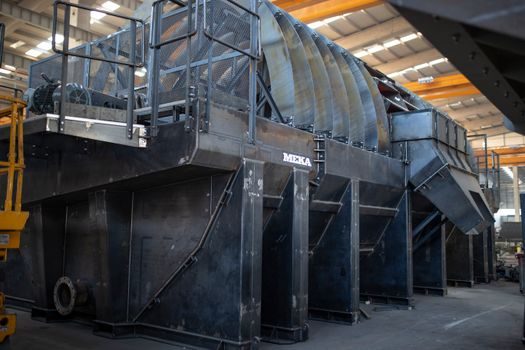
By contrast, the single-bag MB series from Feature-Tec uses Ø180×430 mm or Ø180×810 mm bags inside a 0.25-0.6 MPa vessel rated for ambient-to-120 °C service, with a side-in/top-out flow path that seats the bag on a positive-pressure restrainer basket [S2].
It is the go-to housing for duty points under 30 m³/h where change-out frequency is acceptable: electroplating rinses, machine-tool coolant loops, and small-scale RO pre-filtration typically run 8-12 weeks per bag in this format. The 304/316L stainless option, or the carbon-steel-with-rubber-lining variant, is chosen by feed-water corrosivity rather than by ΔP budget [S2].
Replacement-Interval Decision Matrix
Compared on four decision criteria — cutoff, ΔP ceiling, change-out frequency, and capex per m³/h — the two formats split cleanly:
• Cutoff range: bag filter 1-200 µm [S2]; precision filter 0.5-25 µm [S1][S2]. • Typical change-out interval: bag 4-12 weeks; precision 2-6 weeks under matched flow [S2]. • ΔP trip setpoint: both terminate around 0.15 MPa, but the multi-bag geometry spreads that pressure drop across N parallel elements, so a 6-bag housing runs roughly 6× the dirt load of a single-bag housing before trip [S1][S2]. • Capex per m³/h: single-bag is lower for flows under 20 m³/h; multi-bag precision wins on total cost of ownership above 30 m³/h once labour-hours per month are counted.
Who Each Format Is FOR — and Who It Is NOT For

Specify a single-bag bag filter when the duty is intermittent (under 8 h/day), the cutoff is 25 µm or coarser, and the operator can open the vessel without a permit. It is the wrong tool for clean-room or sterile applications, for 0.5-10 µm final polishing, or for any line where ΔP creep past 0.10 MPa is unacceptable on a continuous process [S2].
Specify a multi-bag precision filter when the process is continuous, the cutoff is below 25 µm, and the cost of an unscheduled shutdown exceeds the cost of the bag set. It is over-specified for utility-water pre-filtration, irrigation loops, and any open drain where 100 µm straining is enough. Lab bio-safety work falls into a separate code path — GB19489-2008 — where bag-in/bag-out (BIBO) housings are mandatory, and standard single- or multi-bag vessels do not satisfy the change-out protocol [S3].
Failure Modes and Field Limits
The dominant failure mode for both formats is bag bypass — feed water channelling past the seal because the restrainer basket is undersized or the O-ring has lost compression. Symptom is loss of cutoff rating at 30-50% of service life, not a ΔP trip. [S2]
Second failure mode is media migration at the end of life, when needle-felt bags shed fibres downstream. That rules out single-bag felt media for any polishing duty in front of a UF or RO membrane, even when the nominal rating looks right on paper [S2]. The practical mitigation is to step down cutoff in two stages: a 50 µm or 25 µm bag first, then a 5 µm or 1 µm absolute-rated filter element as the polishing stage.
Total-Cost Variables That Drive the Swap Point
Three numbers decide whether the extra capex of a multi-bag housing pays back: change-out labour hours per month, bag unit-cost differential, and the cost of one unplanned ΔP trip. A 6-bag precision housing typically bundles bag unit-cost 10-20% lower than the same bag bought as a single, and cuts monthly change-out hours from ~6 to ~2 on a 40 m³/h line [S1].
Where the math flips is on low-flow, low-frequency duties. For a 5 m³/h coolant loop running 8 h/day, a single-bag housing has lower total cost over a 5-year life, and the precision format is justified only if the downstream process is sensitive to 5 µm particles. For higher-flow chemical or industrial filter skids, the labour saving dominates within 12-18 months of operation.
Standards and Code Anchors
Bag- and precision-filter housings in chemical-service duty typically follow ASME BPVC Section VIII for unfired pressure vessels, with PED 2014/68/EU compliance for EU installations and GB 150 for the Chinese market [S1]. NSF/ANSI 61 or FDA Title 21 CFR compliance applies to the bag media itself for potable-water and food-contact service, but is independent of the housing code [S2].
For lab bio-safety, GB19489-2008 specifies that HEPA-filter change-out in BSL-3/BSL-4 labs must use a bag-in/bag-out housing so the contaminated filter never sees room air — that is a dedicated equipment class, not a modified bag filter [S3].
Selection Verdict by Use Case
Use a single-bag bag filter for 25-200 µm pre-filtration on low-flow, intermittent lines where 4-12 week intervals are acceptable. Use a multi-bag precision filter for continuous 0.5-25 µm duty on flows above 20 m³/h, or any time 2-6 week change-out at a single access point is operationally acceptable. Use a BIBO housing for any BSL-3/BSL-4 lab air exhaust, regardless of cutoff [S1][S2][S3].
For deeper sizing math on the upstream pump feeding the filter skid, see the Inline Pipeline Pump vs Diaphragm Pump selection map and the Centrifugal Pump vs Plunger Pump selection map.