Industrial buyers sourcing balancing valves in mid-2026 face a 12-15x spread between a brass DN15 manual static unit and a DN300 dynamic balancing assembly with an integrated actuator, with body material, nominal diameter, Kv precision and certification stack accounting for roughly 70-80% of the total landed cost delta.
The market in 2026 still segments cleanly across three product families: manual static balancing valves (fixed orifice), manual adjustable (multi-turn handwheel) balancing valves, and automatic / dynamic balancing units with electric or pneumatic actuators. DirectIndustry catalogues 6 balancing solenoid products from 4 manufacturers as of 2026-05-24, dominated by 3-way and 2-way ports with NC or NO functions and media ratings spanning gas, vacuum, water, food and fuel [S1]. Comparato Nello's SCPV series offers a ball-pattern, electrically-actuated control configuration that sits in the higher-cost active tier [S2].
Price Bands by Type and DN Size
Brass-body manual balancing valves in the DN15-DN25 range — typically CW614 brass per the dominant China-mill spec [S5] — clear customs in the $20-80 FOB-China band when ordered at 50-200 pc MOQ; below 50 pc the unit price commonly doubles because tooling amortisation is spread over a smaller run. Ductile-iron fixed-orifice balancing valves in the DN50-DN150 range land between $80-260 FOB, and DN200-DN300 units run $260-400 FOB based on current Botou Yaxing product-list reference pricing [S3].
Dynamic balancing valves with integrated differential-pressure control and an electric actuator occupy a separate tier starting around $300 for DN50 and reaching $1,200-2,500 for DN150-DN300 assemblies; this category carries HS-code 8481 for customs declaration purposes in China, with declarations requiring brand type, model, GTIN and CAS fields per the 2026-06-16 customs reference [S6]. Valve cost correlates more tightly with body-alloy content and machining hours than with Kv precision itself, which is why two DN65 valves with identical Kv can differ by 40% if one uses 304SS internals and the other brass.
Material Cost Levers and Machining Premium
Body material is the single largest cost lever after DN size. CW614 brass (the European equivalent of C38500) is the default for DN15-DN50 manual units and benefits from mature Chinese supply chains, holding the price floor at roughly $18-30 FOB for a finished DN15 balancing valve body [S5]. Ductile iron (GGG40/GGG50) steps in at DN50 and above because casting economics flip there; 304SS adds 60-90% over ductile iron at the same DN, and 316SS for pharmaceutical or marine service adds another 25-40% on top of 304SS [S3].
Machining cost is the second lever, driven by port count and seat geometry. A 2-way straight-pattern balancing valve needs roughly half the CNC time of a 3-way mixing or diverting pattern with the same DN, which is why 2-way manual units are 20-30% cheaper than 3-way equivalents at identical body size [S1]. Comparato Nello's ball-pattern SCPV series, by contrast, uses a characterised ball port that requires precision grinding rather than a simple seat-and-orifice machining step, pushing its cost closer to actuated control-valve territory [S2].
Kv Precision, Cert Stack and Sourcing Region

Kv (or Cv) tolerance and leakage class drive the third cost layer. Standard manual balancing valves are rated to ±5-10% Kv tolerance with Class IV leakage, which is acceptable for HVAC and closed-loop hydronic work. Units specified to ±2-3% Kv with Class VI soft-seat leakage — common in district heating and clean-room process loops — carry a 30-60% premium because flow characterisation requires individual bench calibration rather than batch test [S1][S3]. Buyers should match the tolerance to the loop duty; overspecifying a precision Kv on a simple two-pipe heating system is wasted capital.
CE marking under the EU Pressure Equipment Directive (PED 2014/68/EU) is essentially mandatory for European HVAC exports; adding EAC for the Russia/CIS customs union, WRAS for UK potable-water service, or FM/UL for fire-protection duty each pulls the price in 8-15% increments [S3]. For chemical-plant service where the balancing valve also sees aggressive media, 316SS body plus NACE MR0175 sour-service compliance is a 40-70% adder over a standard 304SS build at the same DN.
MOQ Economics and Total Landed Cost
MOQ is the most under-estimated cost lever. Chinese brass-body DN15-DN25 balancing valves priced at $20-30 FOB at 200 pc MOQ jump to $40-60 at 50 pc and $80-120 at single-piece orders, because the factory absorbs the same setup, inspection and crating overhead regardless of run length [S5]. For ductile-iron DN100+ units the MOQ curve is flatter — typically 10-20 pc — because iron-casting foundries run continuous moulding lines, not batch CNC. Total landed cost for a 40 ft HQ container of mixed DN50-DN150 manual balancing valves out of Botou or Wenzhou in 2026 runs $14,000-22,000 for the goods, plus roughly $3,500-5,500 ocean freight to North Europe and $1,200-1,800 in customs duty and clearance at a 2-4% EU tariff band [S3].
Lead time on standard brass/ductile-iron manual units sits at 15-25 days ex-works for in-stock patterns and 35-50 days for custom DN or special-alloy builds [S3][S5]. Actuated dynamic balancing assemblies carry 45-75 day lead times because the actuator, positioner and valve body ship from separate suppliers and are bench-commissioned at the integrator. Buyers chasing a 30-day delivery window should treat actuated units as a stocked SKU at a regional distributor rather than a mill-direct order, accepting a 15-25% distributor markup as the cost of compressed schedule.
Selection Criteria: Static, Adjustable or Dynamic
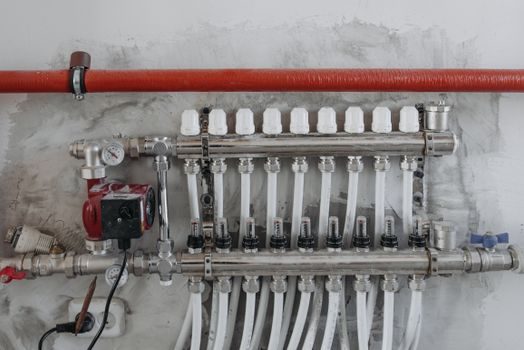
Choosing between the three families comes down to loop control intent, not price alone. Manual static balancing valves — fixed orifice, no adjustment — are the right call for terminal-unit rebalancing where the Kv was pre-calculated by the design engineer; they are also the cheapest option, but require drain-down and re-fit if the system is rebalanced [S3]. Manual adjustable balancing valves with handwheel and digital readout position (e.g. IMI Ta-balance, Tour & Andersson STAD equivalents) are the workhorse for HVAC commissioning and carry a 40-80% premium over fixed-orifice equivalents because of the integrated differential-pressure measurement ports and the calibrated Kv vs. turns curve.
Automatic / dynamic balancing valves with an actuator are specified where the differential pressure across the load varies with other loop operations, which is common in district heating substations and large chilled-water plants. Comparato Nello's SCPV ball-pattern electrically-actuated family sits in this category, with a characterised ball port that gives modulating control rather than on/off [S2]. The decision criterion is whether the loop can tolerate a fixed Kv at design flow; if load diversity pushes the operating point away from design by more than 30%, an automatic unit pays back its premium within 1-3 years in pump-energy savings. For simple constant-flow loops, a manual adjustable unit is the cost-effective choice, and for one-off balancing on a fixed design, a static unit suffices.
Comparison Table: Type vs Cost vs Application
Three-way porting appears in 4 of 6 catalogued balancing solenoid products, versus 4 two-way and 2 four-way patterns [S1], confirming that mixing/diverting duty is the dominant application segment. Manual static units win on first cost but lose on commissioning flexibility; manual adjustable units are the sweet spot for 80% of HVAC hydronic loops at roughly 1.5-2x the static cost; automatic dynamic units are 5-10x static cost and only pay off in variable-load loops. For a typical DN65 mid-range project in 2026, expect $90-140 for ductile-iron static, $160-260 for manual adjustable, and $700-1,400 for automatic dynamic — each tier with a clearly different commissioning workflow and spare-parts profile.
Two trackable signals to watch for the rest of 2026: Chinese ductile-iron casting capacity continues to consolidate, with at least three Botou-area foundries reporting extended lead times on DN200+ patterns as of mid-2026 [S3], and EU PED 2014/68/EU enforcement on balancing valves has tightened documentation requirements, with more SKUs now requiring full material traceability and pressure-test certificates rather than the self-declared CE that was common pre-2024.
For related coverage, see Steam Trap 2026 Price & Cost Guide: Type, Sizing and Cert Levers.