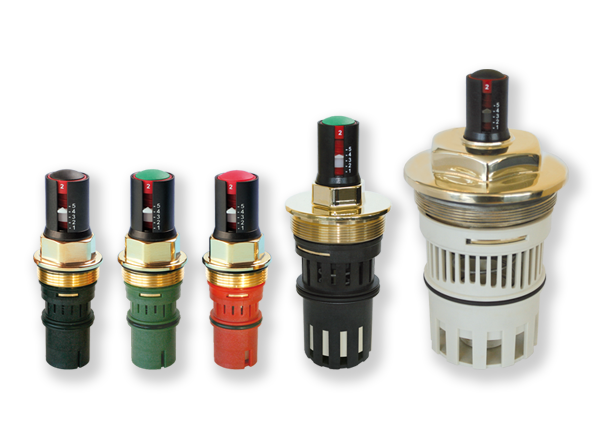
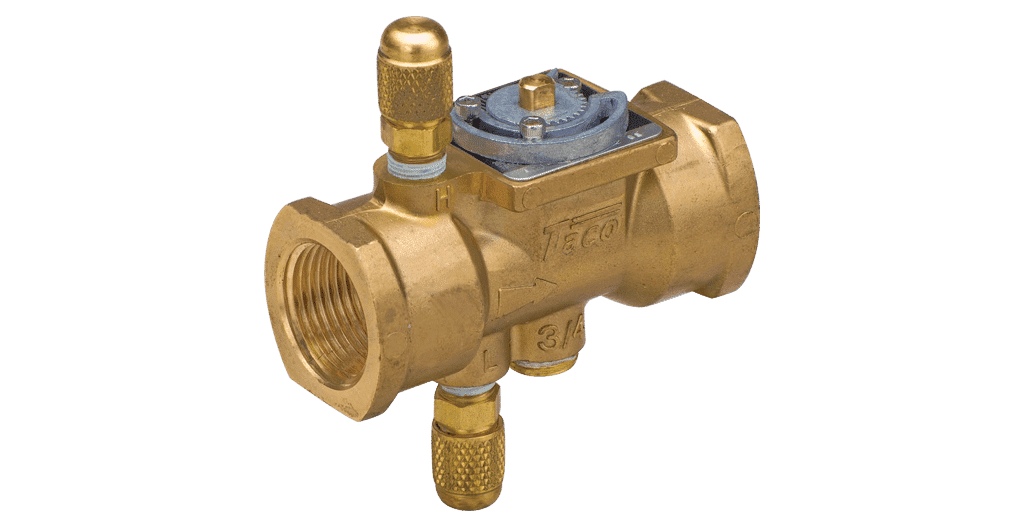
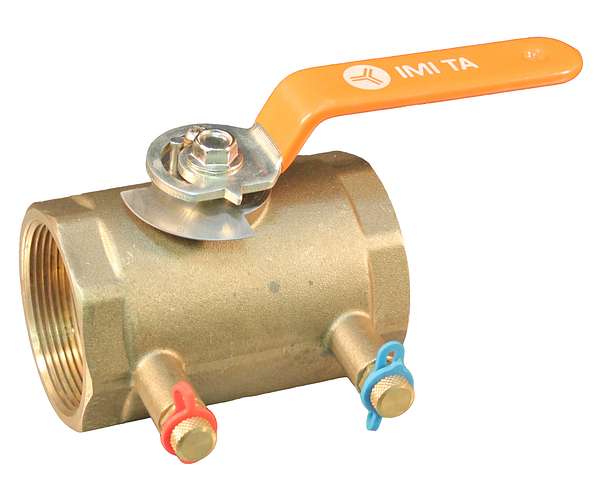
A balancing valve is a hydronic flow-regulating device that sets and holds the correct water flow rate in each branch of a heating or cooling distribution system, so every terminal receives its design flow rather than the circuits nearest the pump starving the far ones. It works by deliberately introducing a calibrated pressure drop, either fixed by a manually set orifice (static balancing) or held automatically by a spring-loaded diaphragm (dynamic balancing).
Balancing valves sit between the pump and the load in closed recirculating water systems. Correct balancing is the single largest lever for HVAC pump energy and occupant comfort: an unbalanced system overflows some circuits while others run short, forcing the pump to work harder and still failing to deliver design temperatures. This guide covers the static, dynamic, and pressure-independent families, their flow coefficients, materials, spec-sheet parameters, and a structured selection sequence.
This guide is written for HVAC purchasing engineers, mechanical design engineers, and commissioning specialists. It covers 6 chapters: what a balancing valve is and why systems need it, the static versus dynamic versus PICV classification, the flow-coefficient and Kvs theory, body materials and connection standards, the spec-sheet parameters that drive selection, and a structured decision sequence, plus 7 FAQs and manufacturer comparisons. Parameters reference BS 7350, EN 1213, EN 12266, CIBSE Commissioning Code W, and published manufacturer datasheets from IMI Hydronic Engineering, Danfoss, Caleffi, and Crane Fluid Systems.
Chapter 1 / 06
What is a Balancing Valve
A balancing valve is a flow-regulating device installed in the branches and risers of a closed recirculating water system to set each circuit to its design flow rate. Without balancing, water follows the path of least resistance: circuits hydraulically close to the pump receive more than their share of flow, while the index circuit (the most hydraulically remote terminal) is starved. The result is simultaneous overheating and underheating in the same building, nuisance noise from over-velocity flow, and a pump that consumes more energy while still failing to satisfy the worst-served zone.
The valve achieves balance by introducing a controlled pressure drop. A static balancing valve does this through a variable orifice set once during commissioning; a dynamic balancing valve does it through a spring-and-diaphragm assembly that continuously reacts to changing pressure. The governing physics is the same orifice relationship used for all throttling valves: flow is proportional to the valve flow coefficient multiplied by the square root of the differential pressure divided by the fluid specific gravity. Because flow depends on the square root of pressure, an unregulated system is highly sensitive to pressure changes, which is exactly why deliberate, measured regulation is needed.
Balancing valves belong to the wider family of hydronic balancing and control components, alongside differential pressure control valves, automatic flow limiters, and pressure independent control valves. In a typical commercial chilled water or low-temperature hot water system, balancing valves are placed at each terminal branch, at each riser base, and at the main plant connections. A double regulating valve also doubles as an isolating and flow-measurement point, letting the commissioning engineer read flow without breaking into the pipe.
The discipline of hydronic balancing matured alongside variable-volume HVAC. Early constant-volume systems used only manual valves set once and left alone. As two-way control valves and variable-speed pumps spread through commercial buildings from the 1990s onward, branch differential pressure began to swing as other loads opened and closed, and a single fixed orifice could no longer hold flow. This drove the adoption of dynamic balancing, and later the pressure independent control valve, which merges balancing and modulating control into one body. Standards bodies followed: BS 7350 formalized double regulating valve accuracy, and CIBSE Commissioning Code W codified the proportional balancing method still used today.
Three engineering metrics determine whether a balancing valve performs over its service life: flow-setting accuracy (how closely measured flow matches design), the working differential pressure window (the pressure band over which a dynamic valve holds its setpoint), and serviceability (whether the orifice fouls, the diaphragm ages, or the test ports leak). A cheap valve with a coarse setting scale or no test ports cannot be commissioned to a tight tolerance, which propagates into permanent comfort complaints and wasted pump energy across the building lifecycle.
Chapter 2 / 06
Types and Classification
Balancing valves divide into two broad families by how they respond to changing system pressure: static (manual) and dynamic (automatic). Choosing the wrong family is the most consequential selection error, because a static valve in a variable-volume system cannot hold flow when neighboring loads modulate, and an over-specified dynamic valve in a simple constant-volume system wastes capital. The table below summarizes the four main valve types across the two families.
Type
Family
What it holds
Best-fit system
Double regulating valve (DRV)
Static / manual
Fixed orifice setting
Constant-volume circuits
Differential pressure control valve (DPCV)
Dynamic
Constant Δp across circuit
Variable-volume risers
Automatic flow limiter
Dynamic
Constant max flow
Flow-capped branches
Pressure independent control valve (PICV)
Dynamic + control
Constant flow + modulation
Variable-volume terminals
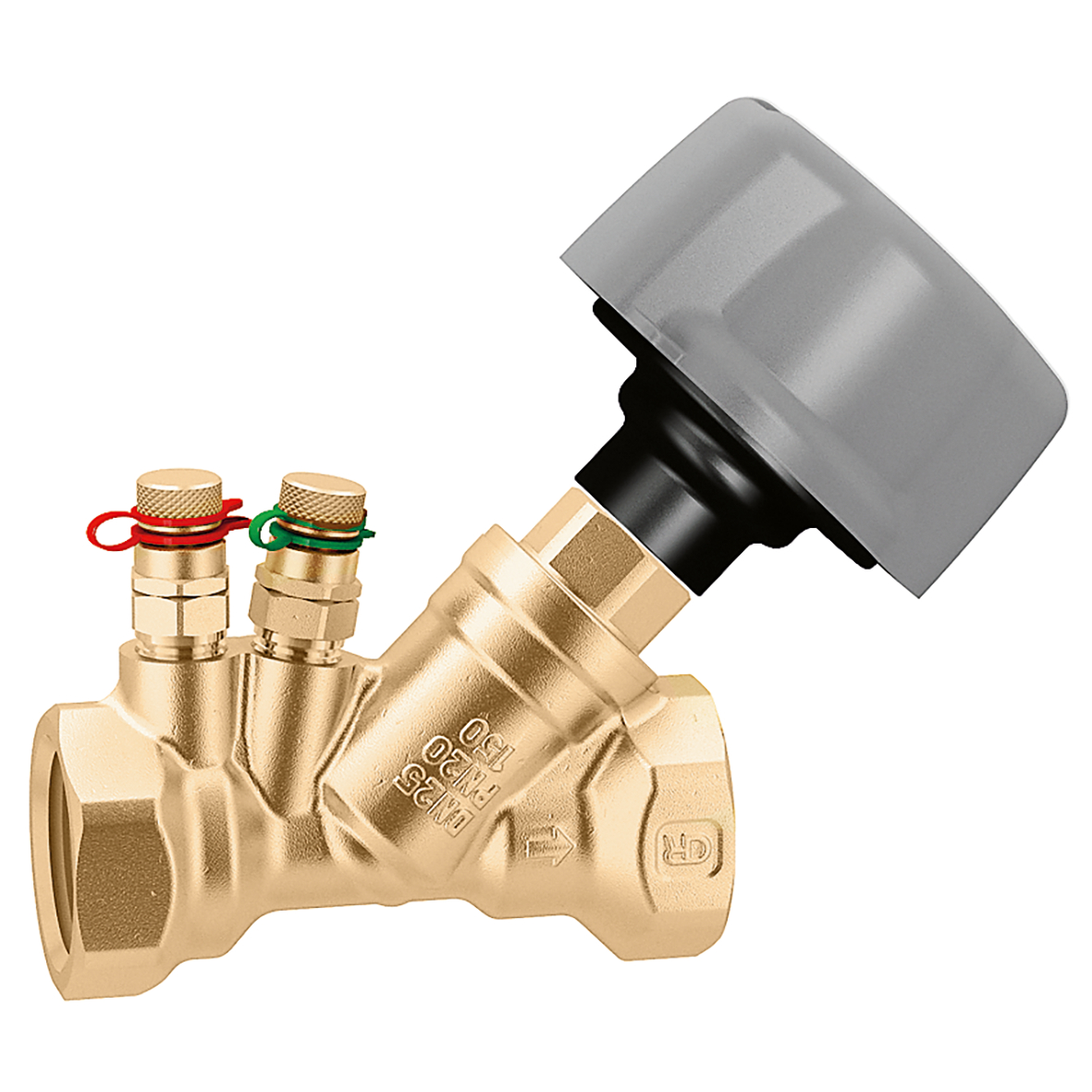
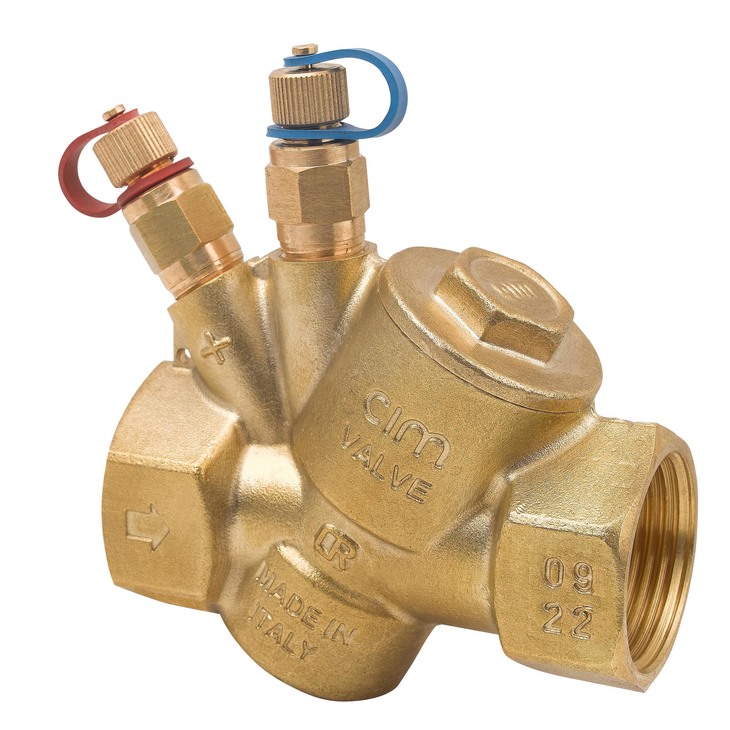
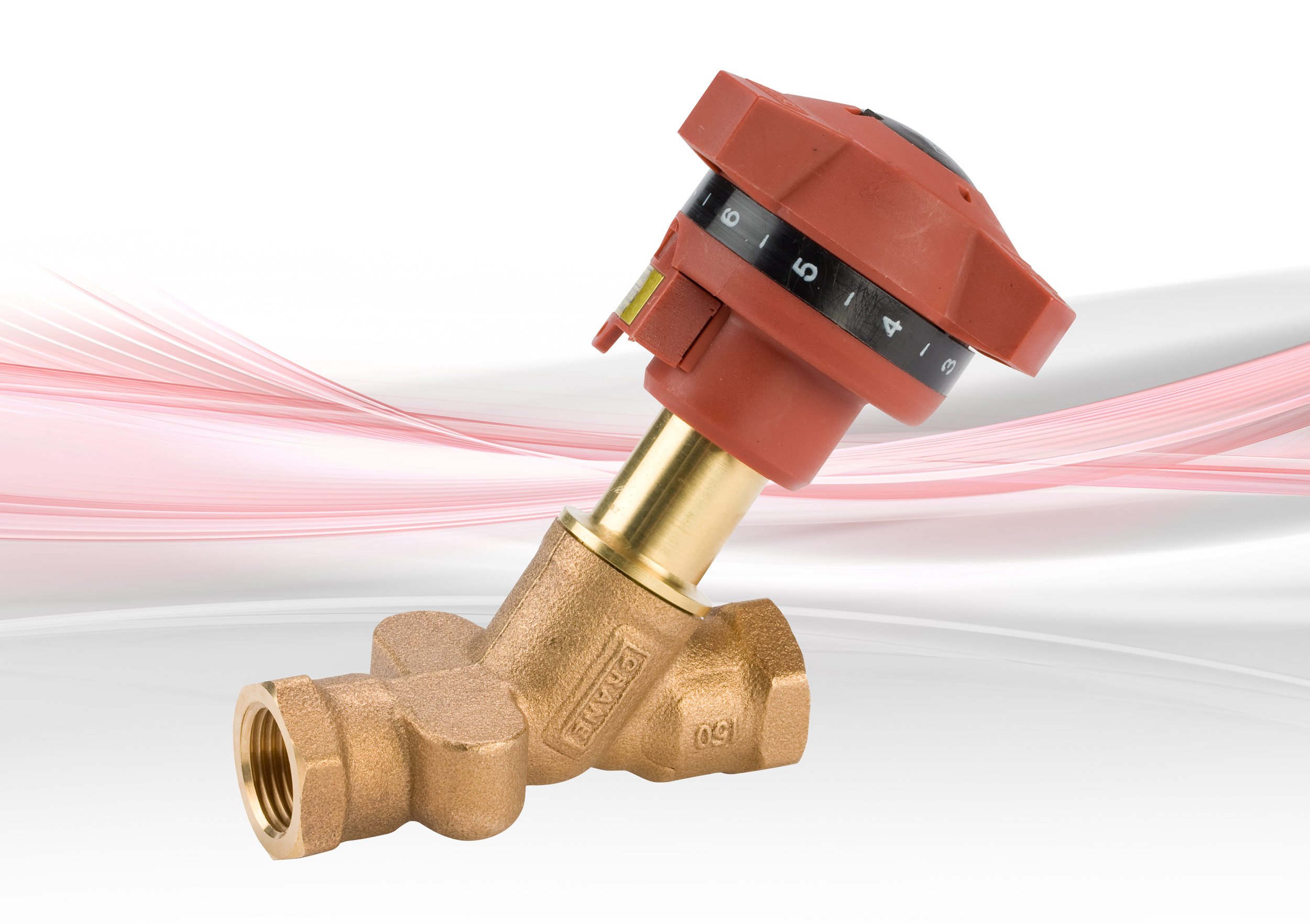
Static balancing valves, also called manual balancing valves or double regulating valves (DRV), are the original and still most common type. They are typically Y-pattern or oblique-globe valves with a variable orifice driven by a handwheel carrying a numbered scale. The engineer sets a turn number during commissioning that corresponds to a published flow coefficient. Most carry two pressure and temperature test ports straddling the orifice so flow can be measured in situ. They are inexpensive and robust but only deliver the design flow at one specific differential pressure: if pump head or adjacent loads change, the flow through a static valve drifts proportionally to the square root of the new pressure. Static valves therefore suit constant-volume systems or as the riser-base regulators beneath dynamic terminal valves. Crane Fluid Systems D921 and IMI TA STAD are representative threaded DRVs; IMI TA STAF and STAG cover the flanged and grooved larger sizes.
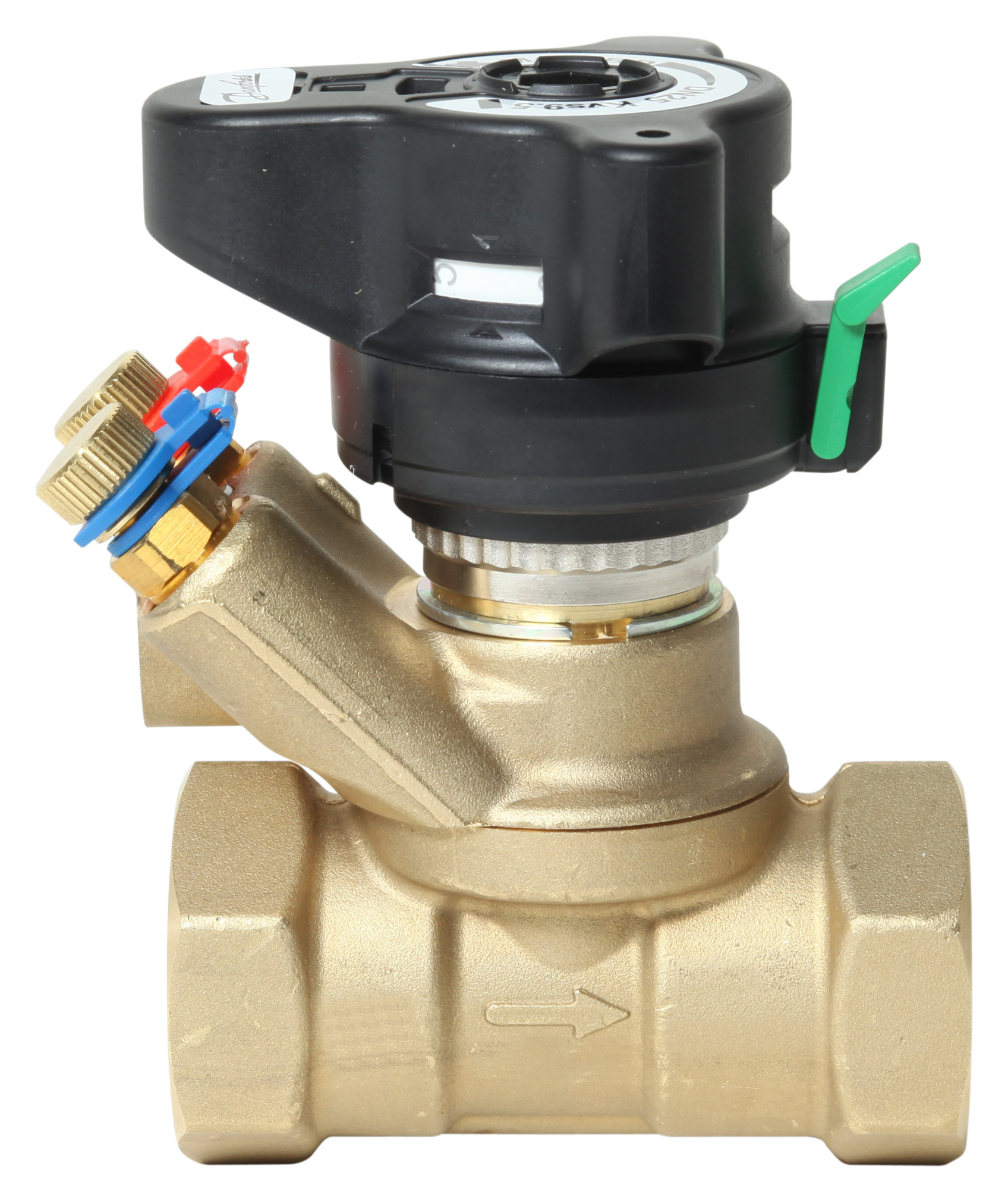
Dynamic balancing valves contain a spring-loaded diaphragm that mechanically reacts to pressure and holds a target value as the system fluctuates. There are three sub-types. A differential pressure control valve (DPCV) holds a constant differential pressure across a circuit. It works as a pair: a partner valve sits in the supply pipe and a capillary tube transmits supply pressure to the DPCV diaphragm in the return pipe, so the diaphragm regulates to keep the circuit differential pressure at the set value over ranges such as 5 to 25 kPa, 20 to 40 kPa, 20 to 65 kPa, 35 to 75 kPa, or 60 to 100 kPa. An automatic flow limiter uses a self-acting cartridge to cap flow at a fixed maximum regardless of differential pressure within a working window. The Danfoss ASV-PV is a representative DPCV available in DN 15 to 50 with a maximum differential pressure across the valve of 1.5 bar.
Pressure independent control valves (PICV) are the most integrated type. A PICV combines three functions in one body: a differential pressure regulator that mechanically absorbs branch pressure swings, an adjustable flow limiter that caps maximum flow at the design value, and a modulating control element driven by an actuator that responds to a thermostat or building management system. Because the internal diaphragm holds a constant pressure drop across the control element, the controlled flow stays accurate over a wide working differential pressure band, which removes the valve authority problem entirely. The Danfoss AB-QM covers DN 15 to 250 for flows up to 407 m³/h, with a control ratio of 1:1000 and the ability to close against 16 bar of differential pressure. IMI TA-Modulator and Oventrop Cocon Q are comparable PICV families.
A useful rule for type selection: constant-volume systems use static DRVs; variable-volume systems with two-way control valves use either DPCVs at riser level plus static valves at branches, or PICVs at each terminal. The PICV approach minimizes commissioning labor because each terminal is independently pressure-stabilized and does not require iterative proportional balancing.
Chapter 3 / 06
Flow Coefficient and Valve Authority
Every balancing valve is characterized by a flow coefficient that links flow rate to pressure drop. Understanding Kv, Kvs, and Cv is essential because the entire commissioning workflow rests on reading a differential pressure and converting it to flow. The table below defines the three coefficients and their unit systems.
Coefficient
Definition
Units
Conversion
Kv
Flow at 1 bar drop, current opening
m³/h, bar
Reference metric value
Kvs
Kv at fully open (maximum)
m³/h, bar
Kvs ≥ Kv always
Cv
Flow at 1 psi drop, water 60°F
US gpm, psi
Cv ≈ 1.156 × Kv
Kv is the flow in cubic metres per hour of water at 5 to 30 degrees Celsius that passes through the valve when the pressure drop across it is exactly 1 bar. It is a property of the valve at a given opening, so a manual balancing valve publishes a Kv value for each handwheel turn position. Kvs is the Kv at the fully open position, the maximum the valve can pass. Cv is the imperial equivalent, defined as the number of US gallons per minute of water at 60 degrees Fahrenheit that pass at a 1 psi pressure drop. The two are directly convertible: Kv is approximately 0.865 times Cv, or equivalently Cv is approximately 1.156 times Kv. Mixing the two unit systems is a common and costly selection error.
The working equation that ties these together is the orifice flow relationship: flow equals the flow coefficient multiplied by the square root of the differential pressure divided by the fluid specific gravity, all in consistent units. During commissioning, the engineer measures the differential pressure across the valve test ports, looks up the published Kv for the current handwheel setting, and computes the actual flow. The handwheel is then turned until measured flow equals design flow. For glycol or other non-water fluids the specific gravity and viscosity correction must be applied, because the published coefficients assume clean water.
Valve authority is a control concept that governs whether a modulating valve regulates smoothly. It is defined as the ratio of the pressure drop across the fully open valve to the total pressure drop across the controlled circuit, including the valve. A widely used design target is an authority of at least 0.5. When authority is too low, the installed flow characteristic of the valve is distorted: most of the flow change happens in a small part of the stroke near the closed position, so the loop becomes difficult to control, hunts, and effectively behaves like an on-off switch. Sizing a control valve so its Kvs is not far above the required operating Kv preserves authority and keeps the controllable range usable.
The valve authority problem is precisely what a pressure independent control valve eliminates. Because the PICV internal regulator maintains a constant differential pressure across the control element regardless of branch pressure, the control element always sees the same pressure drop and therefore always presents the same, undistorted characteristic. This is the core engineering advantage of PICVs over the traditional combination of a separate balancing valve plus a pressure-dependent control valve, and the reason variable-volume designs increasingly default to PICVs at the terminal.
Chapter 4 / 06
Materials, Connections and Standards
Body material and connection type are set by valve size, pressure class, and water chemistry. Small threaded valves up to about DN 50 are made from copper alloys, while larger valves switch to cast iron or cast steel because brass becomes uneconomic at scale. The most important water-chemistry decision is dezincification resistance: ordinary brass in aerated or potable water can leach zinc, leaving a porous copper-rich structure and white meringue deposits that block test ports and weaken the body.
Bronze and gunmetal bodies suit threaded balancing valves to DN 50 in heating and chilled water. Dezincification-resistant brass, designated DZR or CR brass (and marketed by IMI Hydronic Engineering as AMETAL), is specified where potable, softened, or highly aerated water would otherwise attack standard brass. Cast iron, typically grey iron EN-GJL-250 or ductile iron EN-GJS-400, is used for flanged valves from DN 50 to DN 400. Spindles and internal trim are usually stainless steel for corrosion resistance, and elastomer seals are commonly EPDM, which is compatible with water and water-glycol mixtures but not with mineral oils.
Connection type follows pipework practice. Threaded ends (parallel BSP or NPT, taper threaded on some larger DRVs) cover small bore. Flanged ends (PN 16 or PN 25 drilling per EN 1092) cover medium and large bore. Grooved ends suit mechanical-coupling pipework. Press, solder, and union connections appear on small terminal valves. The pressure class, denoted PN in bar (for example PN 16, PN 25) or ANSI Class, must match the system maximum working pressure with margin for surge.
The table below maps common applications to recommended body material and connection. It is a starting point only: always confirm the specific water treatment regime, temperature, and approval requirement against the manufacturer datasheet before specifying.
Application
Recommended body
Typical connection
Closed LTHW / chilled, to DN 50
Bronze or gunmetal
Threaded BSP / NPT
Potable / aerated water
DZR or CR brass (AMETAL)
Threaded, WRAS approved
Risers and mains, DN 50 to 400
Grey or ductile cast iron
Flanged PN 16 / PN 25
Mechanical-coupling pipework
Ductile iron
Grooved
Higher pressure / district energy
Cast or forged steel
Flanged PN 25+ / Class
Relevant standards include BS 7350, the specification for double regulating globe valves and flow measurement devices for heating and chilled water systems, which sets a flow-measurement accuracy of plus or minus 10 percent in the fully open condition and plus or minus 5 percent when used with a matched commissioning set. EN 1213 governs copper alloy isolating valves for potable water inside buildings. EN 12266-1 and EN 12266-2 define pressure testing and acceptance criteria for industrial valves. Functional commissioning of the assembled water system follows CIBSE Commissioning Code W and the BSRIA commissioning guides, which set out the proportional balancing method. Potable installations additionally require WRAS or equivalent drinking-water approval.
Chapter 5 / 06
Key Specification Parameters
A balancing valve datasheet lists many parameters, but only a handful drive the selection decision. The table below compares representative published specifications across four common product families, spanning the static and dynamic types. Values are from manufacturer datasheets and should be reconfirmed against the current revision before ordering.
Parameter
Crane D921 DRV
IMI TA STAD/STAF
Caleffi 130
Danfoss AB-QM PICV
Family
Static / manual
Static / manual
Static / manual
Pressure independent
Body material
Bronze
AMETAL DZR brass
Brass / cast iron
Brass / cast iron
Size range
DN 15 to 50
DN 15 to 400
DN 15 to 300
DN 15 to 250
Pressure class
PN 25
PN 16 / PN 25
PN 16
PN 25
Temperature range
-10 to 120°C
-20 to 120°C
-20 to 120°C
-10 to 120°C
Setting / accuracy
±5% with comm. set
±5% with comm. set
Venturi metering
±10% of flow
Max flow / Δp
By Kvs
By Kvs
By Kvs
407 m³/h max
Flow-setting accuracy is the headline parameter. BS 7350 double regulating valves achieve plus or minus 10 percent in the fully open condition and plus or minus 5 percent when read with a matched commissioning instrument across the test ports. Pressure independent control valves quote flow accuracy directly: the Danfoss AB-QM holds flow within plus or minus 10 percent across its setting range and working differential pressure band, and modulates below 1 percent of set flow regardless of setting, with a control ratio of 1:1000.
Working differential pressure window applies to dynamic valves and defines the pressure band over which the valve holds its setpoint. A DPCV such as the Danfoss ASV-PV has a maximum differential pressure across the valve of 1.5 bar and holds the set differential pressure over its working range. A PICV maintains controlled flow across a wide band, commonly tens to hundreds of kilopascals, and the valve must be selected so that the actual branch differential pressure falls inside that band; below the minimum, the regulator cannot maintain flow.
Flow coefficient (Kvs) sizes the valve to the design flow. For manual valves the published per-turn Kv table lets the engineer find the handwheel position that delivers design flow at the available differential pressure. Pressure rating (PN) and temperature range must bracket the system maximum working conditions, with margin for surge. Representative ranges from the families above are PN 16 to PN 25 and roughly -20 to +120 degrees Celsius for standard water and glycol service.
Measurement and serviceability features matter for the working life of the valve: two pressure and temperature test ports with self-sealing nipples for in-situ flow measurement, a memory stop on the handwheel that lets the valve be closed for isolation and reopened to its commissioned setting, a drain option, and on dynamic valves a clog-resistant membrane design. The Caleffi 130 uses a built-in Venturi metering device so that the pressure ports give a direct, repeatable flow reading independent of the throttling position.
Output and control interface applies to PICVs, which accept thermal or modulating electric actuators (for example 0 to 10 V or 2 to 10 V, or three-point floating) so they can serve as the terminal control valve under a building management system. This integration is the reason a single PICV can replace a separate balancing valve, control valve, and flow limiter.
Chapter 6 / 06
Selection Decision Factors
To turn the preceding chapters into a specific model, follow the decision sequence below. Most selection mistakes come not from a single wrong number but from deciding the valve type before understanding whether the system is constant-volume or variable-volume. These steps double as an RFQ template.
System type first: Establish whether the circuit is constant-volume (three-way control valves or no control valves) or variable-volume (two-way modulating control valves and a variable-speed pump). Constant-volume points to static DRVs; variable-volume points to DPCVs at riser level or PICVs at terminals.
Valve family: Choose static DRV, dynamic DPCV, automatic flow limiter, or PICV per Chapter 2. For variable-volume terminals, a PICV removes proportional balancing labor and the valve authority risk; for risers, a DPCV stabilizes branch differential pressure.
Size to flow, not to pipe: Select for the required design flow using the Kvs table so the operating Kv leaves controllable headroom, rather than line-sizing the valve. Oversizing pushes the operating point to a near-closed handwheel position where setting resolution and, for control valves, valve authority collapse.
Working differential pressure: For dynamic valves, confirm the branch differential pressure falls inside the valve working window (for example a DPCV setting band of 5 to 25 kPa or 20 to 40 kPa, or a PICV minimum differential above which flow is guaranteed). Below the minimum the regulator cannot hold flow.
Materials and approvals: Match body material to water chemistry per Chapter 4: DZR or CR brass for potable and aerated water, cast iron for larger flanged sizes. Confirm WRAS or equivalent for potable duties and the required pressure class with surge margin.
Connection and pressure class: Threaded BSP or NPT to DN 50, flanged PN 16 or PN 25 above, grooved for mechanical-coupling pipework. Verify the PN rating brackets the system maximum working pressure.
Measurement and commissioning features: Require two pressure and temperature test ports, a memory stop so the valve can be isolated and reopened to setting, and for dynamic valves a clog-resistant membrane. These determine whether the valve can be commissioned and recommissioned to tolerance over its life.
Total cost of ownership: Weigh purchase price against commissioning labor and lifetime pump energy. A PICV costs more per unit but can eliminate separate balancing valves, cut commissioning time, and reduce pump energy by preventing overflow, often paying back within the building lifecycle.
One last commonly overlooked dimension is manufacturer serviceability: availability of replacement cartridges and membranes for dynamic valves, local technical support for commissioning, published per-turn Kv tables and selection software, and actuator compatibility for PICVs. These seem secondary at purchase but determine how easily the system can be rebalanced after years of operation or after a load change. IMI Hydronic Engineering, Danfoss, Caleffi, Oventrop, Crane Fluid Systems, Honeywell Resideo, Armstrong, and FlowCon all publish selection tools and maintain spare-part supply, making them dependable choices for large hydronic projects.
FAQ
What is the difference between a static and a dynamic balancing valve?
A static balancing valve is a manually set variable orifice (a double regulating valve) that fixes a single flow resistance during commissioning. It only delivers the design flow at one specific differential pressure, so if pump head or neighboring loads change, its flow drifts. A dynamic balancing valve contains a spring-loaded diaphragm that mechanically reacts to pressure, holding either a constant differential pressure (DPCV) or a constant flow (automatic flow limiter or PICV) across a working differential pressure window, typically 20 to 400 kPa. Static valves are cheaper and suit constant-volume systems; dynamic valves suit variable-volume systems with two-way control valves.
What is a PICV and when should I use one instead of a separate balancing valve?
A pressure independent control valve (PICV) combines three functions in one body: a differential pressure regulator, an adjustable flow limiter, and a modulating control valve driven by an actuator. Because the internal diaphragm holds a constant differential pressure across the control element, the controlled flow stays accurate regardless of system pressure swings, over a working range such as 20 to 400 kPa on the Danfoss AB-QM family. Use a PICV in variable-volume HVAC terminals (fan coils, AHU coils) where you would otherwise need a separate balancing valve plus a two-way control valve. It removes proportional balancing labor and prevents valve-authority problems, at a higher unit price.
What do Kv, Kvs and Cv mean on a balancing valve datasheet?
Kv is the flow in cubic metres per hour of water at 5 to 30 degrees Celsius that passes through the valve at a 1 bar pressure drop. Kvs is the Kv at the fully open position, the maximum flow coefficient. Cv is the imperial equivalent: US gallons per minute of water at 60 degrees Fahrenheit at a 1 psi drop. The conversion is Kv equals approximately 0.865 times Cv, or Cv equals approximately 1.156 times Kv. On a manual balancing valve, each handwheel turn corresponds to a published Kv value, so you set flow by dialing the turn number that gives the required Kv for your design differential pressure.
What is valve authority and why does it matter for balancing?
Valve authority (often written as the symbol beta) is the ratio of the pressure drop across the fully open control valve to the total pressure drop across the controlled circuit including the valve. A common design target is an authority of at least 0.5. Low authority distorts the installed flow characteristic: the valve loses fine control near the closed position and behaves like an on-off switch, causing hunting and poor temperature control. Sizing a control valve so its Kvs is not far above the required Kv preserves authority. Pressure independent control valves sidestep the authority problem because the internal regulator holds a constant pressure drop across the control element.
Which standards govern balancing valves?
BS 7350 specifies double regulating globe valves and flow measurement devices for heating and chilled water systems, with flow measurement accuracy of plus or minus 10 percent in the fully open condition and plus or minus 5 percent when used with a matched commissioning set. EN 1213 covers copper alloy isolating valves for potable water inside buildings. EN 12266-1 and EN 12266-2 define pressure testing and acceptance for industrial valves. Functional commissioning of the whole water system follows CIBSE Commissioning Code W and the BSRIA commissioning guides, which set out the proportional balancing method. Potable applications additionally reference WRAS approval and dezincification resistance per the CR or DZR brass designation.
How do I set flow on a manual balancing valve during commissioning?
Manual valves carry two pressure and temperature test ports straddling a fixed measuring orifice. A commissioning engineer connects a differential pressure manometer or balancing instrument across the ports, reads the differential pressure, and combines it with the published Kv at the current handwheel setting to calculate actual flow. The handwheel is then adjusted up or down until measured flow matches design flow. On a multi-circuit system the proportional method in CIBSE Commissioning Code W is used: index circuits are identified, branch valves are set in proportion to each other, then the system is regulated from the index outward so that changes do not disturb already-balanced circuits.
What materials are balancing valve bodies made from and which suits potable water?
Small threaded balancing valves up to about DN 50 are usually bronze, gunmetal, or dezincification-resistant (DZR or CR) brass, the latter required where potable or aerated water would otherwise leach zinc and cause meringue dezincification. IMI TA uses a proprietary dezincification-resistant brass called AMETAL. Larger flanged valves from roughly DN 50 to DN 400 are cast iron (typically grey iron EN-GJL-250 or ductile iron EN-GJS-400) or cast steel for higher pressure classes. Spindle and internal trim are commonly stainless steel, and seals are EPDM for water and glycol service. For potable duties confirm WRAS or equivalent drinking-water approval.
Balancing Valve Manufacturers
Source-backed product routes. Open a company dossier for procurement scope and cited evidence.
Crane Fluid Systems documents the bronze D923 low-flow double regulating valve for precise flow regulation.
Published product fact
D923 bronze low-flow double regulating valve, DN15, with 1/2-inch and 3/4-inch parallel-threaded options and a published ±5% flow-regulation accuracy statement.
FlowCon documents E-JUST as an externally adjustable flow-control cartridge within its dynamic-balancing route.
Published product fact
FlowCon E-JUST externally adjustable flow-control cartridges covering 100-17,000 l/h, with optional valve bodies from DN15 to DN50; larger sizes are described separately as FlowCon SH valves up to DN150.
Taco documents Accu-Flo fixed-port Venturi balancing valves with calibrated presetting and a tamper-resistant memory stop.
Published product fact
Accu-Flo fixed-port Venturi balancing valves with flow measurement independent of stem and ball position, calibrated presetting and a tamper-resistant memory stop.
Published product fact
KV Series vertical in-line pumps with a close-coupled design.
Victaulic documents the TA Series 78BL as a balancing ball valve for hydronic balancing.
Published product fact
TA Series 78BL balancing ball valve with shut-off, manual-throttling and measuring functions, in 1/2- to 2-inch sizes (DN15-DN50) and up to 28 bar stated pressure.
Published product fact
Series 78Y Y-Strainer/Ball Valve Combination in 1/2–2 in / DN15–DN50 sizes