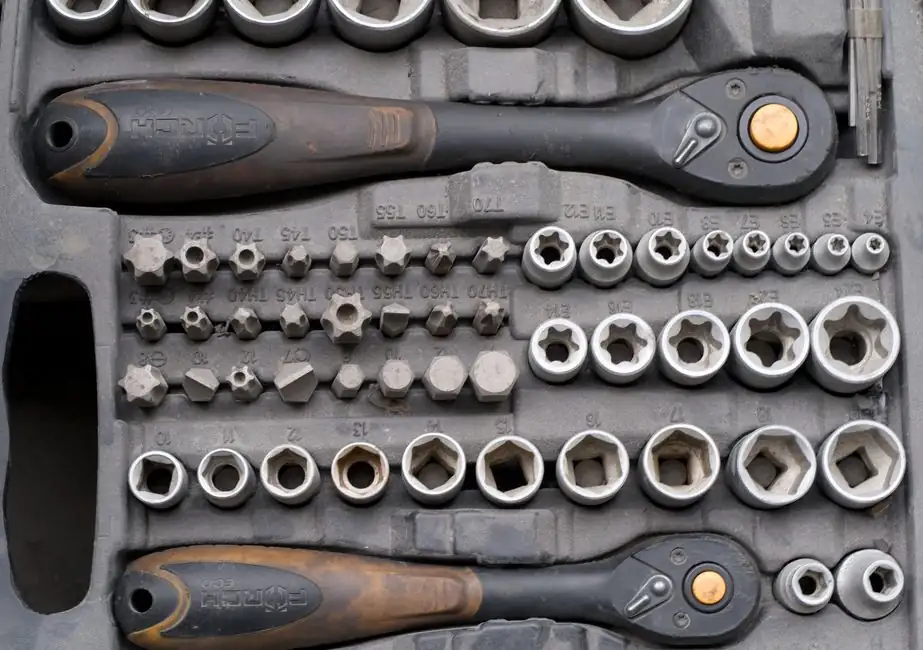
Ball-end hex keys typically engage a socket cap screw at up to a 25° off-axis angle, trading roughly 15–30% of the straight-end contact patch for access in recessed or obstructed fasteners [S5][S2].
The practical consequence is a hard ceiling on torque: once the applied moment exceeds what the ball contact can transmit, the tip either slips, mushrooms into the socket, or shears off, which is why seasoned mechanics reserve the ball end for assembly and reach for the straight end the moment a fastener is stuck or corroded [S1][S3].
Engagement geometry: why the straight end transmits more torque
A straight hex key drives along the full flat of the socket for its entire insertion depth, distributing the reaction load over multiple line contacts and a long shear path. A ball-end tool only contacts the socket on a small spherical cap, so the same input force produces a much higher contact stress and a shorter moment arm on the ball-to-shaft transition. That single geometric difference is the reason every experienced user in the cross-forum data limits ball-end tools to the "loosening a snug fastener" envelope and refuses to take a seized fastener off with one [S1][S3][S8].
KC Tool's published buying guide puts the off-axis access window for a ball-end tip at "typically up to 25°" before the tool loses positive engagement, and notes that above that angle the tool is more likely to deform the socket than to turn the screw [S5]. MSC Direct's buying guide describes the same trade-off qualitatively: the ball end exists specifically to reach fasteners that a straight key cannot physically approach on-axis, not to deliver more force [S2].
The torque ceiling in practice
Bondhus, one of the most cited USA hex-tool brands in the user discussions, ships its ball-end T-handle sets with a deliberate engineering tell: the smaller sizes are straight-tip only, and the ball-end drivers in the set ship with reduced-diameter handles so the user physically cannot apply as much hand torque [S3]. That decision is a direct manufacturer admission that the ball end cannot survive the torque an equivalent straight-end T-handle can deliver.
Across the practitioner threads, the same rule repeats: ball ends work on assembly and on lightly snug fasteners, then give up. Sawmillcreek kart racers, who routinely torque small hex fasteners hard, report abandoning ball ends entirely for that reason [S6]. Bike mechanics on the 8-year-old BikeForums thread flatly state "don't use the ball end to torque anything" because the tip mushrooms the socket before the fastener breaks free [S8]. Festool Owners Group users echo the same point: Torx is preferred over ball hex for any size below roughly 3 mm because the ball wears the internal hex faster and slips sooner [S4].
Failure modes the user has to budget for
Three failure modes dominate the field reports. First, socket rounding: the ball contact stress is high enough to plastically deform the internal hex, and a previously rounded socket will only round faster on the next attempt with the same tool [S1][S4]. Second, ball detachment: the ball end is a separate geometry welded or pressed onto a reduced shaft, and under overload that joint is the weakest link, after which the broken ball sits inside the fastener and the job stops [S3]. Third, tool flopping during starting: a ball-end tip does not positively centre on the fastener, so the user spends more time getting the thread to line up before any torque is applied at all, a complaint that recurs in the Garage Journal thread [S1].
ToolGuyd's 2018 side-by-side comparison also flags a fourth, subtler mode: long-arm ball-end keys can cam out under load even when the user is applying force on-axis, because the ball allows a small lateral play that a straight key does not [S3].
Selection rules for a working kit
Use ball-end hex keys for: blind or recessed socket cap screws where a straight key physically cannot approach on-axis, for starting a screw so the thread can find the pilot, and for low-torque final snug-up on small fasteners in the 1.5–6 mm hex range [S2][S3][S5]. Use straight-end hex keys for: any break-out on a corroded or threadlocked fastener, any torque above finger-tight on a 4 mm or larger hex, any precision adjustment where a positive "click-stop" feel matters, and any production work where the same socket will be engaged hundreds of times [S1][S6][S7][S8].
The two formats are not mutually exclusive. The mainstream pattern in the L-key market is to put the ball end on the long arm of an L-key and the straight end on the short arm, so the user gets angular access for free spinning and the high-torque short arm for the final tighten or break-loose [S3]. Combination sets from Bondhus, Wera, Wiha, and PB Swiss all follow this convention, and a Wera Hex-Plus set was specifically called out in the Garage Journal thread as the daily-driver pick of a working mechanic [S1].
Comparison: ball end vs straight end on the criteria that matter
Off-axis access: ball end wins, with engagement reliable up to roughly 25° and partial engagement beyond that, while a straight end needs a near-90° approach [S5]. Maximum transmittable torque: straight end wins, by enough margin that manufacturers derate ball-end handle diameters rather than let the user find the limit [S3]. Risk of stripping the socket: straight end wins, because its contact area is the full flat rather than a spherical cap [S1][S4]. Suitability for starting threads: ball end wins, because it self-centres approximately and tolerates misalignment while the thread finds the pilot [S3]. Suitability for break-out on seized fasteners: straight end wins, unanimously across the field reports [S1][S6][S8]. Replacement cost when the tip fails: ball end loses, because a broken ball is usually non-replaceable on a one-piece L-key, while a straight L-key can be re-ground or simply replaced cheaply [S3].
Trackable signals to watch in the next buying cycle
Two engineering signals are worth checking on any new hex-key set before purchase. First, whether the smaller sizes in the set are still straight-tip only, since that is the manufacturers' own admission of the torque ceiling [S3]. Second, whether the long-arm ball-end keys use a hex-through-shaft design, where the ball is just a contoured tip on a full hex bar, which preserves far more torque capacity than a reduced-shank ball-end geometry, and is the construction Wera uses on its Hex-Plus L-keys [S1][S5]. For heavier torquing on impact-rated fasteners, a matching article on impact driver torque ranges is at Impact Drill Torque Rating in Nm: Range, Meaning, and Selection Rules, since the ball-vs-straight logic carries over directly to 1/4" hex driver bits as well.