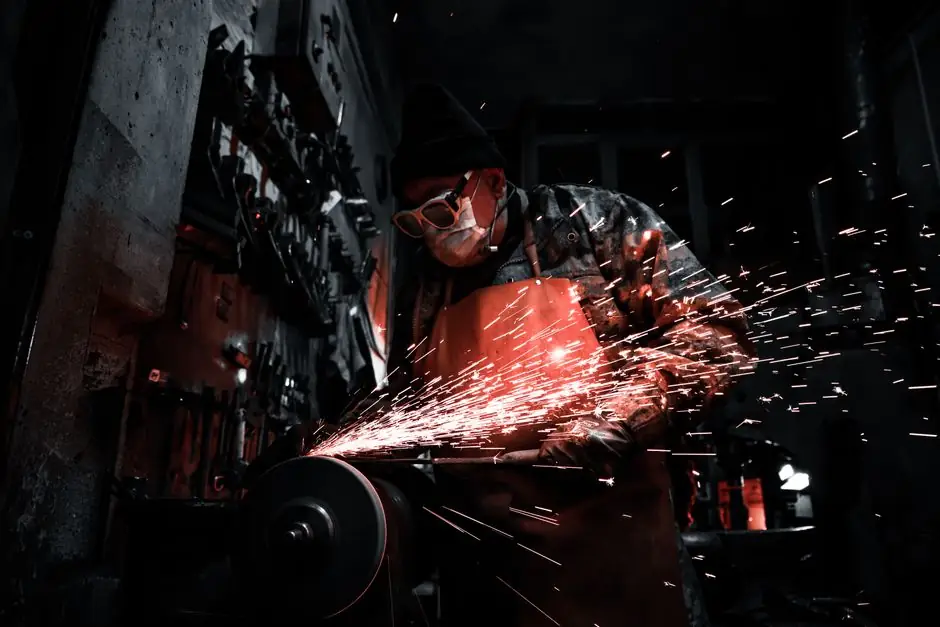
Backing pad selection governs three things on a right-angle grinder: cut rate, surface finish, and disc life, and the right pairing is almost always a function of the abrasive grit in use [S1][S3]. Industry guidance puts 24-40 grit coarse stock removal on firm/ribbed rubber pads, 50-80 grit blending on medium/smooth pads, and 100+ grit finishing on flexible/hard smooth-face pads, a grit-to-hardness map echoed across coated-abrasive catalogs [S3].
For a 4-1/2" or 5" disc on a 5/8"-11 spindle, the standard rubber backing pad is rated to the grinder's no-load RPM (commonly 11,000-12,000 RPM on 4-1/2" models), and pairing the wrong durometer with the grit is the single most common cause of premature disc edge wear and poor finish [S1][S2][S5].
Pad Hardness vs Grit: The Three-Tier Map Used by Shops
Firm/ribbed backing pads are specified for 36-40 grit and coarser, where the ribbed face channels airflow, cools the disc face, and resists disc deformation under high lateral load, which is the condition that otherwise smears a 24-36 grit ceramic or zirconia disc [S3][S4]. The rib geometry on a 7" BP70-style pad is described by manufacturers as actively cutting down loading, i.e. weld spatter and swarf sticking to the abrasive, on heavy stock removal work [S4].
Smooth/medium pads are matched to 50-80 grit, the blending and weld-bevel range, where the operator wants full disc-face contact to flatten scratch patterns without the pad flexing past the abrasive [S3]. Flexible/hard smooth pads are reserved for 100 grit and finer finishing, where conformability to a curved workpiece matters more than aggressive cut, and where a ribbed face would imprint a pattern into the final Ra [S3].
That three-tier map is the de facto spec across major suppliers: Empire Abrasives' 4-1/2" rubber backing pad is qualified for "general purpose grinding... resin fiber discs that have a grit of 36 grit or higher" [S1], while G. Wendt's coated-abrasives catalog explicitly splits the same product line into FLEXIBLE/SMOOTH for 50+ grit and FIRM/RIBBED for 40 and coarser [S3].
What "Hardness" Actually Means on a Resin-Fiber Backing Pad
Resin fiber disc backing pads are almost universally molded rubber or rubber-composite, with the working face either smooth or ribbed, and a molded-in or bonded metal hub that mates to the grinder spindle (commonly 5/8"-11 UNC for North American 4-1/2"-7" angle grinders, M14 for European) [S1][S2]. Hardness is communicated two ways: by durometer (Shore A, typically 70-90 for general-purpose pads) when the spec sheet lists it, or by the face geometry description, ribbed = firmer response, smooth = more conformable [S3][S4].
Durometer and ribbing both change the contact patch. A firm ribbed pad concentrates load on the abrasive tips, raising point pressure per grit and accelerating cut, while a flexible smooth pad spreads load across the disc face, lowering pressure per grit and producing a finer, more uniform scratch [S3]. The 7" BP70 pad is marketed specifically around that "ribbed face cools the disc and cuts down loading" behavior, which is the practical reason fabricators reach for it on 24-36 grit ceramic discs [S4].
One consequence worth flagging: a pad that is too soft for the grit will deflect rather than let the abrasive cut, the disc glazes, and the operator concludes the abrasive is bad. A pad that is too hard for the grit will telegraph any operator wobble into the surface and shorten disc life on curved work [S3][S5].
Sizing, Thread, and RPM: The Specs That Have to Match First
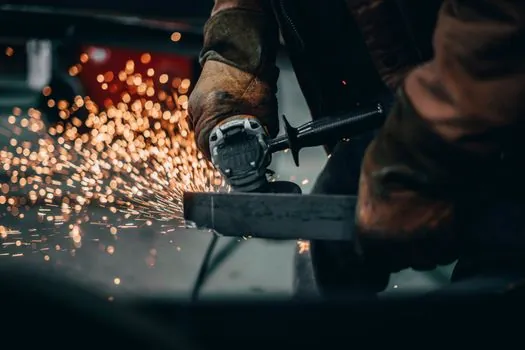
Before durometer, three mechanical specs have to align: disc diameter (4-1/2", 5", 7"), spindle thread (5/8"-11 UNC in North America, M14 x 2.0 in Europe, M10 x 1.25 on some 100 mm grinders), and the grinder's maximum free speed [S1][S2]. A 4-1/2" rubber backing pad on a 5/8"-11 spindle is the stock SKU for North-American 4-1/2" right-angle grinders, and the same pattern at 5" covers the 5" disc class [S1][S2].
Operating speed is non-negotiable. Norton Abrasives' shop-floor case study documents fabricators running 5" right-angle grinders at 11,000 RPM with a medium air-cooled backup pad on 36-grit 4-1/2" discs, which is the upper end of the speed band where pad cooling actually matters [S5]. Exceeding the pad's rated RPM, which is typically printed on the pad's metal hub and matches the grinder's no-load speed, is the failure mode that sends rubber segments into the workpiece.
The M14 vs 5/8"-11 split is the most common cross-border spec error. A 4-1/2" pad ordered with the wrong hub thread will not seat on the spindle, and forcing it with an adapter changes the dynamic balance enough to cause vibration at 10,000+ RPM. Confirm the spindle thread before grit matching.
Air-Cooled vs Solid Rubber: When to Spend More
Air-cooled backup pads, identifiable by radial slots or multi-piece construction, pull airflow across the disc face and are specified for production-grinding cells where a single pad-disc combination runs for extended periods at high contact pressure [S5]. Solid rubber pads are cheaper and adequate for job-shop and maintenance use where the disc is changed every few minutes and heat build-up is not a limiting factor [S1][S2].
For a fabricator grinding 36-grit ceramic discs on 5" grinders at 11,000 RPM, the documented best practice is a medium air-cooled backup pad rather than a solid rubber one, because ceramic grain runs hot and unvented pads shorten both disc life and pad life [S5]. For a maintenance tech running a 50-grit zirconia disc intermittently on a 4-1/2" grinder at 10,000 RPM, a solid rubber backing pad from any major abrasive supplier is sufficient [S1].
Real Failure Modes and How to Read Them
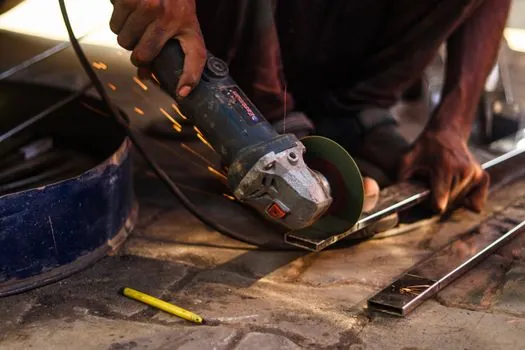
Pad selection failures show up in the disc, not the pad. A disc that cuts slow and glazes on the face points to a pad that is too soft for the grit, or to operator pressure that is too low [S3][S5]. A disc that wears unevenly on the outer edge while the center is intact points to a pad that is too hard, or to a grinder with a worn or wrong-size backing pad that is too small in diameter for the disc [S1][S2].
For an in-depth look at how pad attachment, hook-and-loop versus threaded, changes the disc-change workflow on the same grinder class, the comparison in Hook-and-Loop vs Threaded Backing Pads on an Angle Grinder is a useful adjacent read. For disc thickness and safe RPM-class sizing rules on the same tool platform, see Angle Grinder Disc Thickness vs RPM Class: Safe Sizing Rules.
Who This Spec Is For, and Where It Is the Wrong Choice
This grit-to-pad-hardness map is the right tool for coated-abrasive fiber disc work on a right-angle grinder, covering weld blending, deburring, millscale removal, and surface prep on carbon and stainless steel [S1][S2][S3][S5]. It is the wrong framework for flap discs, which use their own integrated backing plate, for cut-off wheels and grinding wheels, which are rigid bonded abrasive products, and for non-woven surface conditioning discs, which use a different conformable pad system [S1][S2].
It is also the wrong framework for a finishing operation that requires a controlled Ra value below what an 80-grit abrasive can deliver, in which case the right tool chain is a floor grinder with a finer abrasive sequence, or a stationary belt grinder, not a hand-held right-angle grinder with a softer pad [S3]. For 4-1/2" and 5" work where the abrasive is changed often, the stock rubber backing pad from any major supplier covers the spec at the right price point [S1][S2].
The two trackable signals to watch are: (1) pad-face temperature after a 30-second cut at production pressure, which should stay below the point where the rubber visibly deglosses, and (2) disc-edge wear pattern, which should be uniform radial rather than concentrated at the outer perimeter, the latter indicating a pad that is too hard or too small in diameter for the disc [S3][S4][S5].
