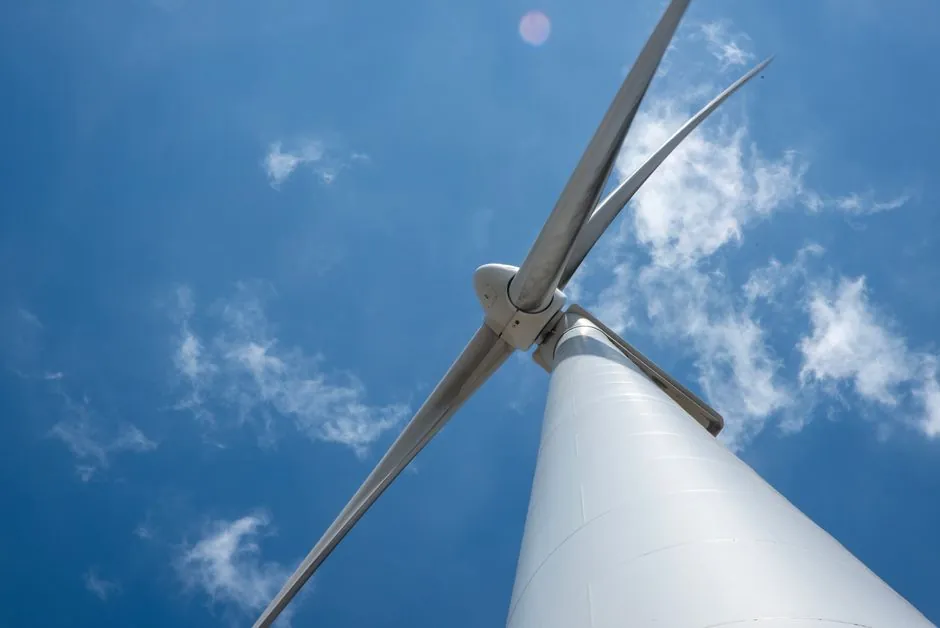
Wind turbine pitch and yaw mechanisms demand ball splines that transmit continuous torque under cantilever loading, with service intervals aligned to 6- to 12-month maintenance windows. In 2026 reference builds, the typical pitch-axis spline is a medium-preload (P1) caged-ball type on a through-hardened SUJ2 shaft, sized for the maximum static torque at the parked-blade position rather than the aerodynamic mean [S1][S2].
Operating envelopes vary by assembly: pitch drives run intermittent low-RPM indexing (typically below 10 RPM) with high shock loading during emergency feathering; yaw drives run slow continuous rotation (roughly 0.1–0.5 RPM) under steady gravitational and wind moment loads. Both applications classify as heavy-duty per the THK selection flow, which requires stroke, velocity, applied load, mounting direction, environment, duty cycle, and accuracy to be locked before type selection [S1].
Mechanical envelope and torque sizing
Torque transfer is the primary sizing axis: for a ball spline, the maximum bending moment an assembly can absorb depends on the inner-race diameter and the position of the outer race relative to the applied load, with cantilevered mounting amplifying deflection as a function of the lever arm [S5]. Standard sizing rules require the designer to lock maximum load, desired linear-travel life, rotational speed, and bearing-span length before the calculation [S5]. For wind power, the "maximum torque" used for selection is the worst-case feathering or parked-blade torque, not the duty-cycle mean, so the selected spline line on the manufacturer life chart sits to the right of the operating point [S5].
Inner-race materials are through-hardened alloy steel, induction or vacuum heat-treated to 56–60 HRC, with gothic-arch ball grooves for long life and low rotational lash; outer races use bearing-quality steel at 58–60 HRC and carry three or six active recirculating ball circuits in the standard build, with high-performance versions available for higher-speed, heavy-duty duty cycles [S5]. SUJ2 high-carbon chromium bearing steel, the JIS designation equivalent to DIN 100Cr6 / AISI 52100, is the default through-hardening material referenced for wind-grade splines, with load surfaces ground to a smooth track so balls roll without brinelling the grooves [S8].
Preload class: why P1, not P0, for pitch and yaw
Preload eliminates rotational clearance and roughly doubles spline rigidity: with preload applied, displacement at a given torque is cut to about half of the un-preloaded value, and rigidity more than doubles [S2]. For wind power, the practical impact is reduced hysteresis in pitch feedback and tighter yaw holding under wind moment.
The three standardized preload classes used by TBI / KTOMOTION-style catalogues map cleanly to wind applications: P0 (zero preload) suits smooth, low-force, unidirectional drive with no cantilever load; P1 (light preload) suits cantilever or alternating torque with high repeat-positioning accuracy, the typical industrial-robot arm and EDM-spindle class; P2 (medium preload) suits single-nut torque transmission under high rigidity with vibration and impact, the indexing-table and tool-changer class [S2]. For pitch and yaw in utility-scale turbines, P1 is the standard 2026 reference, stepping to P2 on the larger pitch bearings where gear-driven impact loads dominate during emergency feathering [S2]. The wider ball-spline selection rule for any application with reciprocating motion plus vibration is to apply preload, since it "can significantly improve the lifespan and accuracy" [S2].
Environmental and lubrication constraints

Wind turbines present a brutal environment: temperature swings of roughly −30 °C to +60 °C at the nacelle, salt-laden humidity in offshore units, UV exposure, and grease-starvation risk because the spline runs at very low duty-cycle RPM. The selection flow explicitly lists environment and operating frequency as inputs before type selection, and accuracy class is locked at the same step [S1]. For offshore units, the practical build is a stainless or zinc-nickel-plated spline with sealed end caps and a corrosion-inhibited grease; the underlying steel selection still defaults to SUJ2 because no commercial alternative matches its 60 HRC through-hardening band at comparable cost [S8].
Lubrication regime drives the maintenance interval more than any other single choice. Standard greases with a mineral-oil base and lithium thickener typically deliver 6–12 month relubrication on a wind pitch spline; synthetic PAO or PFPE greases push that to 12–24 months at the cost of compatibility testing against the existing seal elastomers. A related point, often missed: ball splines in pitch systems share the grease pool with the ball bearing set in the blade root, so any grease migration or hardening in cold-soak conditions can stall both systems simultaneously.
Accuracy class, life calculation, and critical speed
Accuracy on a wind ball spline is normally specified to a precision-ground class rather than a rolled class, with running parallelism on the order of 0.01–0.02 mm over the spline length, depending on diameter. Hollow shafts are an option where system mass must drop, with the trade-off that torsional stiffness falls roughly with the cube of the outer-to-inner diameter ratio; this is the same hollow-shaft trade-off used on some ball screws, and is worth using only where the torque demand is well below the rating [S5].
Critical speed is the final verification step: the spline shaft must not run at a speed that excites its first natural frequency, and critical speed varies with diameter, bearing span, load, rotational speed, and end fixity [S5]. Wind yaw drives are well below the danger band, but a pitch drive accelerated into emergency feathering can transiently cross the first critical speed of a long, slender spline, so verification of the first three modes is standard practice in 2026 drivetrain reviews.
Comparison: P0 vs P1 vs P2 preload for wind duty

Three preload classes, three decision criteria:
1) Rigidity: P0 baseline ≈ 1.0×; P1 typically 1.5–2.0×; P2 above 2.0×, with displacement at a given torque roughly halved versus P0 [S2].
2) Suitability for wind: P0 fits only small passive vanes with unidirectional torque; P1 is the default for pitch and yaw on utility-scale turbines because it balances rigidity and grease drag; P2 fits large pitch drives with severe feathering shock and indexing tables under reversing torque [S2].
3) Cost and life: P0 is the cheapest but offers the shortest fatigue life under vibration; P1 is the 2026 cost-of-ownership sweet spot; P2 trades higher initial cost for the longest life under reciprocating motion and impact, and is the right pick when the ball screw on the same axis is also preloaded [S2][S8].
Failure modes and what to verify at the PO stage
Three failure modes dominate the 2026 field-failure population: brinelling from static overload during parked-blade events, grease hardening in cold-soak offshore conditions, and seal failure allowing salt ingress onto the ground ball grooves. A fourth, less common but expensive, is fretting corrosion at the spline-to-hub interface when torque is transmitted through a loose fit; the standard mitigation is a shrink-fit or keyed hub, never a setscrew on a precision-ground shaft. [S8]
What to lock at purchase order: inner-race material and hardness certificate (SUJ2 or equivalent, 55–60 HRC through-hardened), preload class (P1 default), accuracy class (precision-ground), seal type (contact nitrile or fluoroelastomer, depending on temperature), grease specification (manufacturer, base oil, thickener, worked penetration), and the calculated L10 life at the worst-case torque, not the mean. Cross-check that the ball valve-style sealing approach is not being applied by mistake: a ball spline seals lubricant, not process fluid, and the seal geometry differs accordingly.
Trackable signals for the next quarter: wind-grade spline suppliers releasing documented 12-month grease-life test data on P1 preloaded splines at −20 °C cold-soak, and IEC 61400-27-1-style simulation inputs being published for pitch-actuator duty cycles, which would let procurement teams standardise the worst-case torque assumption across vendors.
For related coverage, see Skylight selection for cold storage: U-value, IP rating, and daylight factor trade-offs.