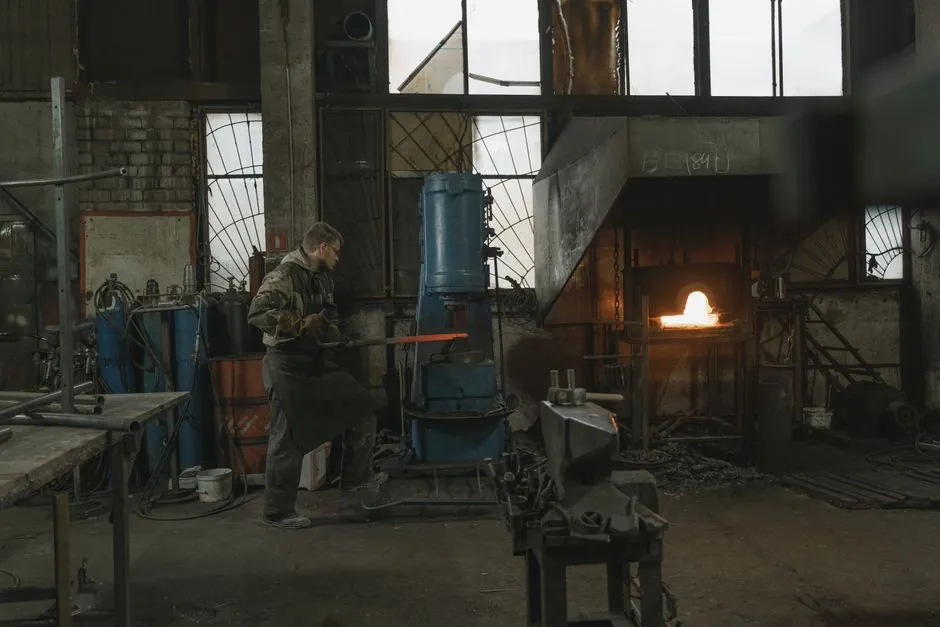
Steel-mill duty puts ball splines into hot, scale-laden, shock-loaded service: roll-screw-down drives, coiler mandrel lifts, run-out table transfers, and side-guide adjustments on a reversing mill. The spec that survives that duty is the high-torque 45° angular-contact type on a through-hardened bearing-steel shaft at 58 HRC, in nominal shaft diameters of 15 to 100 mm, with integral wipers and grease lubrication [S2][S7].
Three OEM product families define the field for this duty class: the THK LBS/LBF/LBR/LBH high-torque series (shaft 15 to 150 mm, 45° contact, six rows of balls on three crests), the TBI SL/SG/SO series (40° angular contact, gothic-arch ground grooves, zero angular clearance), and the MISUMI BSHS both-ends-tapped series built on EN 1.3505 / EN 1.4125 / EN 1.7225 / EN 1.7242 equivalents at 58 HRC and 55 HRC [S2][S3][S4]. Each ships in shaft-end configurations that match steel-mill framing: straight, one-end tapped, both-ends tapped, and round-flange or compact-flange nut shapes [S1].
Steel-mill service classes and the contact angle that fits each
Ball splines for steel mills are not interchangeable with the medium-torque 20° contact types used in office automation and instrument axes [S2]. The high-torque LBS-class spline uses a 45° contact angle with six ball rows on three 120°-spaced crests, and applies an even preload so angular backlash is zero and torsional rigidity is high enough for reversing-mill screw-downs [S2]. The medium-torque LT-class (20° contact, four to six rows) is the right pick only for light indexing, gas-welding spindles, and similar low-impact service, and the catalog explicitly steers it away from shock-loaded steel-mill positions [S2].
TBI's 40° angular-contact gothic-arch groove geometry is the second common pattern; the ground profile eliminates clearance on both sides of each crest, so a 40°-class spline is also a valid fit for the high-moment steel-mill positions where a 20° contact would deflect [S4]. The 45° LBS geometry gives the highest torsional rigidity, while the 40° TBI geometry is the common choice where the duty mixes high radial load with moderate torque transmission [S2][S4].
Materials, hardness, and what survives mill coolant
The shaft material on the high-torque steel-mill ball spline is through-hardening bearing steel: SUJ2 (JIS) is the default equivalent to DIN EN 1.3505 / 100Cr6, and is hardened to 58 HRC minimum, then ground to the gothic-arch or 120°-crest profile [S7]. The MISUMI BSHS both-ends-tapped series is documented on EN 1.3505 (shaft) and EN 1.4125 / EN 1.7225 / EN 1.7242 (nut) at 58 HRC and 55 HRC respectively [S1][S3].
Hardness below 58 HRC on the shaft track leads to brinelling and premature fatigue spalling under the cyclic edge loads of a reversing mill, and is the single most common field-failure root cause on retrofit programs [S7]. For positions that see direct coolant spray or hydraulic-oil mist, specify the stainless or corrosion-resistant equivalent (DIN EN 1.4125 / X105CrMo17) for the nut, paired with the same 58 HRC minimum on the shaft; both are offered in the MISUMI both-ends-tapped catalog [S1][S3]. The ball bearing reference page covers the same SUJ2 / 100Cr6 selection logic for the adjacent rolling-element bearings in the same gearbox.
Shaft diameter, length, and end geometry for mill framing

Steel-mill framing dictates the shaft-end and the nut shape. For a coiler mandrel or run-out-table transfer, a both-ends-tapped shaft (MISUMI BSHS style) lets the mechanical designer lock the spline between two end-supported bearings with through-bolts, instead of a press-fit shoulder, which is easier to field-service [S1]. For a screw-down position with a gear-coupled drive, the one-end-tapped shaft (MISUMI "One End Tapped") with a press-fit key into the nut is the standard pattern, and the catalog warns explicitly against machining the nut after key fitting because accuracy will be lost [S3].
Nominal shaft diameter is the second hard gate. THK's LBS-class high-torque series is offered in 15 to 150 mm nominal diameters, with the 25 to 60 mm range in the caged-ball SLS/SLF subfamily; the LT-class medium-torque range extends down to 4 mm and up to 100 mm [S2]. For steel-mill screw-downs and side guides, 25 to 60 mm is the common operating band; for coiler mandrel lifts, 50 to 100 mm is the standard. TBI's SL/SG/SO ball-spline family is published for nominal diameters in the same heavy-industrial band that mirrors the THK LBS line [S4]. Selecting undersize is the most common field mistake: a 20 mm spline on a screw-down that belongs on a 40 mm spline will see edge-loading, premature brinelling, and a fatigue life an order of magnitude below the published curve [S7].
Load, life, lubrication, and sealing in mill ambient
For a reversing-mill screw-down, the published high-torque 45° LBS-class spline at 40 mm nominal diameter, 58 HRC EN 1.3505 shaft, and 45° contact, will transmit the reversing torque without measurable angular backlash under the mill's preload [S2][S7]. For a continuous coiler mandrel, the LT-class medium-torque 20° spline is generally underspecified, and the LBS or SLS high-torque 45° / caged-ball spline is the right pick, with the additional advantage that the caged-ball SLS/SLF design cuts ball-to-ball friction, lowers particle generation, and lengthens grease retention in dusty mill air [S2].
Sealing and lubrication are the second failure-mode cluster. Mill ambient carries rolling-mill scale, hydraulic-oil mist, and water-glycol coolant, so the spline must ship with integral wipers on both ends of the nut and a grease-relubrication port. THK's caged-ball SLS/SLF extends grease retention by holding lubricant in the cage pockets, supporting long-term maintenance-free operation in dirty industrial ambient [S2]. The MISUMI both-ends-tapped series ships in standard through-hardened form; for direct coolant exposure, the EN 1.4125 stainless-nut option is the documented pick [S1][S3]. The ball screw reference page documents the same wiper and lubrication logic for the parallel drive screws in the same mill stand.
Comparison: high-torque 45° vs 40° vs medium-torque 20° for steel-mill positions
Three options line up against the duty criteria a steel-mill spec engineer actually uses [S2][S4][S7]:
1. THK LBS / LBF / LBR / LBH high-torque, 45° angular contact, 6 ball rows on 3 crests, shaft 15 to 150 mm: highest torsional rigidity, zero angular backlash, the right pick for screw-downs and coiler mandrels.
2. TBI SL / SG / SO, 40° angular contact, gothic-arch ground grooves, zero angular clearance, heavy-industrial shaft band: the right pick where radial moment load dominates over reversing torque, including side guides and run-out-table transfers.
3. THK LT / LF medium-torque, 20° contact, 4 to 6 ball rows, shaft 4 to 100 mm: too soft for steel-mill screw-downs and coiler mandrels; reserve for light indexing and instrument axes where the catalog places them [S2].
The selection map: use the 45° LBS class when reversing torque and torsional stiffness are the gate; use the 40° TBI class when radial moment is the gate and torque is moderate; do not use the 20° LT class in any position that sees roll-changing shock or mill-scale contamination.
Limits, failure modes, and what the spec must exclude
The ball spline is not a substitute for a gear coupling, a tapered sleeve, or a shrink-disc press fit. Its envelope is limited by the catalog nominal-diameter range (15 to 150 mm for the LBS class, 25 to 60 mm for the caged-ball SLS/SLF class, 4 to 100 mm for the LT-class) [S2]. The nut must not be re-machined after the key is pressed in, or the running accuracy is lost [S3]. The shaft track below 58 HRC will brinell under reversing-mill edge load, and any substitution that drops the shaft hardness below the catalog value is the most common field-failure path [S7].
Seal-less installations in mill ambient will fail prematurely from scale ingestion, regardless of the contact-angle spec; this is why the caged-ball SLS/SLF series and any stainless-nut option must ship with wipers on both ends of the nut [S1][S2][S3]. For a wire-rod block or a bar-mill interstand, where ambient temperature cycles past 80 °C, the published grease retention figures on the caged-ball design are the difference between a one-year and a five-year relubrication interval [S2].
Specification outline a steel-mill buyer can copy
The spec block that holds up in a steel-mill purchase order: nominal shaft diameter 40 mm (coiler mandrel) or 25 to 60 mm (screw-down), high-torque 45° angular contact (THK LBS / LBF class) or 40° contact (TBI SL/SG/SO) per the duty map, shaft material EN 1.3505 / SUJ2 / 100Cr6 at 58 HRC minimum, nut material EN 1.7225 or EN 1.4125 at 55 HRC minimum (EN 1.4125 for direct coolant exposure), both-ends-tapped shaft or one-end-tapped with press-fit key, round-flange or compact-flange nut per the framing, integral wipers on both nut ends, grease-lubrication port, and conformance to the published caged-ball SLS/SLF retention figures where long relubrication intervals are required [S1][S2][S3][S4][S7].
Trackable signals: the next THK caged-ball SLS/SLF catalog revision on the 25 to 60 mm high-torque band, and the next MISUMI BSHS catalog print on EN 1.4125 corrosion-resistant nuts for direct-coolant positions, are the two updates that will move the steel-mill spec. ball spline and alloy steel are the adjacent reference pages for engineers cross-checking the SUJ2 / EN 1.3505 / 100Cr6 selection and the EN 1.4125 corrosion-resistant nut logic. ball valve and electric ball valve are unrelated and should not be cross-referenced on this duty class. For related industrial spec guidance, see the industrial solvent selection map for mold and die making and the heat treatment furnace selection for hardware manufacturing articles, which cover the adjacent process-engineering decisions in a steel-mill hardware line.