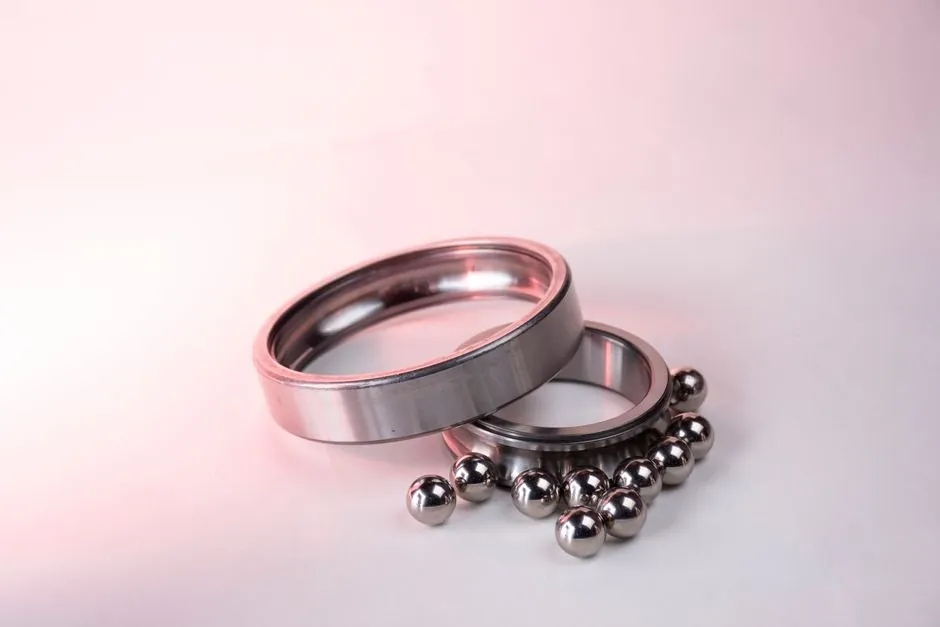
Ball spline shaft hardness should be at least 250 HV when wear resistance is the governing requirement, because abrasion loss rises as shaft hardness falls below that level [S2].
The shaft, nut, steel grade, heat treatment, surface finish, load, speed, lubrication, and temperature must be specified together, since hardness alone does not determine service life.
250 HV Sets the Wear-Resistance Threshold
A softer shaft can still be appropriate where loads are modest, shock is absent, replacement cost must be low, or the nut is intended to be a sacrificial wear component. The selection must then cover torque, contact pressure, sliding speed, lubrication, and temperature rather than using hardness as a standalone life indicator.
The ball spline combines rolling-element motion with a splined shaft and nut. Its useful envelope depends on both rolling-element contact and the sliding interaction at the spline flanks, so the 250 HV criterion is best treated as a wear-design floor, not an unconditional operating rule.
Case Hardening Balances Surface Wear and Core Toughness
This construction separates the two functions: the case resists contact and abrasion, while the core carries bending and torsional stresses without the brittleness associated with through-hardening.
Other shaft options include 1045, 1144, 4140, 52100, and EN8 steels, with availability depending on the specified profile [S3].
For a new ball spline shaft, the drawing should identify the steel grade, case or induction-hardened depth, surface hardness requirement, hardened region, and allowable transition. Without a defined hardened zone, a hardness sample taken on a shaft end may not represent the working spline surface.
Torque, Contact Pressure, and pV Set the Duty Limit
THK calculates spline-nut contact pressure as p = 9.8 PT/T, where PT is applied torque in N·m and T is dynamic permissible torque in N·m [S2]. Its pV selection method combines contact pressure p in N/mm² with sliding speed V in m/min, with allowable pV changing under different lubrication conditions [S2].
The selection equation is fT × PT/fS ≤ T [S2]. Recommended safety factors are 1–2 for a static load used infrequently, 2–3 for an ordinary single-direction load, and 4 or greater for vibration or impact [S2].
Dynamic permissible torque is referenced to a bearing-tooth contact pressure of 9.8 N/mm² [S2]. If the shaft is hardened but the applied torque is excessive, p and pV can still promote flank wear, deformation, or seizure. Hardness specification must therefore remain part of the same calculation used to size the nut and shaft.
Surface Finish and Lubrication Work With Hardness
The lower roughness reduces asperity contact and provides a more consistent sliding interface, but it does not replace correct preload, lubrication, contamination control, or material pairing.
THK states that the allowable pV guide varies with lubrication conditions [S2]. That makes lubricant selection part of the hardness decision: a hard shaft operating without an effective lubricant can still suffer high friction, heat, and wear. The operating checklist should identify lubricant type, replenishment method, seal arrangement, and contamination exposure rather than leaving lubrication as an installation detail.
The wear mechanism also depends on hardness compatibility between mating members. In spline components, lower hardness correlated with more severe wear, while increasing the hardness of the mating part could increase wear on the softer member [S1]. Hardness matching therefore matters even when the shaft itself is hardened.
Hardness Matching Limits Mating-Surface Damage
Aerospace spline interfaces can operate at contact stresses of 1.5–2.5 GPa under high-speed rotation and heavy loading [S1]. The internal-to-external spline hardness ratio, Hi/He, is a critical matching parameter because an unsuitable hardness gradient can promote premature interface wear and initiate microscopic fatigue cracks [S1].
Wear in the studied spline materials was inversely correlated with hardness, but greater hardness in the mating member could accelerate wear in the softer component [S1]. The engineering implication is direct: selecting a harder shaft does not justify an unnecessarily harder or softer nut, and both members should be reviewed as a hardness pair [S1].
That aerospace result concerns extreme spline coupling conditions, so it should not be transferred numerically to every machine-tool or laboratory ball spline. It does, however, support a general inspection practice: record the hardness of the shaft and nut separately, compare them with the approved material pair, and investigate changes in wear rate or noise as evidence of mismatch rather than treating the shaft alone as the root cause.
Select by Application, Not by a Universal Hardness Number
Ball spline shafts suit applications requiring axial and radial movement, high speed, vibration, shock loading, precise positioning, and high torsional loads [S4]. Hardened surfaces can reduce permanent deformation and premature wear, while case-hardened 52100 shafts retain a tough core [S3][S7].
The principal options compare as follows:
The comparison supports different decisions by application. Case hardening is appropriate where the working surface must resist wear and the core must tolerate impact. Through hardening favors section-wide strength where load intensity dominates. Unhardened stock lowers initial material complexity but is harder to justify where abrasion, reversing motion, or close positioning tolerances dominate.
Inspection and Procurement Must Lock the Wear Specification
Specify hardness in HV or another explicitly defined scale, state the measurement location, and require the result on the working spline surface rather than the plain shaft diameter. THK's dedicated rolled-shaft condition provides a useful procurement benchmark of at least 250 HV and Ra 0.20 µm or less [S2]. Where the design uses a conventional ground shaft, Ra 0.80 µm or less is the stated preferred ceiling [S2].
Specify surface treatment as well as the numerical hardness. For 52100 four-spline shafts, case hardening is used to improve surface wear resistance while preserving a softer core [S3]. Drawing notes should identify permitted steel grades, case depth, effective hardened length, transition zone, surface roughness, and inspection method.
Track two service signals after installation: nut wear or preload change, and evidence of spline-flank scoring, heat discoloration, or rising drive current. Compare those observations with the calculated p, pV, fS, and fT values [S2]. If wear rises despite hardness of at least 250 HV, inspect lubrication, contamination, alignment, and nut-to-shaft hardness pairing before increasing hardness further.
A practical hardness specification starts with a minimum of 250 HV on the working surface, adds the appropriate Ra roughness requirement, and ties the result to verified torque and pV calculations rather than treating hardness as a stand-alone life guarantee.