
The choice is not a simple upgrade: ball bearings favor speed, low friction, economy and misalignment tolerance, whereas roller bearings favor load capacity, stiffness, moment resistance and positioning accuracy [S1][S2].
Same Diameter, Different Contact Geometry
A ball contacts the shaft at a point, while a cylindrical roller contacts it along a line. The larger contact area reduces peak contact stress and increases fatigue capacity at a given load, but it also raises heat generation and drag.
For ordinary round-shaft systems, linear bearings can be compared by dynamic rating, static rating, speed, friction, preload and shaft alignment rather than bore alone. Shaft diameter is only one part of the load calculation because rail geometry, roller diameter, bearing arrangement and support conditions also determine performance.
Capacity Comparison by Operating Criterion
Load capacity is the roller bearing’s decisive advantage. For a given bore and outer diameter, line contact normally produces a higher basic dynamic load rating than point contact [S3]. The difference applies to linear bearings as well as rotary bearings, although exact catalog ratings must be taken from the selected manufacturer and series rather than inferred from geometry.
Speed is the reverse. Linear ball bearings are commonly rated for 1–3 m/s continuous stroke velocity. The published friction coefficient for ball recirculating bearings is approximately 0.002–0.004. University precision-design material gives a wider ball range of 0.002–0.003 and a roller range of 0.005–0.01 [S7].
Stiffness and moment loading favor rollers because their longer contact patch and, in some configurations, multiple roller rows reduce elastic deflection.
Dynamic and Static Ratings Must Be Checked Separately
Dynamic load capacity C supports calculated life, while basic static load capacity C0 limits permanent deformation under a stationary or very slowly moving load. Static and dynamic load capacity are different specifications based on different operating parameters and performance criteria and should be evaluated independently.
For linear motion, the dynamic rating relates to fatigue flaking over travel, whereas the static rating concerns the combined deformation of the raceway and rolling element [S4]. A roller unit may win the dynamic comparison but still require a separate check for shock, vibration, static holding and installation alignment.
The load direction matters too. Circular plain bearings resist radial load well but offer little axial restraint. A profile guide is normally preferred when axial loads, overturning moments or high stiffness govern the design. Round-rail systems are more forgiving of parallelism errors and torsional misalignment caused by carriage or base machining and machine deflection [S2].
Application Fit and Misalignment Trade-offs
Ball bearings are the stronger choice for conveyors, packaging equipment, light machine axes, high-reciprocating-speed stages, cost-sensitive assemblies and installations with imperfect mounting alignment. Their lower friction reduces motor sizing requirements, while round-rail ball bushings tolerate rail-height variation and base flatness errors more readily than tightly preloaded profile rails [S1][S2].
Roller bearings are the stronger choice for presses, heavy machine-tool axes, high-load transfer tables, CNC equipment, semiconductor handling and other applications where rigidity, load capacity or moment resistance outweigh speed and initial cost [S1][S2]. Profile-rail systems are used in applications where load capacity, stiffness, and accuracy are central.
Rollers are not automatically superior in every axis. Their higher friction and heat generation can shorten lubrication intervals, increase drive energy and reduce acceptable high-speed duty.
Procurement and Failure-Mode Checklist
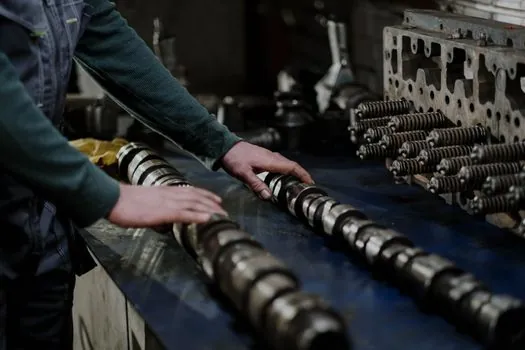
Specify the complete bearing model, not a generic ball or roller designation. For the illustrative LM20 ball unit, record the 20 mm bore, 32 mm outside diameter and approximately 1,100 N dynamic rating; for the roller alternative, request the manufacturer’s exact dynamic rating, static rating, allowable moment, maximum travel speed and preload class [S1]. Shaft material and hardness also matter because the shaft may function as a rolling raceway.
Hardened and ground shafts are commonly made from EN31 or SUJ2 bearing steel in linear-bearing practice [S1]. Check shaft diameter and roundness, mounting parallelism, contamination exclusion, lubrication method, end support, seal drag and the ratio of actual load to catalog C and C0. If the shaft serves as the raceway, inadequate hardness or finish can dominate the failure mechanism even when the selected rolling-element type has adequate capacity.
The principal failure modes differ by architecture. Ball recirculation can suffer from seal drag, insufficient lubrication or raceway wear; roller systems add sensitivity to misalignment, preload and frictional heat. Profile guides can also exhibit notchiness when heavily preloaded, while round ball bushings generally operate more smoothly but with less moment stiffness [S5].
Practical Selection Decision
Choose a ball linear bearing when the shaft diameter is fixed, peak load is modest, continuous velocity approaches 1–3 m/s, misalignment is uncertain, and minimum friction and acquisition cost dominate. Choose a roller linear bearing when the same diameter must carry roughly 2 times or more load, moment loads are significant, or stiffness and positional repeatability justify lower speed and higher friction [S1][S5].
Do not assign a roller bearing from shaft diameter alone. Obtain manufacturer C and C0 ratings for the exact series, calculate the required safety factor, compare allowable speed with the duty cycle, and verify moment, lubrication, shaft finish and support stiffness. A ball bearing or roller bearing selected outside its rating system is not an engineering comparison.