
Caged needle roller bearings suit higher-speed operation because their cage separates the rollers and reduces rubbing, while full complement designs maximize radial load capacity at moderate speed [S2][S7][S8].
The choice depends on the required rpm, radial load, lubrication, temperature and acceptable starting friction, not on a universal rpm threshold that applies to every size and duty cycle [S2][S3][S9].
Decision Rule for Caged and Full Complement Bearings
Use a caged needle roller bearing when shaft speed is a primary constraint, continuous rotation is required, or low lubricant demand matters; Schaeffler states that needle roller and cage assemblies are suitable for higher speeds than full complement arrangements [S2].
SKF identifies its full complement drawn-cup HN series as suitable for very heavy radial loads at moderate speeds, with open ends and without seals [S4]. The selection conclusion is therefore straightforward: specify caged construction for speed priority, and full complement construction for load-density priority. The size, load direction, lubricant and temperature still require manufacturer-specific verification.
Speed Capability Comes From Roller Separation
Caged assemblies use a cage to maintain spacing between needle rollers, which improves speed capability and reduces friction compared with a full complement arrangement [S8]. The cage-guided design also addresses the limitations exposed when rising speed and reduced lubrication demand are imposed on full complement bearings [S7].
The published values illustrate why dimensional and product data must not be reduced to one comparison number. One full complement listing gives a speed-limit factor of 550,000 mm/min and an operating speed of 800 rpm [S6].
Those numbers describe different products and test conditions, not directly interchangeable specifications. The 800 rpm example cannot be applied to another diameter, load, lubrication condition or manufacturer catalog [S6].
Cradle and Full Complement Options Compared
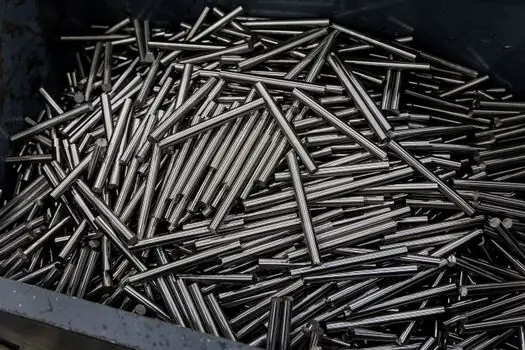
Compared by speed, load capacity, friction and installation, caged needle roller and cage assemblies are the better choice for higher rotational speed, while full complement bearings are stronger candidates for very heavy radial loads at moderate speeds [S2][S4].
For speed capability, caged wins because the cage separates adjacent rollers and supports more controlled motion. For radial load density, full complement wins because more rollers can occupy the available space without cage spacing.
For geometry and handling, a full complement bearing offers a compact, simple radial-load solution, but its roller population creates sensitivity to speed, lubrication and heat.
Cost cannot be ranked universally because price depends on size, materials, cage design, quantity and supplier. The defensible comparison is functional: a full complement arrangement provides maximum load carrying capacity, whereas the caged arrangement adds speed capability and reduces friction [S8].
Application Fit by Load and Duty Cycle
Full complement drawn cup needle bearings in the HN series are suitable for very heavy radial loads at moderate speeds and are available with open ends and without seals [S4]. They are less attractive for continuous high-speed service, restricted lubrication, or duties where generated heat is difficult to remove [S2][S3][S7].
Full complement construction provides maximum load carrying capacity, while caged construction improves speed capability and reduces friction [S8]. For broader rolling-element selection, compare needle bearings against roller bearings, but retain the specific geometry when envelope and radial load dominate.
Failure Modes and Operating Constraints
This makes temperature, lubricant type, lubricant quantity and heat rejection part of the bearing selection, particularly when full complement construction is used for continuous duty.
Misalignment, inadequate shaft or housing support, contamination and insufficient lubrication can shorten bearing life even when the nominal rpm is below the catalog limit. The NTN handbook identifies radial internal clearance, surface roughness, surface hardness, installation error and raceway accuracy as factors that affect bearing performance and life [S3].
The 550,000 mm/min speed-limit factor and 800 rpm operating-speed example should therefore be checked against the exact product, bore diameter, load and lubricant, rather than treated as a universal full complement ceiling [S6]. A caged bearing may still fail through cage damage, lubricant starvation or raceway distress if its installation conditions are outside the approved envelope [S2][S7].
Procurement and Verification Requirements
Specify the exact bearing designation before comparing limits, because “needle bearing” covers full complement, caged assembly, machined-ring and drawn-cup constructions with different geometry and operating characteristics [S3][S5]. For a caged selection, request the rated speed or speed-limit factor, dynamic and static radial ratings, allowable axial load, lubrication requirement and temperature limits for that series.
For a full complement selection, document the 800 rpm-type operating point only when it belongs to the selected product; one listed example is 800 rpm with a 550,000 mm/min speed-limit factor [S6]. Also confirm whether the product is open or sealed, whether the retaining lip is present, and the limits applicable to grease and oil lubrication [S1][S4][S5].
Use caged bearings when speed, reduced friction and lubricant economy dominate. Use full complement bearings when very heavy radial load at moderate speed dominates. Before release, compare the manufacturer catalog limit with the machine’s maximum rpm, peak load, lubrication plan and ambient temperature, then record any deviation in the equipment design specification.