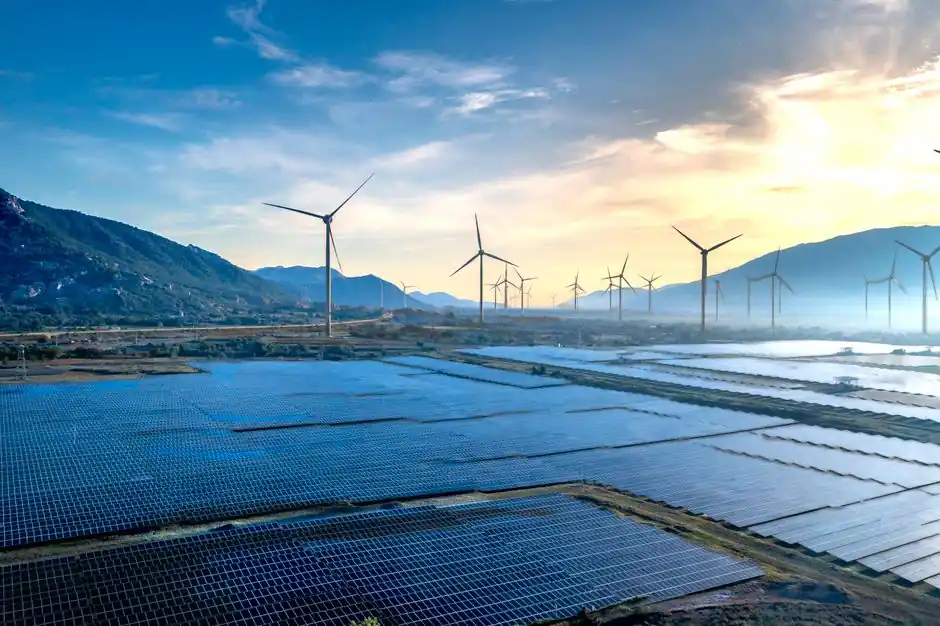
Global installed stationary energy storage capacity reached 768.5 GW in 2025 and is projected to grow from 931.7 GW in 2026 to 3,735.3 GW by 2033, at a CAGR of 21.9% from 2026 to 2033 [S8]. Lithium-ion holds more than 90% of electrochemical installations, with LFP and NMC as the two dominant chemistries [S5].
Competitive differentiation in 2026 is shifting away from cell-level energy density (now commoditised) toward system-level integration: cabinet architecture, EMS, fire suppression, and warranty term. For a related deep-dive on upstream demand and spec gates, see the BESS demand 2026-2030 capacity map.
Cell Chemistry Split: LFP Takes Grid-Scale, Residential Stays Agnostic
Grid-scale operators are consolidating around LFP because of lower cost per kWh, better thermal-runaway margins, and longer cycle life relative to NMC [S5]. Residential suppliers remain chemistry-agnostic because consumer usage patterns (shallow daily cycles, partial SoC operation) tend to dictate lifetime rather than intrinsic cell chemistry [S5]. NMC retains a foothold where volumetric energy density matters: space-constrained indoor residential and certain C&I cabinets.
Sumitomo Electric brought one of the world's largest vanadium redox flow batteries (RFBs) online in Japan in 2022, signalling proof-of-concept for long-duration (>10 hour) storage beyond the Li-ion envelope [S5]. As of mid-2026, RFBs remain an early-stage complement to Li-ion, not a substitute, for typical 2-4 hour applications. Battery cell teardown and autopsy work, increasingly offered as a service by labs such as Intertek, supports failure-mode root-cause analysis and supplier QA across both chemistries [S7].
Form Factor Segmentation: Residential LV/HV, C&I Cabinet, and Container
Residential lines split into low-voltage (LV) modular stacks (commonly 48 V nominal, 5-15 kWh per module, parallelable to 30-60 kWh) and high-voltage (HV) series strings that interface directly with hybrid inverters at 200-450 V DC. For example, Renon Power ships an LV residential line and an Xtreme HV 1.0 high-voltage product, plus the ECube 60AP, MPack 233A, EStand, MPack 261AS, and MPack 261A in the C&I cabinet segment, with the Smart Matrix A serving as a containerised option [S1].
C&I cabinet products on the Made-in-China B2B catalogue in 2026 show typical ratings in the 1-20 kW inverter output class paired with 5-15 kWh lithium battery modules, with 2-year inverter warranty and 5-year battery warranty offered as a common baseline [S2]. Containerised C&I/utility products push the upper end: 100 kWh to multi-MWh per container, with thermal management, fire suppression, and integrated PCS. The distributed-energy thesis is gaining traction in 2026: the competitive question is no longer "who has the bigger system" but "whose assets are more resilient and flexible" [S1].
OEM Selection Criteria: Warranty, Cycle Life, BMS Architecture, Service Network
Among Chinese BESS suppliers, warranty terms observed in product listings include 5 years on battery modules and 2 years on inverters as an entry-level offering [S2]. Renon Power's "Mature and Extensive Product Line" plus "TS16949 Execution System" positioning is an example of how OEMs market process discipline alongside product breadth [S1].
For related context on how upstream instrument suppliers (pressure transmitters, energy meters) feed BESS site commissioning, see the measuring instruments industry map 2026.
China Cell-Maker Dominance and the Tier-1 Supply Chain
Sunrange positions itself explicitly as a "Tier-1 supply chain" integrator, pairing Longi, Trina, Jinko, Tongwei, JA Solar, Astronergy, and Canadian Solar modules with C&I, residential, and containerised BESS [S3]. This bundling of cell-maker and module-maker brands into a single OEM portfolio is the 2026 norm: the cell itself is largely interchangeable (LFP prismatic 280-314 Ah), so the value capture moves to the pack-and-system layer. The competitive risk for downstream OEMs is the raw-material squeeze: LFP cathode precursors (iron phosphate, graphite anode) and lithium carbonate price volatility set the floor under cell cost.
For a supplier-tier breakdown and how Chinese cell makers reshape global installed base, see the 2026 BESS supplier map.
Comparison: Residential, C&I Cabinet, and Containerised BESS on Decision Criteria

Residential (LV modular), C&I cabinet, and containerised BESS differ on four engineering decision gates. (1) Energy capacity per unit: 5-15 kWh per residential module, 30-215 kWh per C&I cabinet, and 1-6 MWh per 20-foot container. (2) Voltage architecture: 48 V LV residential, 100-800 V DC for HV residential and C&I, and 600-1500 V DC for utility container systems. (3) Cycle life target at 80% DoD: residential 4,000-6,000 cycles, C&I 6,000 cycles, containerised grid 7,000-8,000 cycles. (4) Typical warranty: 5 years residential, 5-10 years C&I, 10 years containerised, all conditioned on operating temperature (commonly 0-45 deg C discharge, -10 to 55 deg C charge for LFP). [S3]
The cabinet form factor dominates the C&I segment in 2026 because it fits through standard doors, requires no civil work, and scales by paralleling, whereas the containerised form is reserved for sites with outdoor floor space and >500 kWh demand. For background on the broader C&I segment, see the portable generator and C&I power guide 2026.
Standards, Sourcing, and Operational Constraints
UN38.3 transport testing, IEC 62619 (industrial Li-ion cells), UL 9540 / UL 1973 (North American BESS), and CE/IEC 62133 are the recurring compliance gates seen on 2026 OEM datasheets [S2][S4]. IP55 outdoor rating is common for C&I cabinet enclosures, IP65 for residential indoor/outdoor hybrid. Operating temperature derating above 45 deg C reduces available capacity and cycle life: a real spec gate for hot-climate and outdoor-utility deployments. EMC/EMI compliance to EN 61000-6-2/6-4 is standard for European C&I cabinet shipments. For instrumentation inside the BESS enclosure, an energy meter with MODBUS output is the typical EMS input, while a pressure transmitter on the fire-suppression circuit is a UL 9540A-informed best practice.
Market Sizing and 2026-2030 Trajectory
Grand View Research's 2026-2033 outlook places the energy storage systems market at 931.7 GW in 2026, rising to 3,735.3 GW by 2033 at a 21.9% CAGR [S8]. IDTechEx's earlier forecast pegs 2033 global cumulative stationary battery storage capacity at above 2 TWh, with a 30% CAGR over 2023-2033 and front-of-the-meter (FTM) installations taking a larger annual GWh share than behind-the-meter (BTM) [S5]. The two forecasts differ on units (GW vs GWh) but converge on direction: grid-scale and C&I deployments outpace residential by installed capacity. Wood Mackenzie's 2023 reporting already flagged the market entry of new battery suppliers, including EV-cell-makers pivoting to stationary storage [S6].
Trackable signals to watch through 2026 H2: (a) the BESS-levelised cost of storage (LCOS) curve, which sets the price floor for LFP and NMC cells; (b) the global LFP vs NMC mix in newly awarded utility-scale EPC contracts; (c) regulatory milestones such as FERC Order 2222 (US) and the EU electricity market design implementation feeding FTM revenue stacking; and (d) the share of new BESS shipments carrying a UL 9540 or IEC 62933 label, which is the clearest cross-border interoperability gate. Operators should also monitor whether a real energy management layer becomes the procurement criterion that displaces nameplate kWh as the headline spec.