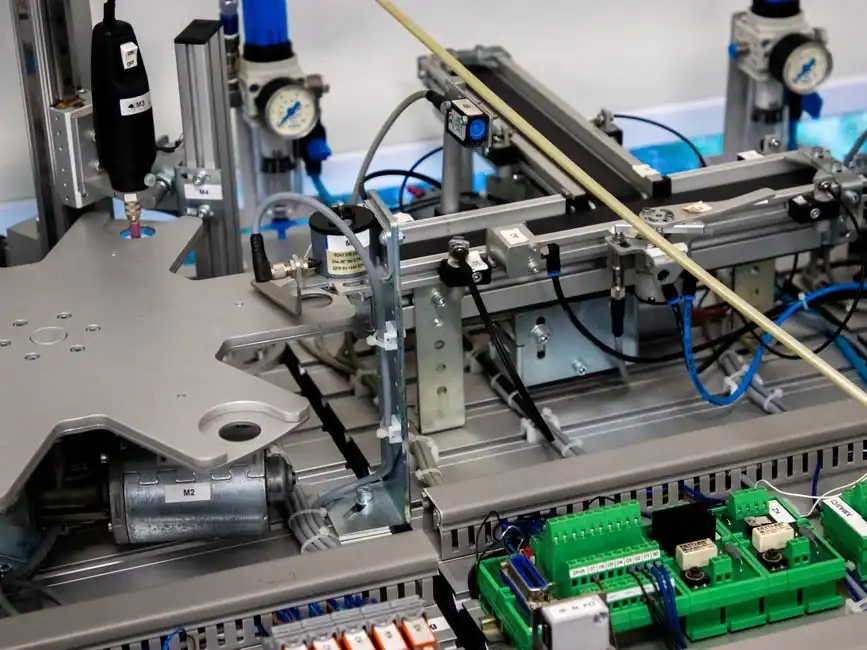
A 2026 bearing production line is specified as a chain of linked work cells, not a single machine: bar stock cutting and forging, ring machining (turning, grinding, superfinishing), heat treatment, assembly with cage and ball/roller insertion, and a final non-destructive testing bench. The dominant template remains the deep groove ball bearing (DGBB) line, as confirmed by BKZ Industry bringing its first new-factory line up in June 2026 dedicated to DGBB output [S3].
Specifying a line in 2026 means picking the product mix (DGBB, tapered roller, cylindrical roller, spherical, linear), the diameter series (e.g. 6200, 6300, 22200), ABEC/ISO tolerance grade (commonly P0/P6/P5), the contact angle for angular contact types, and the cage material (steel pressed, brass machined, PEEK polymer). Each choice locks in different machines downstream, which is why cell-level layout is the first decision an engineer should freeze before equipment RFQs go out.
Product mix and capacity sizing: what the new BKZ line signals
Bearing lines are usually launched on a single high-volume product, then expanded. BKZ Industry's first line at its new plant is dedicated to deep groove ball bearings, the same family that historically accounts for the largest share of unit output in Asian bearing plants [S3]. Deep groove ball bearings cover non-loaded or lightly loaded radial loads in electric motors, pumps, gearboxes, conveyors, and agricultural machinery, which is why they remain the first product a greenfield line is built around.
Capacity sizing flows from a small set of numbers: target annual output in pieces, the average bore and OD range, the number of shifts (typically 2 or 3 in 2026 Asian plants), and overall equipment effectiveness (OEE). A common sizing rule is to set the bottleneck cell (usually grinding or heat treatment) to roughly 1.2x the takt of the line, so a single unplanned stop on the bottleneck does not stall the whole flow. For linear bearings, capacity is sized differently because they are not forged in the same way: linear bearing production uses hardened and ground shaft stock, machined housings, and recirculating ball or roller inserts, with cells optimised for accuracy in microns, not raw tonnage [S2].
Forging, turning and grinding: the upstream cell stack
The upstream half of a rolling-element bearing line is dominated by ring-forming and machining. Forging presses (hot or warm) shape the inner and outer rings from steel bar; for smaller series, cold forming headers are also used. After forging, rings go through rough turning on CNC lathes, then heat treatment (typically through-hardening for chrome steel such as 100Cr6 / SUJ2, or case hardening for 16MnCr5 / 20Cr3 family steels), followed by finish grinding and superfinishing on raceways. [S1]
Linear bearings use a different upstream flow. Production typically starts with hardened and ground shaft stock, machined or extruded aluminium/steel rails, and turned or moulded bearing housings, with the recirculating ball or roller path assembled as a sub-unit. According to IQS Directory, the rolling-element linear bearing family uses balls or rollers positioned between matching grooves on the bearing and the linear guide rails to minimise friction [S2]. That means the precision surfaces are on the rail and the bearing body, not forged rings, so the upstream cell stack is grinding-centric rather than forging-centric [S2].
Heat treatment, cleaning and process gas atmosphere
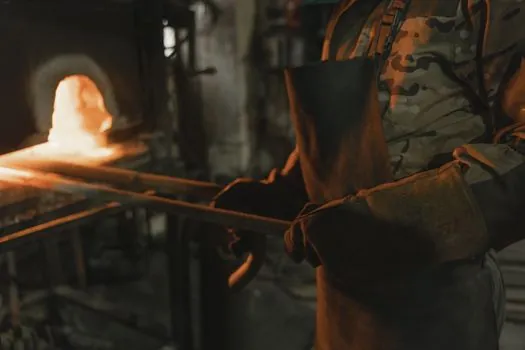
Heat treatment cell selection is one of the most spec-heavy calls. Through-hardening of 100Cr6 (or the Chinese equivalent GCr15) to 60-64 HRC is the standard recipe for DGBB rings; case-hardening to a case depth typically in the 0.6-1.5 mm range is used for tapered roller bearings and many cylindrical roller bearings. Furnace choice is governed by lot size: mesh-belt or pusher furnaces suit high-volume DGBB output, while pit or chamber furnaces suit small batches of large-bore rings. [S3]
After quench and temper, parts go through cleaning, often with aqueous alkaline wash followed by rust preventative, then hardness testing, microstructural checks, and dimensional checks before assembly. Process atmosphere control (endothermic gas, nitrogen-methanol, or pure nitrogen for stainless variants such as 440C) directly affects retained austenite and grain size, which is why the heat treatment cell carries its own instrumentation and data logging rather than being a passive sub-cell of the line. The same logic applies to the line-frequency-furnace class, which is widely used for through-hardening in high-volume bearing plants because it gives a fine, uniform austenitic grain and short cycle times compared with gas furnaces.
Assembly, cage selection and sealing options
The assembly cell joins inner ring, outer ring, rolling elements and cage, then installs shields or seals. Cage options in 2026 production are: pressed steel cages (lowest cost, common in small DGBB), brass machined cages (higher speed and temperature tolerance, common in spherical and large cylindrical types), and polymer cages in PEEK or PA66-GF25 (light weight, good for high-speed and some e-motor applications). Ball or roller count and grade (e.g. G10, G5 for quiet running) are set at this cell. [S3]
Sealing options are typically 2RS (rubber seals on both sides), ZZ (metal shields on both sides), 2Z+2RS hybrids, or open (no seal). For e-motor and pump applications, 2RS is now the default because of contamination control; for high-speed spindles, open or hybrid shields dominate so that grease churning does not overheat the bearing. The assembly cell also sets the radial internal clearance (C2, CN, C3, C4, C5), which is one of the most over-specified parameters on a bearing drawing and should be tied to the actual fit and operating temperature of the host equipment.
Automation, conveyors and inspection: linking the cells
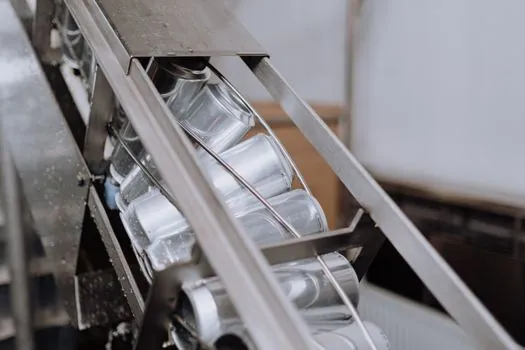
In 2026, the assembly and testing cells are where most of the new capex is concentrated, and they are linked by automated conveyors rather than manual transfer. Part-to-fixture tracking, RFID carriers, and inline dimensional inspection with vision systems are now standard on new Asian lines. For a spec-first look at how adjacent industries are wiring up similar flows, see the Bearing manufacturing equipment 2026: spec-first selection guide for plant engineers reference. [S2]
Sorting and routing on the way to final test is also a key cell: parts are usually diverted by diameter class, tolerance grade, and customer bin. A modern bearing plant therefore reuses the same conveyor-sorting-line architecture that runs through electronics assembly, but tuned for the higher mass and tighter tolerance window of bearing components. Final testing is built around noise and vibration benches (commonly referenced against ABEC 5/7/P4/P2 grades), bore and OD gauging, and rotational torque checks; many lines now add an automatic-molding-line cell to mould plastic cages in-line rather than buy them in.
Quality standards and tolerances that anchor the spec
Every bearing line is judged against three families of standards: dimensional (ISO 15 for radial bearings, ISO 355 for tapered, ABEC 1-7 / ISO 492 for tolerances), material (ASTM A295 for through-hardening steels, ASTM A534 for case-hardening steels, DIN 5401 for balls), and process/quality (IATF 16949 for automotive, AS9100 for aerospace, ISO 9001 as a baseline). For linear bearings, ISO 10285 and the linear-motion tolerance classes cover accuracy and preload. [S3]
Material-grade traceability is the spec that auditors actually check. 100Cr6 / GCr15 rings are usually delivered with a heat number and a chemistry certificate, while stainless variants such as AISI 440C or AISI 304 for cages and shields follow their own ASTM or EN grade rules. Cage material choice ties to temperature and speed: PEEK cages routinely rated up to around 250-260 deg C, brass cages higher, pressed steel cages lowest. For a deeper standards walk-through, see Bearing Manufacturing Quality Standards: ISO, ABEC and Forging Specs in 2026.
Layout and utility planning: power, coolant, cleanliness
A bearing plant's cell layout is driven by utility runs, not by product flow alone. Heat treatment is the biggest power load and is usually placed on a dedicated heavy-utility bus; grinding cells need filtered coolant at controlled temperature (often 18-22 deg C) and good lighting; assembly and final test need ISO 14644-7 Class 7 or Class 8 cleanroom-style local enclosures to keep particulate out of unsealed bearings. Noise and vibration isolation between the heavy forging cell and the assembly cell is mandatory because vibration couples into the precision benches. [S2]
Layout is also where the choice of molding-line integration becomes a real decision: in-line moulding of polymer cages cuts lead time and packaging damage, but ties the bearing line to a tooling team and a moulding-machine uptime budget. For linear-bearing production, the equivalent of the moulding cell is the recirculating-element assembly bench, where balls or rollers are loaded into the bearing body and verified for smooth travel.
Selecting between a rolling-element line and a linear-bearing line
The two templates diverge early. A rolling-element bearing line (DGBB, tapered, cylindrical, spherical) is forging- and grinding-heavy, with a clear bottleneck in heat treatment and finishing. A linear-bearing line is grinding- and assembly-heavy, with a clear bottleneck in rail and shaft accuracy and in the recirculating-element assembly bench. The decision criteria line up as: primary product family (rotary vs linear motion), target accuracy (ABEC/ISO grade for rotary, micron-class for linear), host equipment (motors, gearboxes, machine tools vs automation axes, CNC slides, robotics), and unit cost per piece. [S3]
On cost per piece, small DGBB (6200, 6300 series) is among the lowest in the industry, while large-bore tapered and spherical roller bearings sit at the high end. Linear bearings in a recirculating-ball format are mid-range on a per-piece basis but are sold on accuracy, not on tonnage. For a parallel view of how this fits the broader capacity and capex picture, see Bearing Production Capacity Planning: A Spec-First 2026 Reference and the related Bearing market share by manufacturer: 2026 ranking and supplier landscape market context.
Failure modes and limits to design for
Most bearing-line downtime comes from a small set of cell-level problems. In heat treatment, distortion beyond the grinding stock allowance and retained austenite outside the spec window are the most common rejects. In grinding, surface burn and thermal damage drive rework and scrap. In assembly, contamination is the dominant cause of noise and vibration test failures. For linear bearings specifically, the failure modes are different: rail straightness deviation, preload set incorrectly, and recirculating-element drag after poor lubrication [S1].
Design choices that mitigate these are concrete: a 1.2-1.3x stock allowance for finish grinding, a 5-10% inspection sample at the heat treatment cell, inline coolant filtration to 10-25 microns, local Class 7 enclosures on the assembly cell, and a lubrication policy that ties grease type (e.g. polyurea, lithium complex) to temperature and speed. Materials also matter: chrome steel rings (100Cr6/GCr15) through-hardened to 60-64 HRC remain the default; stainless (AISI 440C) is used for corrosion resistance, at the cost of lower hardness; silicon nitride (Si3N4) ceramic rolling elements are used for high-speed and electrically insulated applications but raise line cost and change the assembly procedure.
Trackable next signals for the rest of 2026
Three signals are worth watching over the rest of 2026: the first capacity add at BKZ Industry's new factory beyond the initial DGBB line (whether it goes to tapered or cylindrical roller, which would change the upstream cell stack) [S3]; the adoption of inline line-scan-camera and machine-vision inspection on the raceway-grinding cell, which is still uneven across Asian plants; and the wider rollout of polymer-cage in-line moulding, which depends on whether moulding machine uptime can be matched to bearing-line takt.