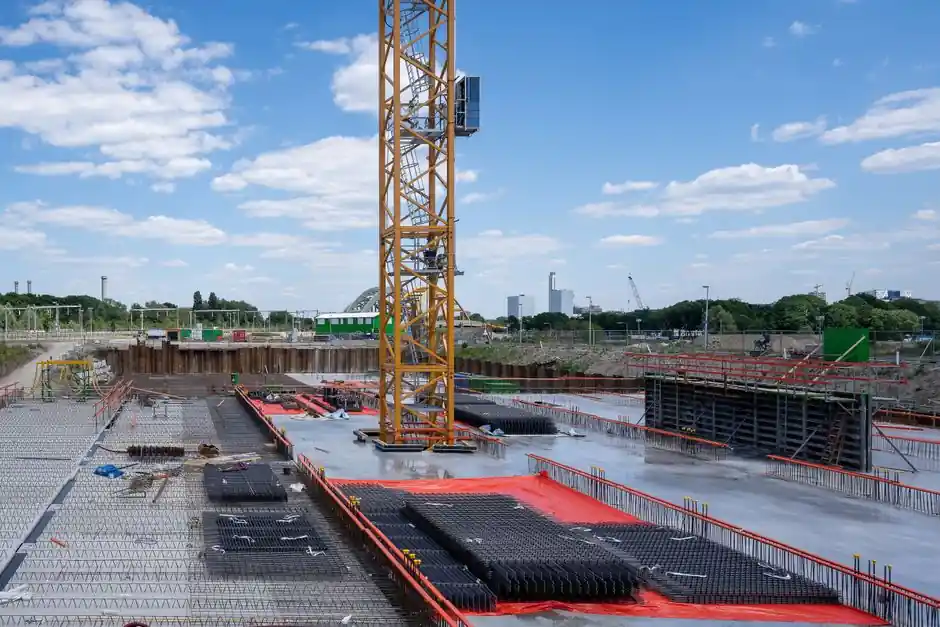
Below-grade waterproofing must resist sustained hydrostatic pressure against a buried structure, while a plaza deck assembly must bridge a moving, trafficked horizontal slab, drain through penetrations, and survive 25–40+ years of freeze-thaw cycling [S2][S3].
Those two service environments push specifiers toward two different material families, and the research [S1][S2][S3] consistently draws the line at prefabricated sheets below grade and fluid-applied reinforced membranes on plaza decks.
Where the Two Applications Actually Diverge
Below-grade waterproofing covers any structural element below the water table, where hydrostatic pressure, capillary action, and an inaccessible substrate after backfill define the design problem [S1]. Plaza decks are horizontal occupied or landscaped surfaces built over occupied space, with vehicular or pedestrian traffic, drainage to internal drains, and movement joints that move 5–10x more than a buried wall [S2][S5].
Access is the other dividing line. A blindside or positive-side sheet membrane on a foundation wall is installed once, then buried, with repair requiring excavation; a plaza deck membrane is fully accessible for the life of the building and is judged on traffic-rated wear surface compatibility and re-coatability [S1][S4]. The 90% failure-at-transitions figure that IIBEC-derived industry data cites for commercial waterproofing as a whole applies to both, but the transitions look completely different: below grade, it is cold joints, tie holes, and pipe penetrations; on a plaza deck, it is drain sumps, parapet upturns, expansion joints, and planter edges [S2].
Below-Grade Material Options: Sheets Dominate
Three material families cover below-grade work, and the research [S1][S4] lists them in the same order: prefabricated sheets, hot- or cold-applied liquid-applied membranes, and mineral-based systems integrated into the concrete foundation itself. Preformed HDPE and PVC sheets are the default on commercial foundations, blindside projects, and elevator pit walls because they are dimensionally stable, factory-thickness-controlled, and chemically welded at seams.
modified bitumen membrane variants appear on slab-on-grade and foundation walls where torch- or cold-adhesive application is feasible, and on pre-applied blindside sheets that bond to fresh concrete as it cures, which prevents water migration between the membrane and the substrate if a breach occurs [S1]. The trade-off is welder skill and seaming QC; a single cold seam in 1,500 m² of HDPE is the leak. Negative-side cementitious crystalline or slurry systems are reserved for retrofit work where exterior access is blocked, and are explicitly described as less durable than positive-side because interior structural movement can crack them [S4].
Plaza Deck Material Options: Fluid-Applied Wins on Complexity
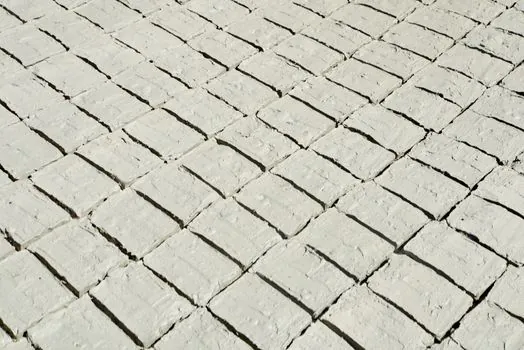
For horizontal traffic-rated surfaces, the Building Enclosure [S3] and Kemper System America [S7] coverage converges on hot fluid-applied rubberized asphalt and cold fluid-applied urethane or reinforced polymeric systems as the plaza-deck default. These materials self-flash around drains, corners, and penetrations, and accept an integrated wear surface (pedestal pavers, concrete topping, or UV-stable topcoat) directly over the cured film.
waterproof membrane selection on a plaza deck is driven by three numbers: tensile elongation to bridge slab movement (cold-applied urethane systems routinely exceed 300% elongation, hot rubberized asphalt sits lower), bond strength to the structural concrete substrate, and compatibility with the specified protection board or wear course. The Mears Park Place Apartments 56,000 SF plaza deck replacement cited in [S2] is a representative scale where a fluid-applied, fully adhered, seamless system was selected over a sheet product because the geometry of multiple planter islands, drain locations, and a parking-garage-to-podium transition could not be reliably detailed in rolls.
Decision Matrix: Below-Grade Sheet vs Plaza Deck Fluid-Applied
Head-to-head on the four criteria that matter in spec review:
Hydrostatic pressure resistance: preformed HDPE/PVC sheets and modified bitumen sheets rate excellent because they are continuous, factory-calibrated, and mechanically or chemically seamed; fluid-applied polyurethane rates good for plaza deck conditions where water is drained, not ponded. Substrate movement tolerance: fluid-applied urethane systems tolerate 300%+ elongation across slab cracks and expansion joints; sheets tolerate only what the seam and detailing can absorb, which on a moving plaza deck is the limiting factor. Installation sensitivity: sheets demand seaming QC and dry substrate; fluid-applied systems demand mil-thickness QC (typically 60–120 mils DFT depending on traffic rating) and surface preparation. Service life: properly detailed and drained systems in both categories are quoted at 25–40+ years, with plaza deck systems requiring re-inspection of the wear surface on a 5–10 year cycle [S2][S3].
For a parking-garage plaza over occupied space with multiple planters and drains, a cold fluid-applied reinforced polyurethane or a hot rubberized asphalt system is the spec default. For a foundation wall, elevator pit, or blindside shoring wall, a pre-applied HDPE sheet or a torch-applied modified bitumen sheet is the spec default. The cost crossover is rarely a reason to swap: material cost is small compared to drainage, protection board, and detail work, and the 90% failure-at-transitions figure is identical for both [S2].
Drainage, Thermal Cycling, and Why Both Worlds Converge on System Detailing
The most defensible technical point in the source material is that the membrane is rarely the failure root. IIBEC-derived industry data cited in [S2] places roughly 90% of commercial waterproofing failures at transitions, terminations, and penetrations, and the same source quotes an estimated 75% of building envelope warranty claims being water-infiltration related. That holds whether the membrane is 60-mil HDPE on a foundation or 90-mil polyurethane on a plaza deck.
Below grade, that means french drains, dimple drainage boards, and waterstops at the cold joint between footing and wall are as critical as the membrane choice itself; coverage of the footing-to-wall cold joint detail with waterstop plus membrane is the single highest-leverage piece of detailing on a below-grade project, and the footing-to-wall cold joint detailing reference walks through the geometry. On the plaza deck side, internal drains, parapet upturns (typically 8 in. minimum above the wear surface), and expansion joint covers are the equivalent high-leverage details [S2][S3]. Midwest freeze-thaw cycling, noted in [S2] as a design driver, forces both systems to be paired with movement-tolerant detailing rather than relying on the membrane's nominal elongation.
Limitations and Failure Modes Engineers Should Plan For
Below-grade: blindside sheet membranes cannot be inspected or patched after concrete placement, so any breach during placement is permanent; seam failures in HDPE/PVC sheets typically present as a localized leak far from the actual breach because water travels between the membrane and the wall [S1]. Plaza deck: hot rubberized asphalt is sensitive to application temperature and mil thickness; under-applied film below 60 mils DFT leads to wear-through at high-traffic zones within 5–10 years, while cold urethane systems are sensitive to moisture in the substrate at placement and can blister if the slab is not within the moisture tolerance the manufacturer publishes [S3][S7].
The shared failure mode is the transition: 90% of failures at terminations, penetrations, and joints means the design review checklist should weight drainage geometry, waterstop continuity, and penetration flashing equally with the membrane product data sheet. thermal waterproofing and advanced material choices at those details are where the 25–40+ year service life is actually won or lost, not in the field of the membrane [S2].
Trackable signals for the next spec cycle: any update to IIBEC plaza-deak detailing manuals that codifies drain sump geometry at 90-mil fluid-applied systems, and any manufacturer move toward pre-applied HDPE blindside sheets with documented concrete-bond strength values rather than generic adhesion claims. Both are concrete enough to verify on a future review pass.