
Belt conveyor specification is a drive-and-belt problem first, a structure problem second, and a safety-guard compliance problem third — a belt conveyor selected on the wrong CEMA duty class typically fails at the splice or the drive coupling long before the frame fatigues [S7].
For 2026 the practical envelope for industrial belt conveyors spans 0.09 kW worm-gear tabletop units through 2,100 kW right-angle MAXXDRIVE XT heavy mining reducers, with shaft-mounted helical IRO reducers at 2.2–160 kW dominating inclined quarry and mining duty [S1]. Food-grade straight horizontal units such as the Alutec NAS add stainless/PVC belt construction and hopper-feed geometry on top of the same skeleton [S2].
Drive reducer class sets the power envelope and the duty limit
The reducer is the single component that locks in available power, output speed and inclined-load capability, and 2026 OEM data clusters around five distinct families [S1].
Right-angle MAXXDRIVE XT industrial units cover 22–2,100 kW with gear ratios of 6.3–22.4, two-stage helical-bevel construction, and axial-fan thermal limit rated for maximum continuous power transfer. Shaft-mounted helical P-series units span 0–90.2 kW at 5–63:1 ratios and are engineered for direct in-line mounting to minimize footprint. IRO shaft-mounted helical reducers, the I-MAK quarry/Mining line, deliver 2.2–160 kW with an integrated backstop that locks the belt against reverse-rotation on inclined loads [S1]. Planetary reducers (50–3,000 kW) handle the very high torque end. Worm-gear units (CYXRV060 0.09–0.37 kW at 10–30:1; T1307 138–197 rpm at 7–100:1) cover low-speed, low-power tabletop or light-incline duty at IP66 sealing [S1].
The decision is mechanical, not budgetary: specify backstop-equipped helical for any inclined belt carrying a loaded charge, planetary or right-angle for >500 kW heavy mining drives, and worm only for short, low-power, low-duty cycles.
Belt type and material contact surface determine the application envelope
Belt construction is the first specification that opens or closes an industry vertical, and 2026 product data splits cleanly across food/PVC, heavy-duty rubber and modular thermoplastic families [S2][S7].
Food-grade flat PVC and PU belts on stainless frames — typified by the Alutec NAS straight horizontal handler — are built for fruit, vegetable and packaged-goods transfer with smooth, cleanable surfaces and roller bypass architecture [S2]. Mining and quarry belts follow CEMA 7th-edition geometry, with the material's angle of repose at rest running 5°–15° less than the surcharge angle governing the maximum recommended inclination [S7]. Modular Type34 and Type60 belts with integral side guide rails are quoted around US$700/set ex-Shanghai at 100,000-set annual production capacity for automated light-industrial lines [S8].
For abrasive bulk, specify CEMA-classed rubber belt with rated cover gauge; for washdown food, specify PU/PVC with stainless slider bed; for inclined or vertical handling, specify side-guide cleated modular belt with raised profiles.
Idler, return and tensioning architecture — the hidden half of selection

Idler set, return-idler basket and belt tensioner selection drives 60% of conveyor energy loss and most belt-misalignment failures, and 2026 accessory catalogs make the optional set explicit [S3][S6].
A complete bulk-conveyor accessory list covers impact bars, side seals, idler sets, primary and secondary belt scrapers, bottom rollers, canopies, drive and idler pulleys and drum coatings [S6]. For safety-critical return-idler zones, return idler baskets, rigid-mount return idler baskets, return idler guards and V-return idler baskets are stocked as separate line items to match CEMA return-idler diameters [S3]. Belt-tensioning hardware — gravity take-ups, screw take-ups and hydraulic winches — is matched to belt length and elongation class; a belt tensioner under-sized for the rated belt stretch causes chronic slip at the drive pulley. Flat-belt conveyors (light-duty, slider-bed or roller-bed) require a different flat belt and tensioner geometry than troughed CEMA bulk belts and the two are not interchangeable.
Safety guarding and regulatory compliance are a separate bill of materials
OSHA, MSHA and CSA compliance in North America is enforced through physical guarding of drive couplings, flange bearings, V-belts, return idlers and pinch points, and the 2026 guarding product line breaks these into discrete SKUs rather than one universal enclosure [S3].
Available guarding types include coupling guards, flat guards, flange bearing guards, V-belt guards, return idler guards, return idler belly guards, return idler baskets, modular barrier guards, modular guardrails, ladder guards, pump guards and box guards, with sectional designs that allow maintenance access without full guard removal [S3]. Locking wedge clamps, guard hangers, guard seats, safety signs and decals, smart wedge clamps, and inspection doors are accessory lines, not options — each is required at specific conveyor zones to keep the assembly compliant [S3]. Specifications cite OSHA general-duty, MSHA Part 56 and CSA B1670 frameworks; a non-compliant guarding package is a citation risk independent of mechanical fitness [S3].
Industry-vertical matching: food, bulk, mining, light automation

Vertical-by-vertical selection is the cleanest way to avoid misapplied hardware, and 2026 catalog data maps each industry to a specific configuration cluster [S2][S5][S8].
Food and agriculture: stainless-frame flat belt, PU/PVC belt surface, hopper feed, sorting/feeding bypass configuration [S2]. Bulk material handling: CEMA 7th-edition troughed belt, 5°–15° surcharge-angle allowance, full scraper and impact-bar accessory set [S7]. Thermal-energy and FBC-fired hot-air systems: heavy rubber belt, refractory-duty drive, elevated guarding package [S5]. Light automation / packaging: Type34 or Type60 modular guided belt, low-power gearmotor, sectional safety guarding [S8]. A mesh belt conveyor substitutes for flat PVC where the product must be cooled, drained or heat-treated in transit; a linear guide rail typically carries the belt-tracking carriage in precision-indexing applications. For high-rigidity indexing conveyors carrying heavy dies or tooling, a crossed roller guide replaces the linear carriage.
Comparison matrix: drive and belt choice against decision criteria
Four common configurations — worm tabletop, shaft-mounted helical, right-angle heavy industrial, planetary mining — line up against four decision criteria: power range, gear ratio, mounting and typical duty. [S1]
Worm CYXRV060 / T1307: 0.09–0.37 kW, 10–100:1 ratio, foot or flange mount, light/tabletop inclined duty, IP66 sealing [S1]. Shaft-mounted helical P-series and IRO: 0–160 kW, 5–63:1, direct shaft-mount on the drive pulley, inclined and quarry duty with backstop option [S1]. Right-angle MAXXDRIVE XT: 22–2,100 kW, 6.3–22.4:1, foot/flange mount, continuous heavy industrial and mining duty with axial-fan thermal limit [S1]. Planetary: 50–3,000 kW, low-ratio high-torque, flange mount, very high torque bulk-handling and mill duty [S1]. Match by envelope first — under-specifying the reducer is the most common engineering error.
Limits, failure modes and what to verify before sign-off
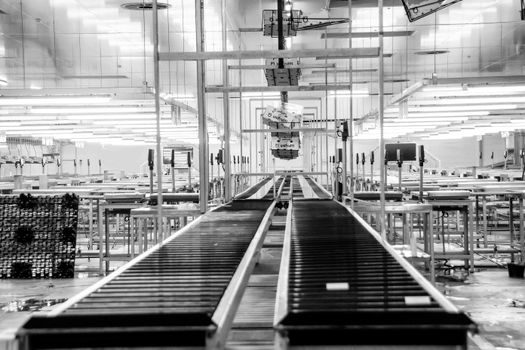
Three failure modes dominate 2026 field reports and each maps to a spec to verify in the RFQ package. [S2]
Reverse-rotation on inclined loaded belts: a backstop must be specified on the reducer, not added later — IRO and FAMUR reducers carry it as a standard feature, others must be optioned [S1]. Belt splice and cover wear: verify the belt's rated cover gauge and the splice type (mechanical fastener vs. vulcanized) against CEMA duty class and material abrasiveness [S7]. Guarding citation: confirm guarding package covers every rotating coupling, V-belt, return idler and pinch point per OSHA/MSHA/CSA — partial guarding is treated as non-compliance [S3]. Sourcing posture for 2026 keeps heavy reducers in EU/US OEM catalogs, modular guided belts in China at low MOQ (US$700/set) and guarding fabricators regionalised across North America [S3][S8]. Specifying reducer, belt, idler set, belt tensioner and guarding as a single integrated package — rather than as separate line items — is the trackable signal that the conveyor will reach nameplate availability. For planetary reducer cost envelopes that pair with high-power belt drives, see the planetary gearbox price and cost guide 2026.