
A worm gear reducer is the default choice for right-angle drives from 0.1 kW up to ~75 kW, with single-stage ratios spanning 10:1 to 60:1 and double-stage ratios reaching 200:1 to 900:1 in catalogued Chinese OEM frames sized from 40 mm to 250 mm centre distance [S3].
Worm gearing remains attractive because a single gear mesh delivers the entire ratio with a self-locking tendency, a compact right-angle footprint and quiet operation - properties that keep it in constant demand for conveyors, mixers, extruders and food-grade packaging lines [S2][S4].
What a Worm Gear Reducer Actually Is
A worm gear reducer is a single-axis-to-single-axis speed reducer in which a helical worm on the input shaft meshes with a bronze or phosphor-bronze worm wheel on the output shaft, producing a right-angle (90°) output at a fixed gear ratio [S2].
Because the two elements only share a line contact, the worm wheel is almost always a centrifugal-cast bronze or aluminium-bronze ring mounted on a cast-iron hub, while the worm is case-hardened or through-hardened alloy steel with the thread profile ground or finish-machined after heat treatment - the WPDS series from HZGEAR specifies "precision cast iron" housing with a quenched gear face and "high accuracy" profile as standard [S3].
The Boston Gear Bost-Kleen (BK) variant demonstrates the format's hygienic ceiling: stainless-steel external hardware, 303 stainless output shafts, a two-part white epoxy coating for caustic washdown and factory pre-lubrication with Klubersynth UH1 6-460 H1 food-grade oil, BISSC certified for direct food-contact machinery [S1].
Ratio Architecture: Single-Stage vs Double-Stage
Single-stage worm reducers typically catalogue standard ratios of 10, 15, 20, 25, 30, 40, 50 and 60, with double-stage units extending the train to 200, 300, 400, 500, 600, 800 and 900, allowing the same housing family (40-250 mm centre-distance frame) to serve everything from low-torque packaging indexers to heavy extruder screws [S3].
Frame size and centre-distance selection is the first hard decision: the WPDS pattern offers single housings at 40, 50, 60, 70, 80, 100, 120, 135, 147, 155, 175, 200 and 250 mm, and double-reduction housings at 40/70, 50/80, 60/100, 70/120, 80/135, 80/147, 100/155, 120/175, 135/200 and 155/250 mm combinations, so a buyer can scale mechanical advantage without changing the mounting envelope [S3].
For extruder drives, the double-stage ratio window is what matters: a conical twin-screw extruder gearbox from Okorder is built around a two-stage worm arrangement to deliver the slow output speed and high torque required for polymer melt, and is typically ordered at 1 set MOQ with a 40 set/month supply capability [S3].
Efficiency, Heat and the Self-Lock Question
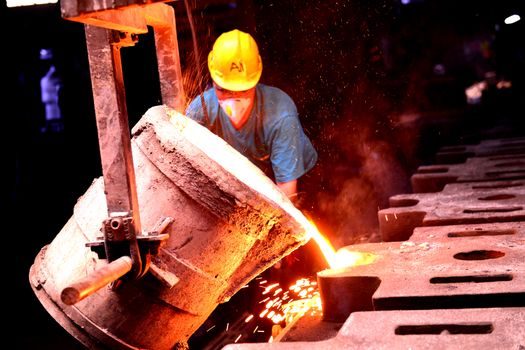
Modern worm gear reducers in the 30:1-60:1 single-stage band routinely reach 60-70% mechanical efficiency at full load when bronze worms wheels run on hardened, ground steel worms, a substantial lift versus the 30-50% figure common on older sand-cast worm pairs, and the published efficiency-improvement case rests on grinding accuracy, lead-angle selection, lower-friction bronze alloys and synthetic EP lubricants [S2].
The trade-off is heat: at high ratios, sliding losses generate a temperature rise that must be checked against the housing's rated dissipation, and the S87/SA87/SF87/SAF87 helical-worm combination shown in Weigao's 2026 product video is one architecture that lowers the worm's sliding load by staging a helical pre-stage ahead of the worm pair [S5].
Self-locking - the tendency of the worm to hold the load against back-driving - is preserved at low lead angles but disappears above roughly 45° lead angle, and at high efficiency the drive may become reversible; the Boston Gear BK datasheet does not claim self-locking as a feature, so the buyer must treat any "back-stop" or hold requirement as a separate brake selection [S1].
Housing, Mounting and Washdown Ratings
Cast iron remains the default worm-gear housing material because of its vibration damping and heat capacity, and the WP / WPDS / F-series frames in the China-OEM catalogue all share a precision cast-iron body with finished mounting faces for foot, flange and shaft-mount arrangements [S3][S4].
For caustic or food-zone service, the housing spec moves from plain cast iron to a coated, sealed and stainless-fastener build; Bost-Kleen uses a two-part white epoxy exterior, all stainless hardware, 303 stainless output shafts and H1 food-grade lubricant, with BISSC certification for direct food-contact lines [S1].
For a general engineering reader, our worm reducer reference page lays out the housing, seal and breather variants in detail, and pairs naturally with the helical gear reducer article for staged-ratio architectures where a helical pre-stage feeds a worm final drive [S5].
Load, Thermal and Lubrication Limits in Practice

Selection is governed by mechanical service factor, thermal service factor and peak-load capability simultaneously, not by ratio alone, and a unit that survives the mechanical service factor can still trip the thermal limit if the duty cycle exceeds the housing's heat-dissipation curve [S2].
Start-stop and reversing service is one place worm gearing earns its keep: the WPDS catalogue explicitly lists "forward and backward running with frequent starting" as a feature, reflecting the worm pair's ability to absorb repeated shock loads without the timing-related wear that a parallel-shaft spur or helical pair would suffer [S3].
For drives that connect to the driven machine through a coupling rather than a direct mount, our gear coupling reference covers the high-torque coupling choices that pair with these reducers, and the broader mechanical side of a worm-gear train is summarised in the crossed-roller guide article where indexing accuracy matters downstream.
Application Fit: Where Worm Gearing Wins and Where It Loses
Worm gear reducers fit right-angle drives with moderate power, frequent starts, occasional reversing, and a need for inherent load-holding, and that is why the WP and NMRV families dominate conveyors, agitators, mixers, elevators, winches and small extruders in the China-OEM catalogue [S3][S4][S6].
The same OEMs also offer parallel-shaft helical (R/RF/RS series) and helical-beurier (SAF/SF/SAF series) gearboxes for higher-efficiency duties, with frames running up to F157 / FF157 / FAF157 centre-distance sizes, signalling that buyers above ~75 kW or above ~1500 Nm typically step out of the pure worm architecture [S5].
For a high-level process-engineering view of how a worm-gear line fits into a wider gearbox manufacturing cell, the industrial gearbox manufacturing guide walks through the six production stages and AGMA quality gates that these Chinese OEM frames must clear before they ship. Buyers comparing the Chinese OEM price floor to the US/EU premium tier should also expect a clear divergence on bearing brand, sealing spec and surface finish at the same centre-distance frame [S1][S3].
How to Read a Worm Reducer Datasheet
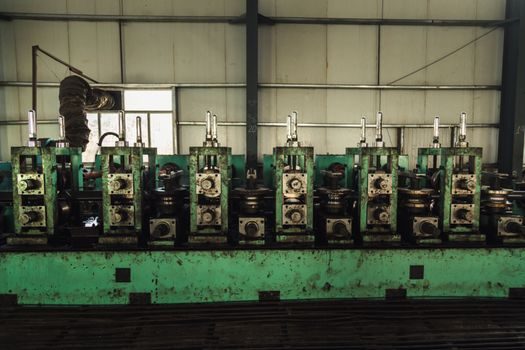
A worm reducer datasheet should be read in this order: input power (kW) and output speed (rpm), service factor (SF) at the application, thermal rating (often a separate P-thermal line), output torque (Nm) at the chosen ratio, mounting configuration (foot / flange / shaft), and lubricant grade plus fill volume, with the China-OEM datasheets typically listing only power, ratio and centre distance and leaving the rest to a sister catalogue page [S3][S4].
Cross-check the ratio against the centre distance: a 60:1 ratio in a 40 mm frame is a high-speed, low-torque small unit, while a 60:1 ratio in a 200 mm frame delivers the same ratio with much higher output torque capacity, and misreading this is the most common selection error on small-quantity import orders [S3].
Worm gear reducers below the 0.1 kW / 10 Nm threshold where motion-control precision is required should not be specified as worm units at all; for those builds, the linear guide and crossed-roller guide families are the correct catalogue, with a backlash class appropriate to the indexing duty.
Quick Sourcing Checklist and a Watch-Item Signal
For a single-stage 30:1 or 40:1 worm reducer in a 60-100 mm cast-iron frame, Chinese OEM FOB Shanghai list prices for the WPDS pattern open around EUR 43 per piece at 1-piece MOQ (December 2025 quotation, single-piece tier), and tier-2 configurations with food-grade lubricant, stainless hardware and BISSC certification sit at a clear premium driven by the Bost-Kleen-style coating and Klubersynth UH1 6-460 fill [S1][S3].
Two signals are worth tracking through the second half of 2026: first, the Weigao and HZGEAR product-page activity, which has been refreshed between April and July 2026 with new F157 and SAF87 frame listings, indicating active range expansion at the high-centre-distance end of the worm-gear market [S5][S6]; second, the persistent appearance of "NEMA / IEC input flange" options on the WPDS pattern, which is the most reliable indicator that a given worm reducer will accept a standard induction-motor foot or face mount without a custom adapter [S3].