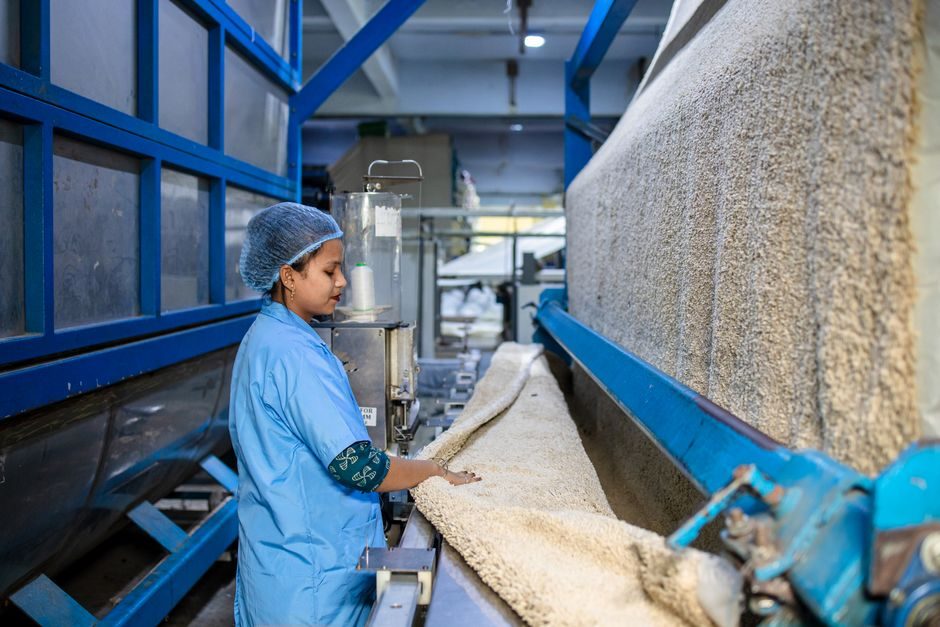
Belt conveyors split into two engineering camps — ordinary units capped at slopes below 18° and large-inclination designs rated to a 38° maximum design angle (33° applied), making incline the single most decisive classification axis [S6].
Beyond incline, the working taxonomy sorts by form (flat, inclined, curved, Z-type, troughed, articulated), by load class (light-duty sub-120 kg, pallet 40–2,000 kg, mining-tonnage), by belt material (PVC, PUR, rubber, polyester canvas) and by drive topology (end-drum, motorized pulley, belt-driven roller, chain-and-belt hybrid) [S1][S2][S3][S4].
Ordinary vs Large-Inclination Belt Conveyors
Ordinary belt conveyors from Weifang Lutong are designed for slopes below 18° and remain the most widely deployed configuration in aggregate, mining and bulk-handling service [S6]. Large-inclination belt conveyors from the same OEM push the maximum design angle to 38° and the applied (working) angle to 33°, trading belt width and chevron / cleat geometry for vertical reach on confined sites [S6].
For Dahan Machinery's general-purpose line, the cut-off sits at loads below 100 kg or powder/granular items handled horizontally or at large inclination angles, with belt width and angle selectable at order entry rather than fixed by series. The two camps are not interchangeable: a 30° incline is unreachable on an ordinary belt without a profiled or cleated surface, and a 38° large-inclination unit is over-specified — and over-priced — for a 10° horizontal run.
Form-Factor Classifications: Flat, Inclined, Curved, Z-Type
Form classification groups units by their path geometry rather than by capacity. Plastic Systems' NDS series is a double-curved articulated belt conveyor with an adjustable bottom-flat collection zone, a sloping transport section, and a flat upper sorting zone; canvas belt speed is fixed at 3 m/min and feed speed is variable from 0 to 20 m/min via a mechanical speed controller [S1].
Modular Assembly Technology's B series is a Z-type belt conveyor offered in four maximum-load ratings of 30 kg, 40 kg, 50 kg and 120 kg (66.139 lb, 88.185 lb, 110.231 lb, 264.555 lb), and the same vendor's PTS series scales the same architecture up to a chain-and-belt horizontal pallet conveyor at 40 kg, 600 kg and 2,000 kg (88.185 lb, 1,322.774 lb, 4,409.245 lb) for automatic single-piece-flow pallet lines [S2][S4]. Z-type units fold a horizontal run up to a higher elevation and back to horizontal, which is how they earn their slot in end-of-line packaging and small-parts elevation. For a deeper dive on end-of-line handling, see the palletizer price and cost guide 2026, which covers the robotic tier that typically feeds these conveyors.
Drive and Roller Sub-Assemblies: Belt-Driven vs Chain-Driven
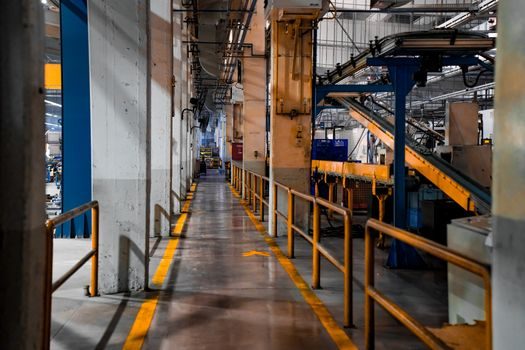
Drive topology is the second hard classification axis. roll-ven spa's Beta3 1PV (POLY-V) is a belt-driven conveyor roller with a 50 mm (1.969 in) diameter and 200 mm (7.9 in) length, using a thermoplastic pulley with an elastic POLY-V belt for high-speed, low-noise straight-line accumulation [S3]. Available tube materials for the same roller family span PVC, thermoplastic, steel, stainless steel, aluminium and galvanised steel, with stainless steel shafts, galvanised shafts, Rilsan-coated tubes and stainless or aluminium bearings as order-entry options [S3].
For heavier unit loads, the roll-ven line branches into chain-driven rollers (Beta3 1R/2R, Sigma 1R-1RD, Omega 1R-1RD) and the GAMMA 1G-2G steel belt-driven roller, which is the correct pick when a polyurethane round belt would stretch or slip under a high-torque start [S3]. The drive-class decision feeds back into the flat belt selection on the carrying side, because POLY-V, round and timing-belt drives each constrain the matching carrying belt profile.
Load-Class Map: Light-Duty, Pallet, Mining-Tonnage
Load classification lines up with the application tier. Light-duty Z-type and curved conveyors top out at 30–120 kg and target moulded-part handling, blow-moulding separation and small-parts elevation in plastics and packaging [S1][S2]. Pallet conveyors in the PTS series jump to 40–2,000 kg and target automatic single-piece-flow pallet lines between stamping, machining and palletiser infeed [S4].
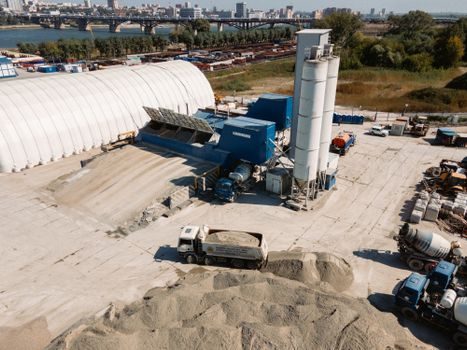
Mining and aggregate service sits above that band, where conveyor selection pivots on belt width (commonly 500–2,000 mm), trough angle (typically 20°–45°), idler spacing and drive power. Dahan groups the whole band under one product family — mobile, rubber, retractable, superior, soil, rock and quarry conveyor belts — with horizontal or large-inclination routing selectable per order rather than per series. US Conveyor, a US recycling-systems integrator, designs shredder infeeds, vibratory conveyors, batch feeders and trommels around belt conveyors sized to the upstream shredder or screen, illustrating that for recycling duty the belt is a sub-component of a system rather than a standalone line item [S5].
Idler, Support and Tensioner Subsystems
A belt conveyor is a system of matched subsystems, and the support / idler / tensioner stack is the most failure-prone layer. Belt-conveyor supports, drives and tripper unloading devices are the three standard sub-assemblies defined in industrial Chinese-English terminology references, and each has its own CEMA / DIN equivalent selection tree. Carry-side idlers, return-side idlers, transition idlers and impact-idler sets are sized off belt width, belt weight, material density and lump size, not off conveyor length. [S1]
Tensioning is governed by a belt tensioner on the take-up pulley, with gravity, screw and hydraulic take-up frames as the three standard options; gravity take-up is the default for long overland conveyors, screw take-up for short fixed plant, and hydraulic for belt-storage systems on shiftable or portable units. The mesh belt conveyor is the variant to specify when the application is wash-down, food, or high-temperature parts — the open metal-mesh surface replaces the solid PVC or rubber carrying belt and changes the idler selection entirely.
Specialty Belts: Timing, Ribbed and Cleated Profiles
Belt selection is the third classification axis, and the four dominant industrial profiles are flat, ribbed, timing and cleated. A flat belt is the default for horizontal and shallow-incline run-out, packaging, and light assembly. A ribbed belt replaces the flat drive belt on the head pulley when smaller pulley diameters or higher torque transmission is needed. A timing belt is mandatory when the conveyor must be synchronised to an indexing operation such as a pick-and-place, a labeling station or a filling head, because positive tooth engagement eliminates the creep that a friction belt would allow. [S2]
For inclines above the ordinary 18° ceiling, the belt itself must be chevron- or cleat-profiled; that is what makes the 33°–38° large-inclination envelope reachable in the first place [S6]. Plastic Systems offers smooth PUR belts, embossed PUR belts, and belts with transverse strips; the embossed surface is the usual pick for moulded-part elevation because it adds grip without snagging on part geometry [S1]. The full belt conveyor encyclopedia entry covers the geometry, drive and idler interactions in more depth.
Selection Criteria: Matching Conveyor Type to Application

Match form to the path: flat for run-out, inclined (ordinary, sub-18°) for feed hoppers, large-inclination (33°–38°) for elevation on tight footprints, curved / articulated for moulded-part separation lines, Z-type for compact elevation between two horizontal runs, troughed for bulk aggregate and ore [S1][S2][S6]. Match load class to the unit: 30–120 kg for plastics and packaging, 40–2,000 kg for pallet lines, mining-tonnage for aggregate and ore [S1][S2][S4].
Match drive to environment: belt-driven rollers (POLY-V) for low-noise accumulation, chain-driven rollers for high-torque heavy-pallet starts, end-drum motorised pulleys for long overland runs [S3]. Match belt to the duty: PVC or PUR for cleanroom and food, rubber for aggregate, cleated or chevron for steep incline, metal mesh for wash-down or hot-parts handling [S1][S3]. Two trackable signals to watch: (a) the spread of cleated / chevron belt SKUs in aggregate-quarry catalogs, which correlates with constrained-footprint mine-site retrofits, and (b) the share of Z-type and curved units quoted against robotic palletiser cells, which tracks brownfield packaging-line density. Specs on the special cement types and classifications page cover a parallel bulk-handling selection tree useful for comparison.